What Is a Market Catalyst?
What Is a Market Catalyst?
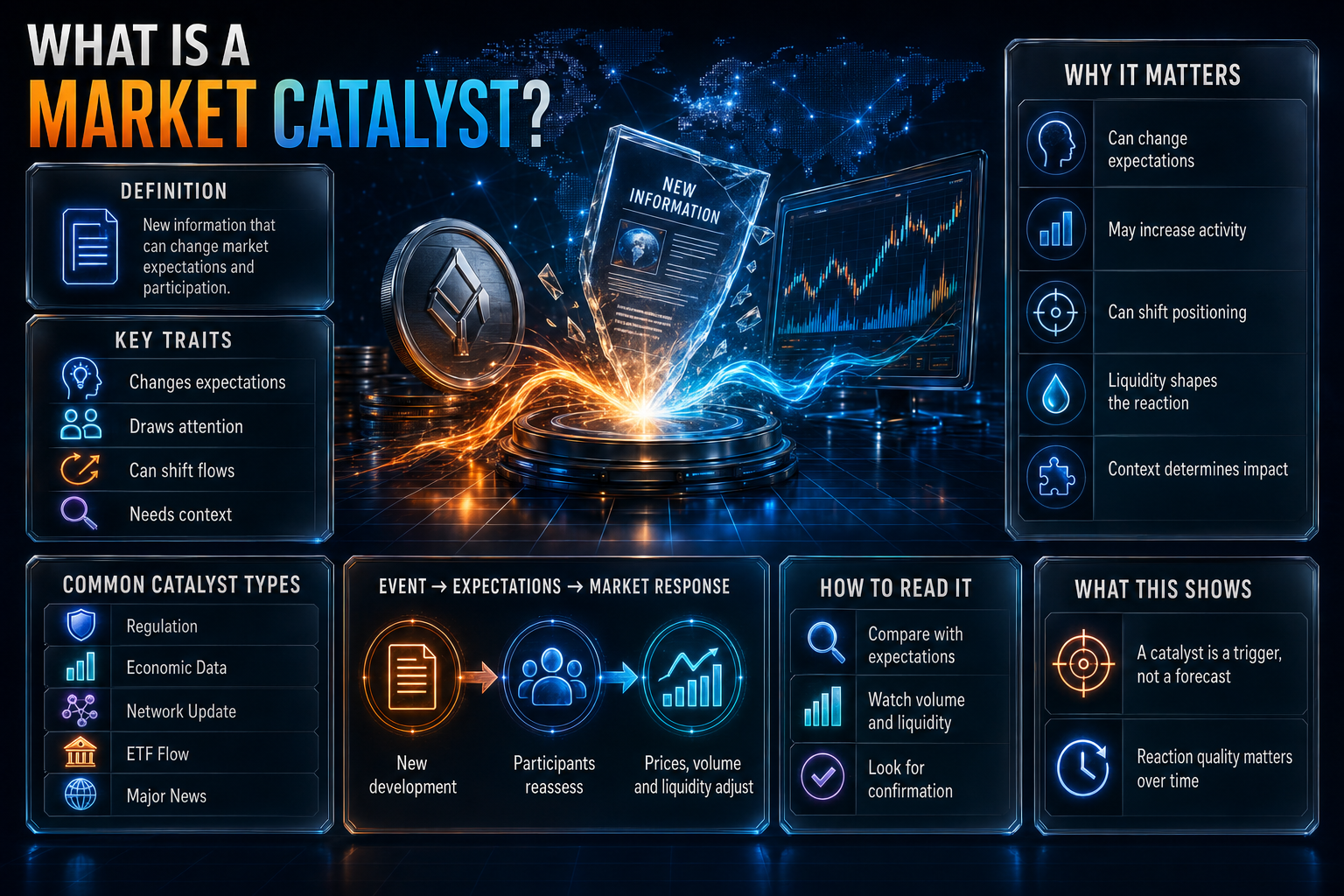
A market catalyst is new information or a development that can change expectations and influence market activity. In crypto, a catalyst may involve regulation, economic data, ETF flows, network upgrades, exchange news, or changes in broader financial conditions.
Simple definition
A market catalyst is an event or piece of information that gives participants a reason to reassess an asset, sector, or market. It can affect attention, sentiment, positioning, liquidity, and trading volume.
Why a market catalyst matters
Markets are forward-looking, so participants continually compare new information with existing expectations. When a development is more important, more surprising, or more credible than expected, it can lead to a faster market response. The reaction may be stronger when liquidity is thin or positioning is already stretched.
How markets usually read it
The key question is often whether the information was already expected. A development that appears positive or negative on its own may have a limited effect if markets had already priced it in. Participants also consider credibility, scale, timing, and whether the news changes the underlying market outlook.
Why it matters for crypto
Crypto trades around the clock and can react quickly to new information. Activity may increase around policy announcements, protocol upgrades, institutional flows, security events, or major macro releases. Derivatives leverage and uneven order-book depth can amplify the initial response, especially in smaller assets.
A market catalyst is not a standalone signal
A catalyst does not guarantee a lasting move or reveal its direction in advance. Markets can react differently from the headline interpretation, particularly when positioning is crowded or the information is incomplete. Volume, liquidity, confirmation, and the reaction across related assets provide useful context.
Common signals people watch
- How the development compares with market expectations
- Source reliability and the quality of confirmation
- Trading volume, spreads, and available liquidity
- Derivatives positioning, funding, and liquidations
- Whether the reaction holds after the first response
Reading the wider context
Catalysts work within an existing market environment. The same event can produce different reactions depending on liquidity, sentiment, valuations, macro conditions, and the amount of leverage already in the market. A broad response with sustained participation can carry a different meaning from a brief move caused by a thin order book.
It can also be useful to separate the event itself from the interpretation that follows. Early reactions may change as additional facts emerge. Comparing the initial move with later volume, price behavior, and participation helps show whether market conditions have changed in a more durable way.
Key takeaway
A market catalyst is new information that can change expectations and market activity. It is a trigger for reassessment, not a prediction of the next price move.
Comments (0)
Join the discussion
Sign in or create a free account to leave a comment.
No comments yet. Be the first to comment!