What Is Market Cap?
What Does Market Cap Mean?
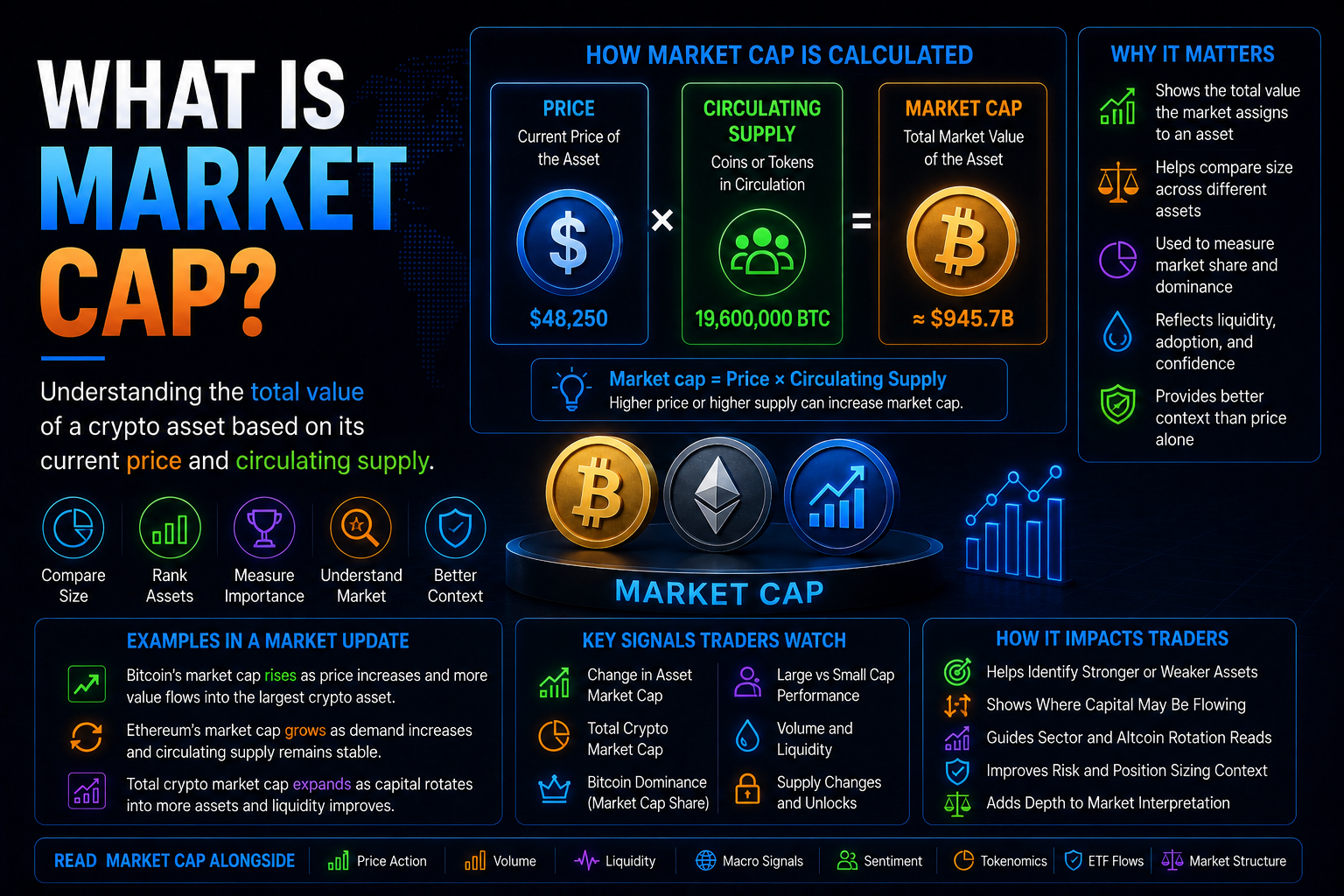
Market cap is a simple way to estimate the total market value of an asset or project. Crypto readers watch market cap because it helps compare Bitcoin, Ethereum, altcoins, sectors, and the broader crypto market without looking only at price.
Simple definition
Market cap means the total value of an asset based on its current price and circulating supply.
In crypto, it is usually calculated by multiplying the coin or token price by the number of coins or tokens currently in circulation.
Why market cap matters
Market cap matters because price alone can be misleading. A coin with a low price is not automatically small, and a coin with a high price is not automatically larger than another project.
Market cap gives traders a cleaner way to compare size, relative importance, and how much value the market is assigning to different assets.
How traders usually read it
A larger market cap usually suggests an asset is more established, more widely followed, and often more important to overall market direction.
A smaller market cap can suggest a more speculative or less established asset. The meaning depends on context because liquidity, supply structure, volume, sentiment, and token design can all affect how useful the market cap number is.
Why it matters for crypto
Market cap is especially useful in crypto because thousands of assets trade at very different prices and supply levels. Bitcoin and Ethereum can have very different prices, but market cap helps readers compare their overall size more clearly.
Crypto traders may use market cap to understand Bitcoin dominance, altcoin rotation, sector strength, liquidity conditions, and whether market activity is concentrated in large assets or spreading into smaller ones.
Market cap is not a complete signal
Market cap should not be used as a standalone market signal. It does not show how much money has entered an asset, and it does not guarantee liquidity, stability, or future performance.
Market cap is most useful when read alongside circulating supply, volume, liquidity, price action, ETF flows, macro signals, sentiment, token unlocks, and broader market structure.
Example in a market update
If Bitcoin is rising and its market cap is expanding while altcoins lag, a market update may say capital remains concentrated in larger crypto assets.
If smaller altcoins are gaining market cap faster than Bitcoin and Ethereum, a market update may say traders are watching whether risk appetite is broadening.
Common signals traders watch
- Whether Bitcoin and Ethereum market caps are expanding or contracting
- Whether total crypto market cap is rising or falling
- Whether large-cap assets are leading or smaller assets are catching up
- Whether volume and liquidity support the move in market value
- Whether supply changes affect how the market cap should be interpreted
Key takeaway
Market cap helps traders compare the size and relative importance of crypto assets, but it should be read with supply, liquidity, volume, and market structure.
Comments (0)
Join the discussion
Sign in or create a free account to leave a comment.
No comments yet. Be the first to comment!