What Does a Margin Call Mean?
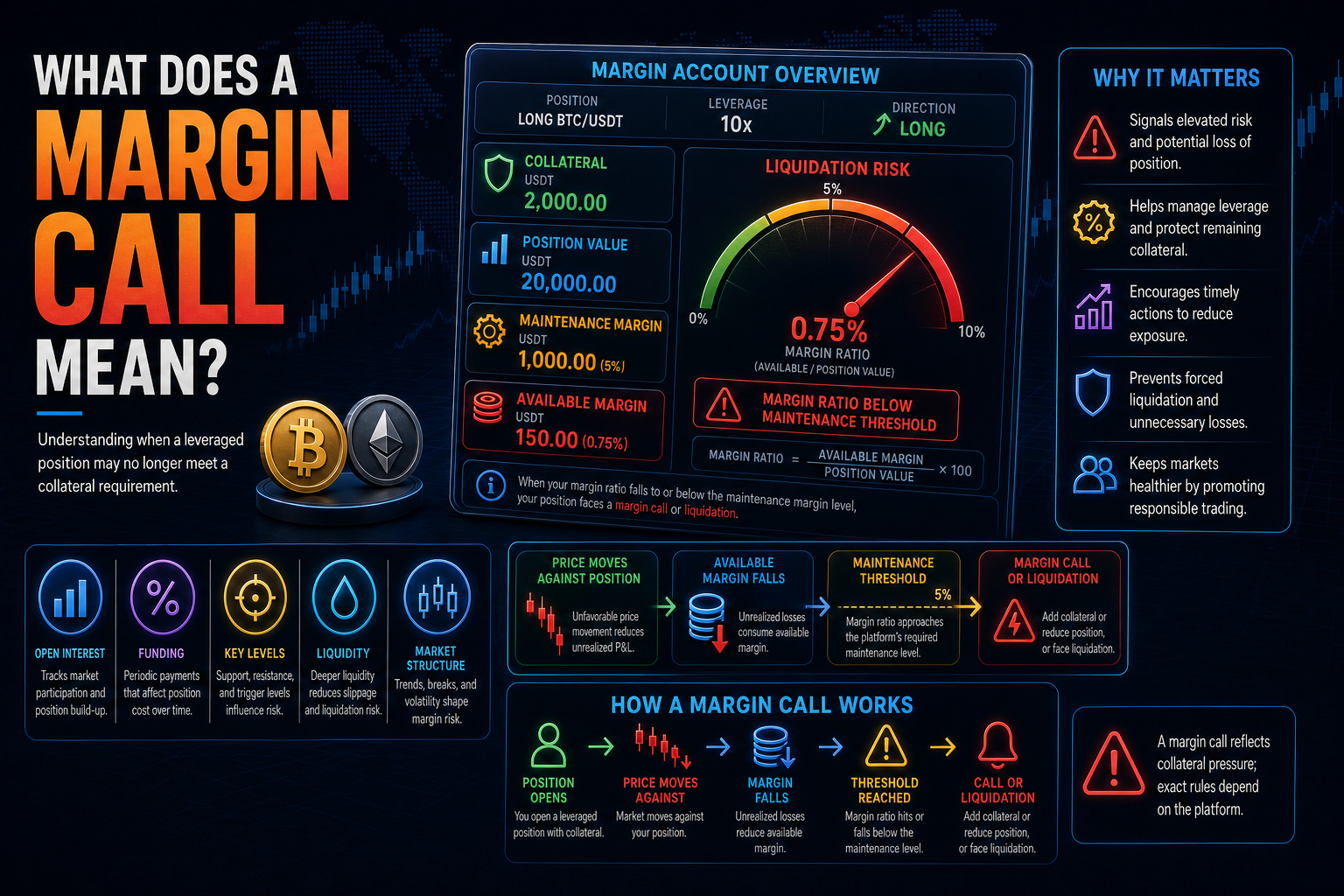
What Does a Margin Call Mean?
A margin call is a request or warning that a leveraged trading position no longer has enough collateral to meet the platform's required margin level. In crypto, the exact process depends on the exchange or protocol, and some platforms may liquidate a position automatically instead of issuing a traditional margin call.
Simple definition
A margin call means a leveraged position has lost enough value that more collateral may be needed to keep it open.
Margin is the collateral used to support a leveraged position. When the value of that position moves against the trader, the available margin can fall toward the platform's maintenance requirement.
Why margin calls matter
Margin calls matter because they show how leverage can increase the effect of a price move on a trading position. A relatively small market move can have a larger impact when the position uses borrowed funds or derivatives leverage.
If margin requirements are not met, a platform may reduce or close the position. That activity can add to buying or selling pressure during fast markets.
How a margin call works
A leveraged position begins with initial collateral. As the market moves, the position's unrealized profit or loss changes the amount of available margin.
If available margin falls below a maintenance threshold, the platform may notify the trader, require more collateral, reduce the position, or liquidate it. The exact rules, timing, and terminology vary by trading venue.
Margin call versus liquidation
A margin call is a warning or requirement related to insufficient collateral. Liquidation is the closing of a position when the collateral is no longer sufficient under the platform's rules.
Some crypto platforms use automated systems and may move directly toward liquidation when a threshold is reached. That is why the platform's specific margin rules matter.
How traders usually read it
Traders may watch margin calls and liquidations as part of the broader derivatives picture. Clusters of leveraged positions under pressure can help explain sudden volatility, especially near important support or resistance levels.
Margin data is context, not a standalone signal. A high level of leverage does not show exactly when or where price will move.
Why margin calls matter in crypto
Crypto markets often offer derivatives and margin trading, so rapid Bitcoin, Ethereum, or altcoin moves can place leveraged positions under pressure quickly. This can be especially visible when liquidity is thin or volatility expands.
Market updates may mention margin pressure to describe why a move is accelerating, while recognizing that each exchange and protocol uses its own risk system.
Margin calls are not standalone signals
A margin call does not predict the next price direction. It describes the condition of a leveraged position after a move against it.
It is most useful when read alongside leverage, open interest, funding conditions, liquidity, market structure, and the wider market environment.
Example in a market update
If Bitcoin falls quickly and long positions are being closed across derivatives markets, a market update may say that margin pressure is contributing to the decline.
If Ethereum rises sharply against a crowded group of short positions, an update may note that margin pressure on shorts could be adding to the upward move.
Common signals traders watch
- Changes in price against leveraged positions
- Open interest and liquidation activity
- Funding conditions in perpetual futures
- Key support and resistance levels
- Rising volatility and changes in liquidity
Key takeaway
A margin call means a leveraged position may no longer meet its collateral requirement, but the exact process depends on the platform's rules.
Comments (0)
Join the discussion
Sign in or create a free account to leave a comment.
No comments yet. Be the first to comment!