What Is a Long Squeeze?
What Is a Long Squeeze?
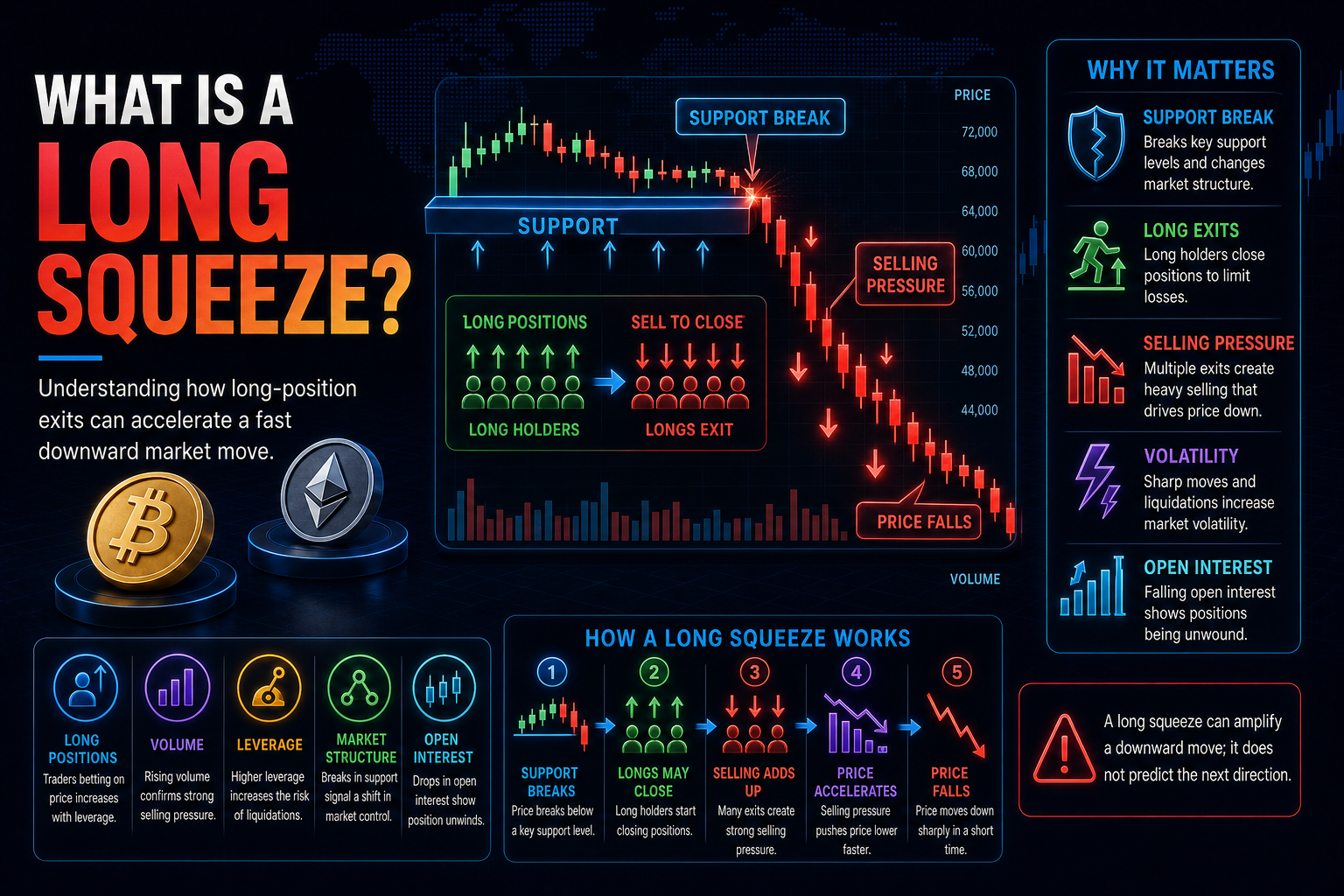
A long squeeze is a fast downward price move that can happen when traders who bet on a price rise need to sell or close their positions. In crypto, that selling can add to an existing decline and make the move accelerate.
Simple definition
A long squeeze is a downward move that can become stronger as long-position holders sell to exit.
A trader with a long position generally expects price to rise. If price falls instead, closing that position involves selling, which may add more supply to the market.
Why long squeezes matter
Long squeezes matter because they can help explain why a decline becomes unusually fast. Selling from traders closing long positions may combine with new selling pressure and create a sharper short-term drop.
The effect can be more noticeable when many long positions are concentrated near the same price levels or when leveraged positions are involved.
How a long squeeze forms
A long squeeze can start when price falls through a level that long-position holders were watching. Some may close positions voluntarily, while others may be forced to close if their leveraged position no longer meets margin requirements.
As more long positions close, more sell orders may reach the market. If that selling pushes price lower, it can place pressure on additional long positions and create a chain reaction.
How traders usually read it
Traders often look for a quick break below support, rising volume, increasing volatility, and signals from derivatives markets such as changes in open interest. They may also watch whether price stabilizes after the initial fall.
No single data point proves that a long squeeze is happening. Price can fall quickly for many reasons, including spot selling, liquidity changes, a broader risk-off move, or a change in market sentiment.
Long squeeze versus liquidation cascade
A long squeeze describes selling pressure from traders closing long positions. A liquidation cascade describes forced closures of leveraged positions that can accelerate a market move.
A long squeeze can include long liquidations, but not every long position is closed by liquidation. Both concepts can help explain why a fast decline becomes more intense.
Why long squeezes matter in crypto
Crypto derivatives markets allow leveraged long positions, so long squeezes can occur around important Bitcoin, Ethereum, and altcoin support levels. They may be more visible when leverage is high or liquidity is thinner.
Crypto market updates may describe a sudden decline as long-position-driven when price, volume, and derivatives data all point to pressure on long positions.
Long squeezes are not standalone signals
A long squeeze does not guarantee that price will keep falling. It describes a possible source of selling pressure during a fast move, not the next market direction.
It is most useful when read alongside price structure, trading volume, open interest, funding conditions, liquidity, and the wider market environment.
Example in a market update
If Bitcoin breaks below support and rapidly loses momentum while long positions are closing, a market update may describe the decline as a possible long squeeze.
If an altcoin falls sharply after a long period of bullish positioning, an update may say that long-position exits could be adding to the downward move.
Common signals traders watch
- Price breaking below a key support level
- A rapid downward move with larger candles
- Rising trading volume and volatility
- Changes in open interest or liquidations
- Whether price stabilizes after the initial decline
Key takeaway
A long squeeze is a fast downward move that can be amplified by long-position holders selling to close, but it does not predict what price will do next.
Comments (0)
Join the discussion
Sign in or create a free account to leave a comment.
No comments yet. Be the first to comment!