What Are Liquidity Conditions?
What Do Liquidity Conditions Mean?
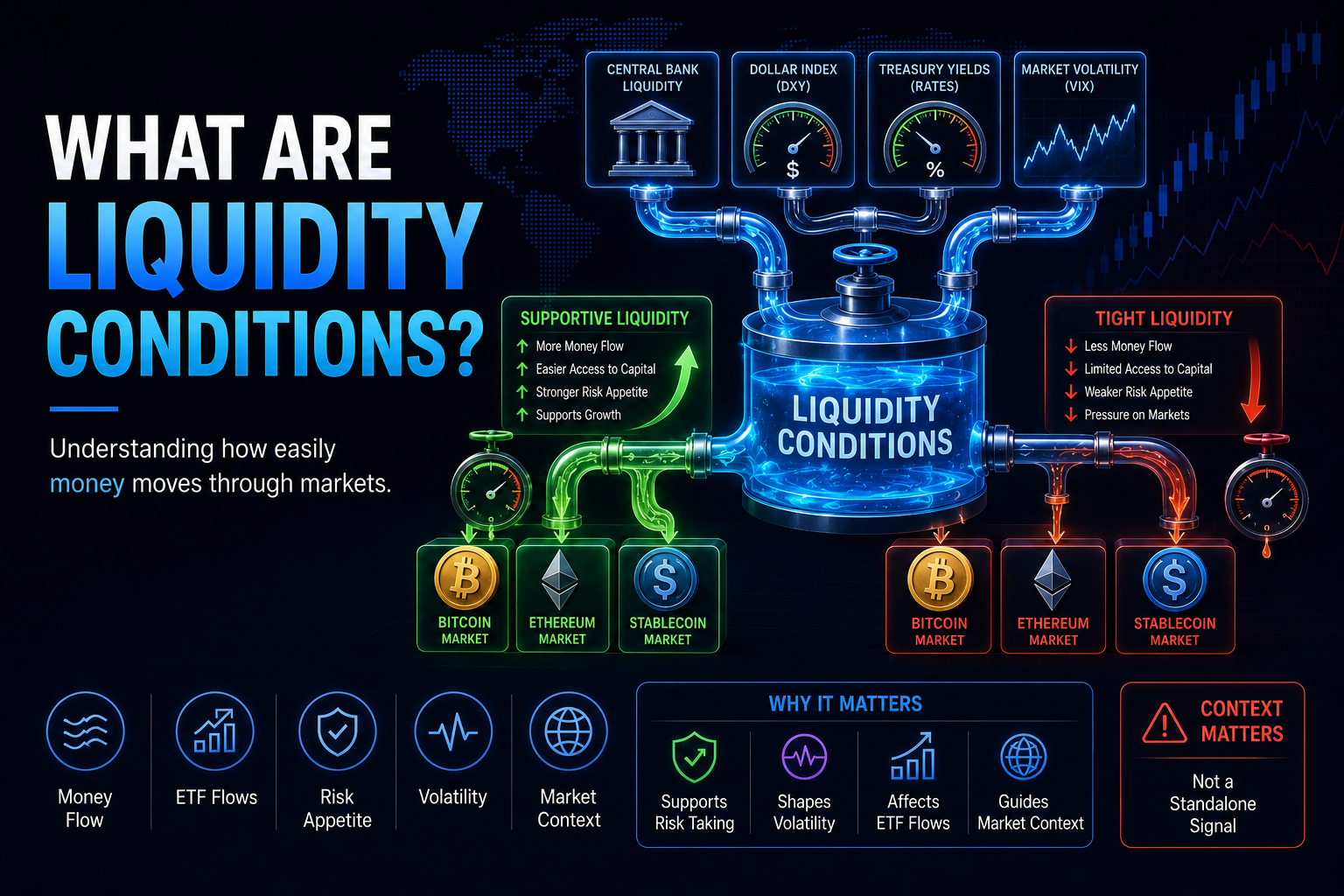
Liquidity conditions describe how easy or difficult it is for money to move through markets. Crypto traders watch liquidity conditions because they can affect Bitcoin, Ethereum, ETF flows, volatility, risk appetite, and broader market behavior.
Simple definition
Liquidity conditions mean how available money is in the market and how easily assets can be bought or sold.
When liquidity conditions are loose or supportive, markets may have more room for risk-taking. When liquidity conditions are tight, traders may become more cautious because money is harder to access or move.
Why liquidity conditions matter
Liquidity conditions matter because markets often move differently when money is easy to access compared with when money is harder to access.
Supportive liquidity can help risk appetite, while tighter liquidity can make traders more selective. The effect depends on the broader market backdrop, including rates, the U.S. dollar, volatility, and investor sentiment.
How traders usually read it
Improving liquidity conditions usually suggest that markets may have more support for risk-taking and smoother trading activity.
Tighter liquidity conditions usually suggest a more cautious backdrop. The meaning depends on context because liquidity can change alongside macro signals, policy expectations, ETF flows, volatility, regulation, and market structure.
Why it matters for crypto
Crypto can be sensitive to liquidity conditions because Bitcoin, Ethereum, and altcoins often react when risk appetite and available capital change.
Crypto traders may use liquidity conditions as part of a broader market read, especially when they appear alongside ETF flows, Bitcoin dominance, stablecoin activity, macro signals, sentiment, and price structure.
Liquidity conditions are not a standalone signal
Liquidity conditions should not be used as a standalone price signal. Crypto can rise during tighter liquidity periods, and it can fall even when liquidity conditions seem more supportive.
Liquidity conditions are most useful when read alongside price action, ETF flows, volume, volatility, Treasury yields, the U.S. dollar, Bitcoin dominance, and broader market sentiment.
Example in a market update
If Bitcoin is holding support, ETF flows are firm, volatility is lower, and macro signals are calmer, traders may describe liquidity conditions as more supportive.
If Bitcoin is fading, ETF flows are weak, the U.S. dollar is strengthening, and volatility is rising, traders may describe liquidity conditions as tighter or less supportive.
Common signals traders watch
- Whether money appears to be moving into or out of risk assets
- Whether ETF flows are supportive or weak
- Whether the U.S. dollar and Treasury yields are pressuring markets
- Whether Bitcoin and Ethereum are holding key levels
- Whether volatility, volume, and sentiment are improving or weakening
Key takeaway
Liquidity conditions help traders understand how easily money is moving through markets, and that can shape risk appetite, volatility, and crypto market behavior.
Comments (0)
Join the discussion
Sign in or create a free account to leave a comment.
No comments yet. Be the first to comment!