What Is Liquidity?
What Does Liquidity Mean?
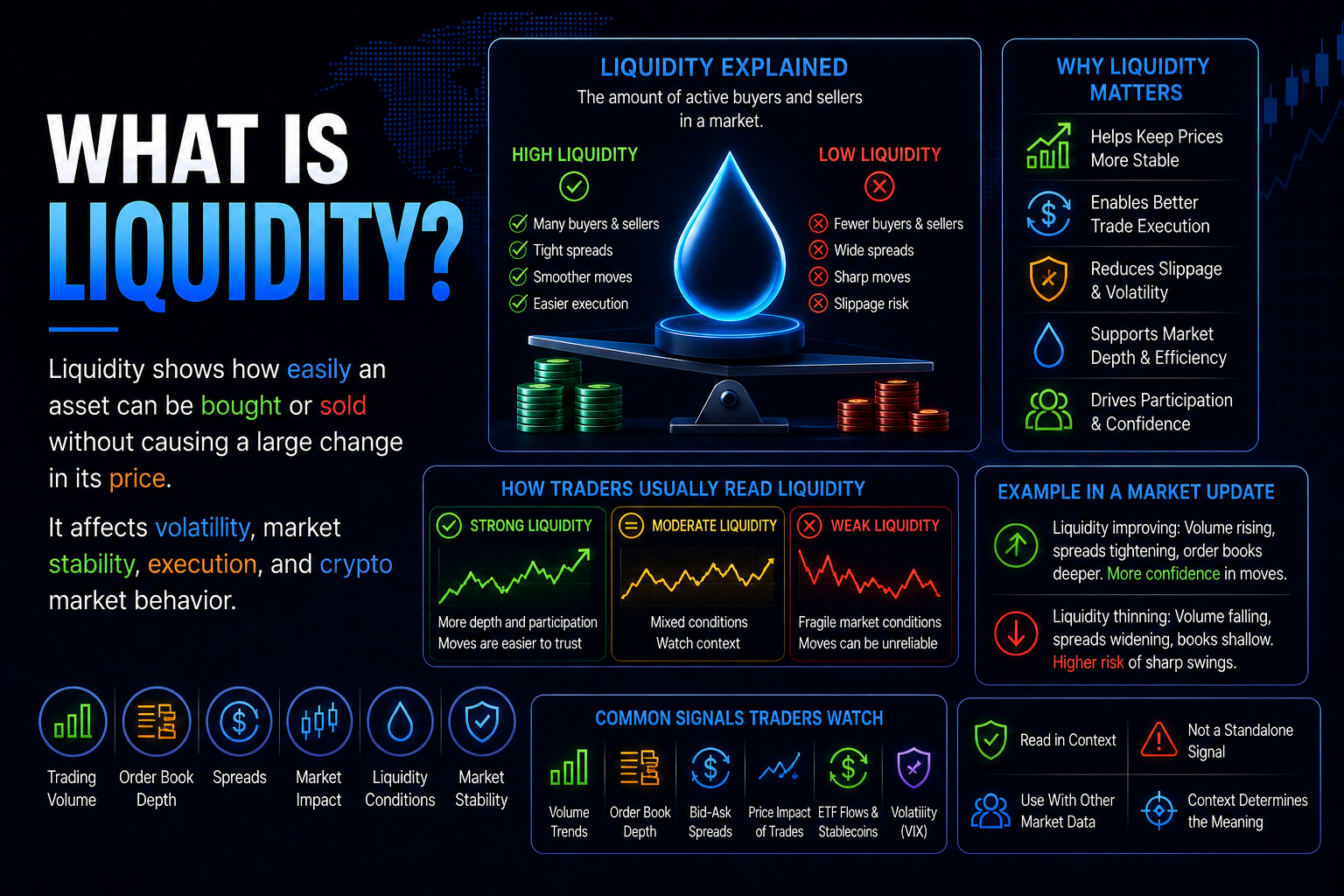
Liquidity describes how easily an asset can be bought or sold without strongly moving its price. Crypto traders watch liquidity because it can affect Bitcoin, Ethereum, altcoins, ETF flows, volatility, market sentiment, and how cleanly prices move.
Simple definition
Liquidity means how much active buying and selling capacity exists in a market.
A liquid market usually has many buyers and sellers, tighter spreads, and smoother trade execution. A less liquid market may move more sharply because fewer orders are available to absorb buying or selling pressure.
Why liquidity matters
Liquidity matters because it affects how stable or fragile price movement can feel. When liquidity is strong, markets can usually handle larger trades with less disruption.
When liquidity is weak, prices may move faster, spreads may widen, and volatility can rise. This can change how traders interpret breakouts, pullbacks, and sudden market reactions.
How traders usually read it
Stronger liquidity usually means a market has more depth and can support smoother buying and selling.
Weaker liquidity usually means price moves may be easier to push around. The meaning depends on context because liquidity can change across exchanges, assets, time of day, and market conditions.
Why it matters for crypto
Crypto can be especially sensitive to liquidity because Bitcoin, Ethereum, and altcoins trade across many venues with different order books and different levels of activity.
Crypto traders may use liquidity as part of a broader market read, especially when it appears alongside ETF flows, Bitcoin dominance, stablecoin activity, volatility, macro signals, and market structure.
Liquidity is not a standalone signal
Liquidity should not be used as a standalone price signal. Strong liquidity does not guarantee higher prices, and weak liquidity does not guarantee lower prices.
Liquidity is most useful when read alongside price action, volume, order book depth, ETF flows, volatility, the U.S. dollar, Treasury yields, Bitcoin dominance, and overall market sentiment.
Example in a market update
If Bitcoin is rising, ETF flows are supportive, and liquidity appears strong, traders may read the move as more durable.
If Bitcoin moves sharply on thin volume and weak liquidity, traders may be more cautious about trusting the move without confirmation.
Common signals traders watch
- Whether trading volume is increasing or decreasing
- Whether spreads are tight or wide
- Whether order books look deep or thin
- Whether ETF flows and stablecoin activity support market participation
- Whether price moves are confirmed by broader market structure and sentiment
Key takeaway
Liquidity helps traders understand how easily markets can absorb buying and selling, which can shape volatility, execution, sentiment, and crypto market behavior.
Comments (0)
Join the discussion
Sign in or create a free account to leave a comment.
No comments yet. Be the first to comment!