What Are Liquidations?
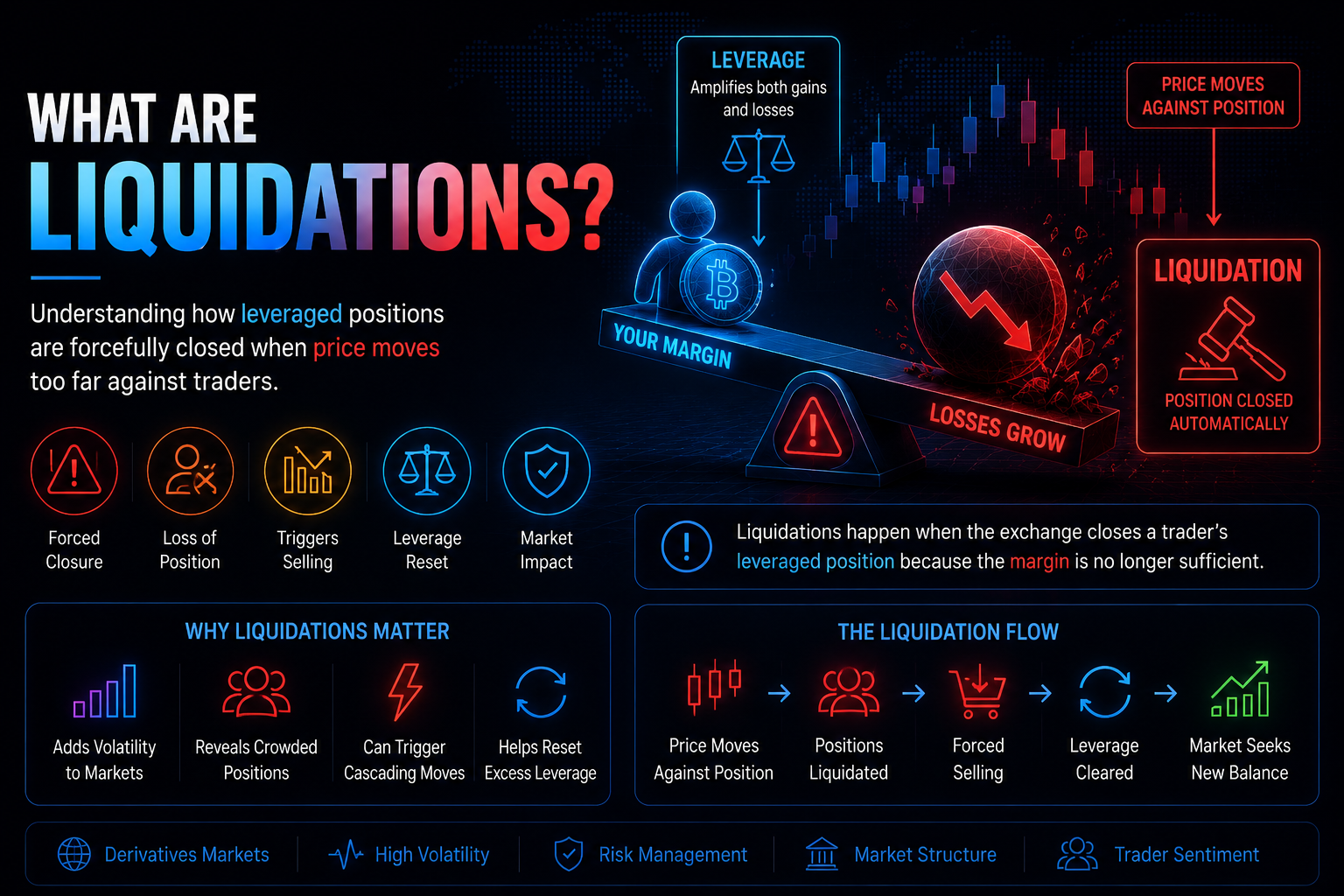
What Do Liquidations Mean?
Liquidations happen when leveraged trades are forced closed because price moves too far against the trader. Crypto traders watch liquidations because they can affect Bitcoin, Ethereum, volatility, liquidity, derivatives positioning, and broader market sentiment.
Simple definition
Liquidations mean forced closures of leveraged trading positions after the market moves against those positions.
A trader may use leverage to control a larger position than their own capital would normally allow. If price moves too far in the wrong direction, the exchange or trading platform may close the position to limit further losses.
Why liquidations matter
Liquidations matter because they can make market moves sharper. When many positions are forced closed around the same time, price action can move faster than it would from normal buying and selling alone.
They can also show when leverage has become crowded. A large liquidation wave may suggest that too many traders were leaning in the same direction before price moved against them.
How traders usually read it
Rising liquidations usually mean leveraged traders are being forced out of positions. Long liquidations happen when traders positioned for higher prices are forced out after price falls. Short liquidations happen when traders positioned for lower prices are forced out after price rises.
The meaning depends on context. Liquidations may show market stress, but they can also help clear excess leverage if price stabilizes afterward.
Why it matters for crypto
Liquidations matter for crypto because Bitcoin, Ethereum, and many altcoins trade actively in futures and perpetual futures markets. When leverage builds quickly, a sharp price move can force many positions to close at once.
Crypto traders may use liquidation data alongside open interest, funding rate, volume, liquidity, market structure, volatility, and macro signals to understand whether a move is being driven by spot demand, leverage, or forced positioning.
Liquidations are not a standalone signal
Liquidations should not be used alone as a complete market signal. A large liquidation event does not automatically mean the market will continue in the same direction or immediately reverse.
They are most useful when read alongside price action, volume, open interest, funding rate, volatility, liquidity, support and resistance, and broader market sentiment.
Example in a market update
If Bitcoin falls sharply and liquidations rise, traders may read the move as a leverage flush where crowded long positions were forced out.
If Bitcoin rises quickly and short liquidations increase, traders may watch whether the move has real demand behind it or whether it is mostly driven by forced short closures.
Common signals traders watch
- Whether liquidations are mostly long liquidations or short liquidations
- Whether open interest falls as positions are forced closed
- Whether funding rate shows crowded positioning before the move
- Whether volume rises during the liquidation wave
- Whether Bitcoin or Ethereum stabilizes after the forced move
Key takeaway
Liquidations help traders understand when leveraged positions are being forced closed, but they work best when read alongside price action, leverage, liquidity, volatility, and market structure.
Comments (0)
Join the discussion
Sign in or create a free account to leave a comment.
No comments yet. Be the first to comment!