What Is Crypto Licensing?
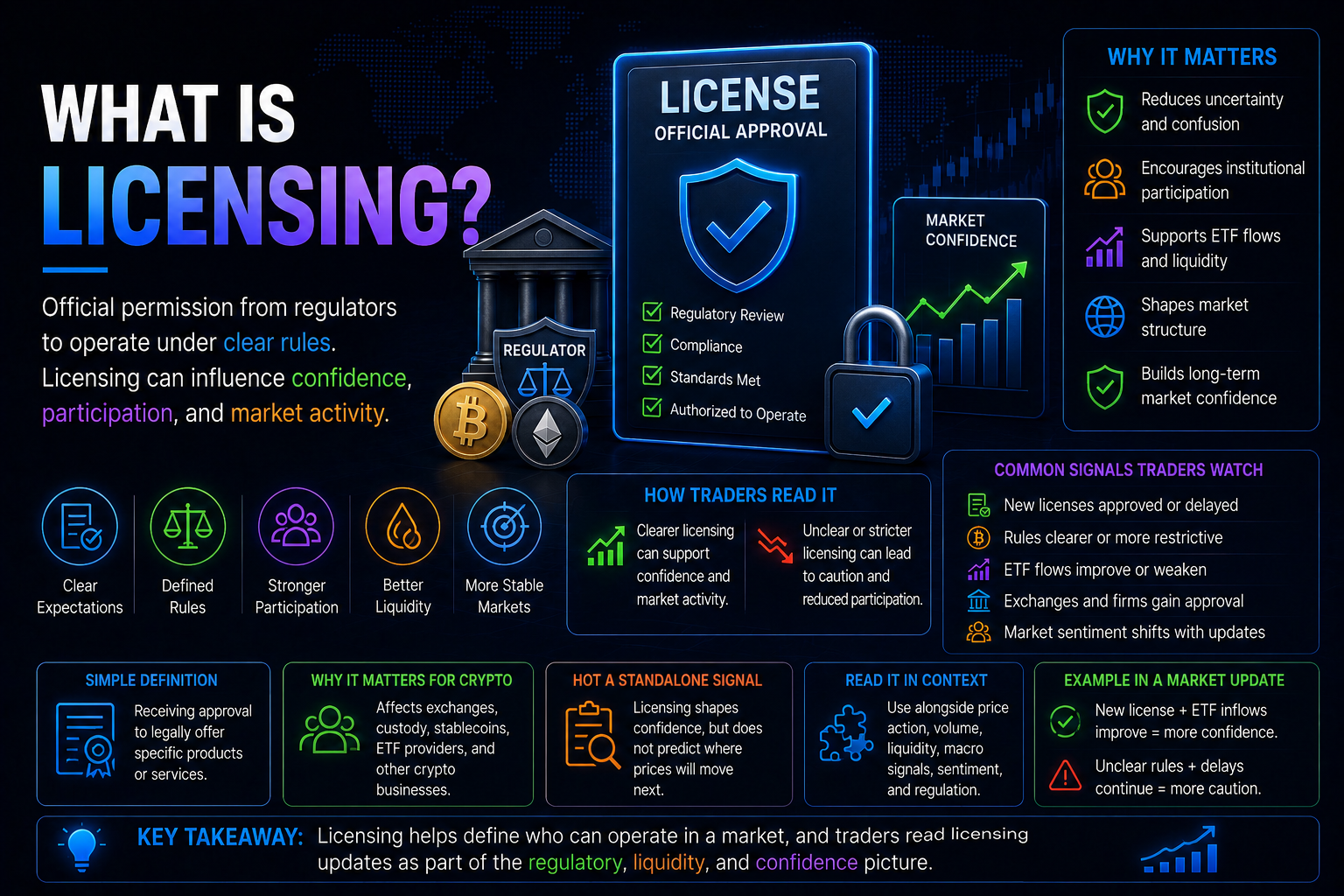
What Is Crypto Licensing?
Crypto licensing refers to regulatory permission or registration required for certain crypto-related services. It can apply to crypto exchanges, custody providers, payment companies, brokers, and other businesses that interact with digital assets.
Crypto traders watch licensing developments because they can influence market confidence, institutional participation, regulation, and how companies operate within the industry.
Simple definition
Crypto licensing is the process through which a business receives a required license or registration to offer specific crypto products or services. The exact requirement depends on the country, regulator, and type of business activity.
Different activities may require different licenses or registrations depending on the country, regulator, or type of business. A license or registration does not mean every product or investment is risk free, and it does not serve as a general endorsement of a business. It means the business has met certain requirements within the scope of that regulatory framework.
Why licensing matters
Licensing matters because it helps define which businesses may legally operate within a regulated market.
Clear licensing frameworks may increase confidence by giving businesses and market participants a better understanding of regulatory expectations. Changes to licensing rules can also influence participation, competition, and market activity.
How traders usually read it
Traders usually read licensing developments as part of the broader regulatory picture. New licenses, registrations, approvals, or clearer licensing frameworks may be viewed as supportive for market confidence.
Licensing news is not automatically bullish or bearish. Its meaning depends on what changed, which companies or activities are affected, and how the market was positioned beforehand.
Why it matters for crypto
Licensing can influence crypto exchanges, custody providers, payment companies, brokers, and other businesses that interact with digital assets.
Crypto traders may consider licensing developments alongside Bitcoin, Ethereum, ETF flows, liquidity, market sentiment, and regulation to better understand the broader market environment.
Licensing is not a standalone signal
Licensing should not be used as a complete market explanation. A licensing decision can shape confidence, but it does not determine where prices will move next.
It is most useful when read alongside price action, trading volume, liquidity, regulation, macro signals, sentiment, and overall market structure.
Example in a market update
If a major crypto company receives a new operating license, a market update may say the development could support confidence or broader market participation.
If licensing requirements become more restrictive or remain uncertain, a market update may say traders are becoming more cautious while waiting for greater clarity.
Common signals traders watch
- Whether new licenses or registrations are being approved or delayed
- Whether licensing rules become clearer or more restrictive
- Whether exchanges or other crypto businesses receive regulatory approval or registration
- Whether market confidence changes after licensing announcements
- Whether licensing developments align with broader regulatory changes
Key takeaway
Crypto licensing and registration help define which businesses may operate in a market. Traders often read developments as one part of the broader regulatory and market picture.
Comments (0)
Join the discussion
Sign in or create a free account to leave a comment.
No comments yet. Be the first to comment!