What Is a Leverage Flush?
What Is a Leverage Flush?
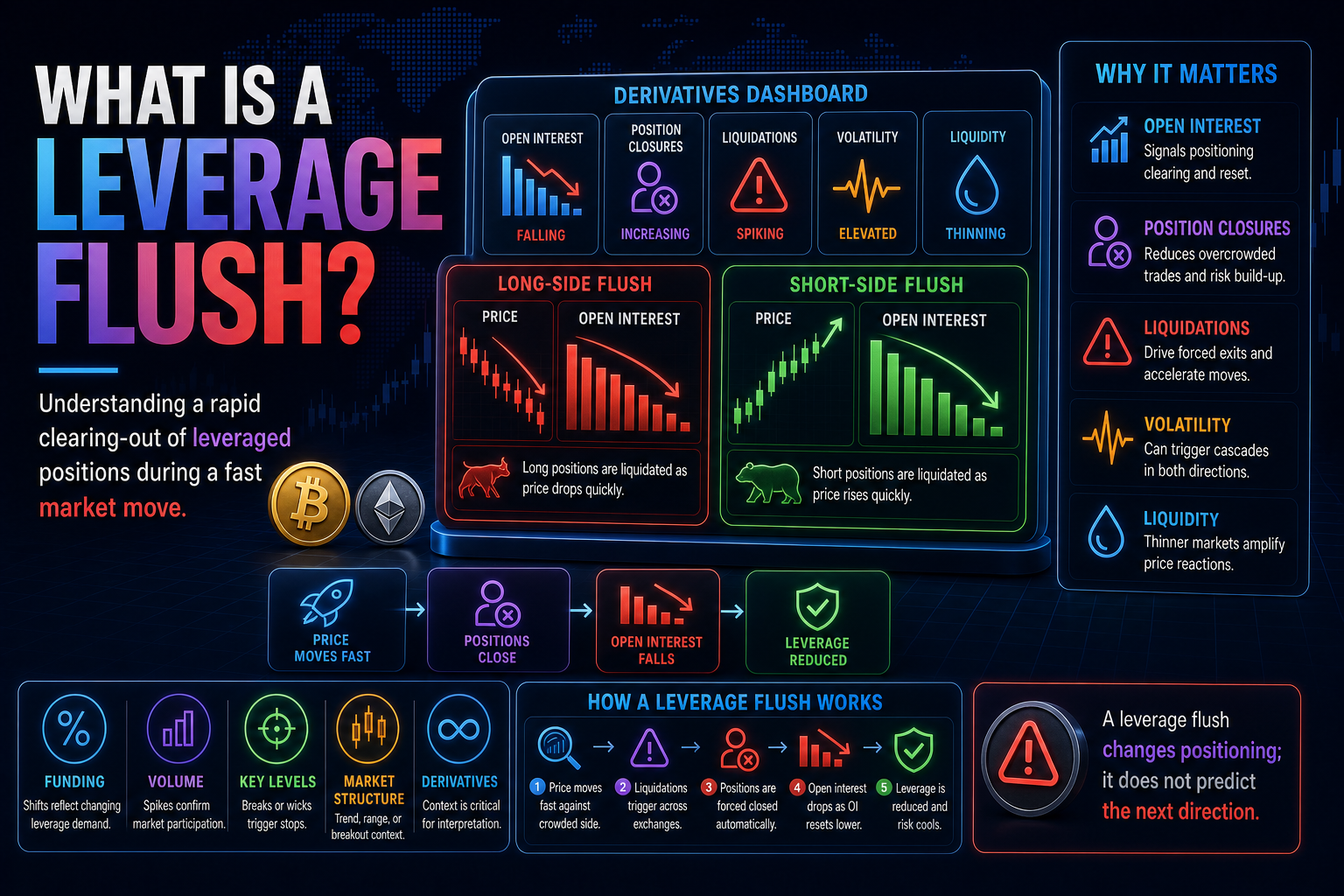
A leverage flush is a rapid reduction in leveraged trading positions, often during a sharp market move. In crypto, the term may describe a period when traders close leveraged positions voluntarily or when positions are liquidated because they no longer meet margin requirements.
Simple definition
A leverage flush is a quick clearing-out of leveraged positions from the market.
It can affect long positions, short positions, or both. The phrase is descriptive rather than a formal exchange term, and the exact mechanics can differ between platforms and market conditions.
Why leverage flushes matter
Leverage flushes matter because they can help explain a sudden change in open interest, volatility, and price movement. When many positions close in a short period, the extra buying or selling can make a market move faster.
After a flush, the market may have less leveraged exposure than before. That does not determine the next move, but it can change how traders describe the derivatives backdrop.
How a leverage flush forms
A leverage flush can begin when price moves quickly through a key level. Traders may close positions as the market moves against them, while highly leveraged positions may be liquidated under a platform's margin rules.
The resulting orders can push price toward additional levels where more positions are under pressure. This can create a chain reaction and a noticeable drop in open interest.
How traders usually read it
Traders often compare price action with changes in open interest, trading volume, funding conditions, and reported liquidations. A large price move paired with falling open interest may be described as deleveraging or a leverage flush.
The direction matters. A decline may flush long leverage, while a fast rally may flush short leverage. In a volatile market, both sides can be reduced over a short period.
Leverage flush versus liquidation cascade
A leverage flush is a broad description of leveraged positions leaving the market. A liquidation cascade is a more specific chain reaction of forced closures that can accelerate a price move.
A leverage flush can include liquidations, voluntary position closures, or both. A liquidation cascade is usually focused on forced closures during a rapid move.
Why leverage flushes matter in crypto
Crypto derivatives markets often use leverage, so Bitcoin, Ethereum, and altcoin moves can quickly affect large groups of positions. A leverage flush may be more visible when open interest has built up and price reaches a key support or resistance area.
Market updates may use the term to describe a sharp move with falling open interest, while noting that exchange-level data and platform rules can differ.
Leverage flushes are not standalone signals
A leverage flush does not predict a reversal or continuation. It describes a change in leveraged positioning during a fast market move.
It is most useful when read alongside price structure, open interest, funding, liquidations, trading volume, liquidity, and the wider market environment.
Example in a market update
If Bitcoin drops sharply through support while open interest falls, a market update may say that the move appears to be flushing long leverage from the market.
If Ethereum rallies quickly and short positions close as open interest declines, an update may describe the move as a short-side leverage flush.
Common signals traders watch
- A sharp price move through a key level
- A notable decline in open interest
- Reported long or short liquidations
- Rising trading volume and volatility
- Changes in funding and broader derivatives activity
Key takeaway
A leverage flush is a rapid reduction in leveraged positions during a fast market move, but it does not determine what price will do next.
Comments (0)
Join the discussion
Sign in or create a free account to leave a comment.
No comments yet. Be the first to comment!