What Is Legal Uncertainty?
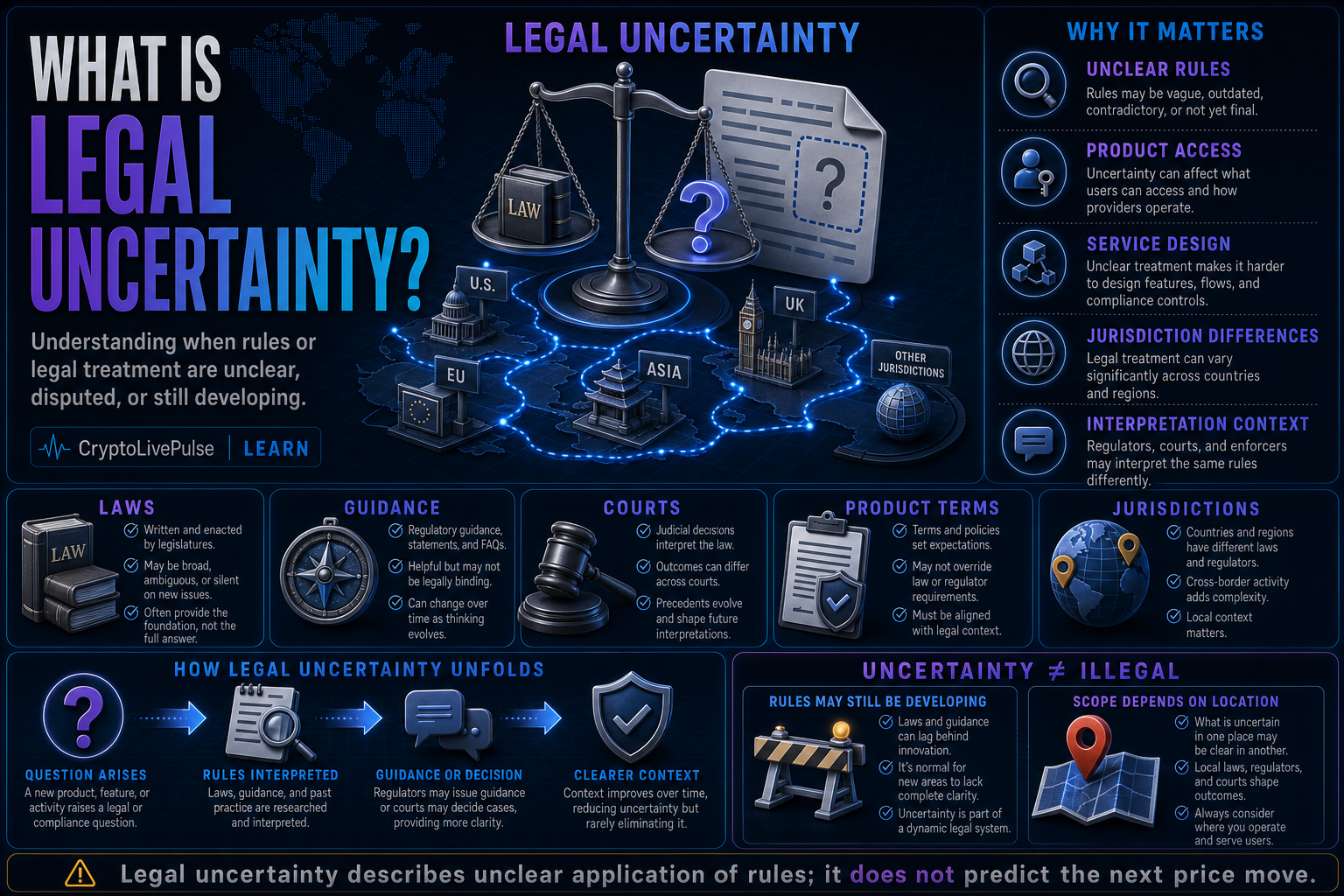
What Is Legal Uncertainty?
Legal Uncertainty is a situation where the rules, rights, responsibilities, or legal treatment of an activity are unclear, incomplete, disputed, or still developing.
Simple definition
It is a useful term for explaining part of the environment around crypto markets and services. It does not describe every project in the same way, because facts, responsibilities, and practical effects can vary by product and location.
Why legal uncertainty matters
Crypto products often combine technology, payments, markets, custody, and cross-border services. This can make it difficult to know which rules apply and how they will be interpreted.
Understanding the term can help readers separate a broad market narrative from the specific details that affect a product, platform, or transaction. The relevant documents, service terms, and official information provide the important context.
How people usually read it
Legal uncertainty is usually read as a context that may affect planning, access, product design, and compliance decisions. It does not mean a product is automatically unlawful or that a certain outcome is guaranteed.
What can change the reading
Uncertainty can narrow when laws are passed, guidance is issued, courts clarify a question, or a regulator explains how a framework applies. It can also remain different across locations.
The same term can have a different practical meaning depending on the parties involved, the jurisdiction, and the stage of a policy or market development. Reading the underlying source and the relevant scope is more useful than relying only on a label.
Why it matters for crypto
Crypto markets and services combine on-chain technology with off-chain businesses, institutions, and rules. This means that broader policy or financial context can influence access, operations, settlement, and the way market participants interpret developments.
Legal Uncertainty is not a standalone signal
Legal Uncertainty does not guarantee that an asset will rise or fall, and it does not provide a complete judgement about a service. It is most useful when read alongside the facts of the situation, market structure, and broader conditions.
Example in a market update
If a project changes its features while waiting for clearer treatment under a new framework, an update may describe legal uncertainty as part of the reason.
Common signals people watch
- Applicable legal framework
- Official guidance and interpretations
- Court or administrative outcomes
- Jurisdictional differences
- Product disclosures and access changes
Questions to keep in mind
What exactly is changing, who is affected, where does it apply, and what is confirmed rather than anticipated? These questions help readers place legal uncertainty in context and avoid treating it as a prediction.
Key takeaway
Legal uncertainty is the lack of clear, settled answers about how rules apply to a crypto activity or product.
Comments (0)
Join the discussion
Sign in or create a free account to leave a comment.
No comments yet. Be the first to comment!