What Is Layer 1?
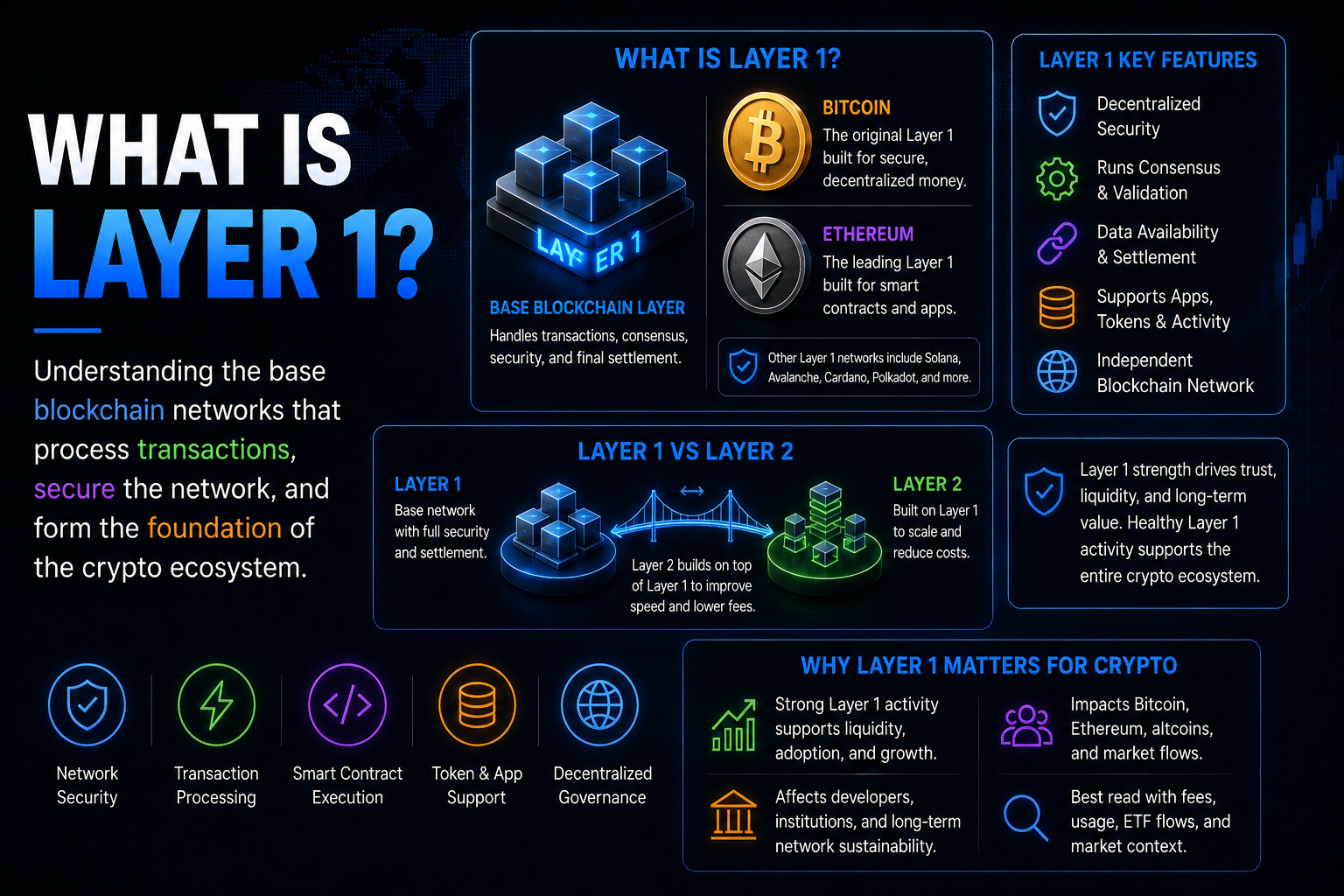
What Does Layer 1 Mean?
Layer 1 describes the main blockchain network where transactions are recorded and secured. Crypto traders watch Layer 1 networks because they can affect Bitcoin, Ethereum, altcoins, fees, liquidity, developer activity, market sentiment, and broader crypto market structure.
Simple definition
Layer 1 means the base blockchain network that processes, records, and secures transactions directly on its own chain.
Bitcoin and Ethereum are common examples of Layer 1 blockchains. They are called Layer 1 because other tools, apps, tokens, or scaling systems can be built around them or on top of them.
Why Layer 1 matters
Layer 1 matters because the base network is the foundation for security, settlement, fees, transaction activity, and user trust.
When a Layer 1 network is active, reliable, and widely used, traders may see it as a stronger part of the crypto market. When fees are high, activity slows, or technical concerns appear, traders may become more cautious.
How traders usually read it
Strong Layer 1 activity is usually read as a sign that users, developers, and capital are paying attention to that network.
Weak activity, falling usage, rising fees, or network stress can be read more cautiously. The meaning depends on context because Layer 1 signals can be shaped by market cycles, upgrades, liquidity, regulation, app activity, and broader sentiment.
Why it matters for crypto
Layer 1 networks matter for crypto because they often anchor major market narratives. Bitcoin is watched as the main store-of-value and settlement network, while Ethereum is watched for smart contracts, apps, tokens, and institutional activity.
Crypto traders may use Layer 1 activity as part of a broader market read, especially when it appears alongside ETF flows, Bitcoin dominance, transaction fees, stablecoin activity, liquidity, developer interest, and market structure.
Layer 1 is not a standalone signal
Layer 1 should not be used alone as a complete price signal. A strong network does not guarantee higher token prices, and weaker activity does not always mean a network is losing long-term relevance.
Layer 1 is most useful when read alongside price action, volume, fees, network usage, ETF flows, stablecoin activity, liquidity, regulation, Bitcoin dominance, and overall market sentiment.
Example in a market update
If Ethereum activity is rising, fees are manageable, and ETF flows are supportive, traders may read Layer 1 sentiment as more constructive.
If Bitcoin is holding steady but several Layer 1 altcoins are fading, traders may read the market as selective rather than broadly risk-on.
Common signals traders watch
- Whether network activity is rising or falling
- Whether transaction fees are stable, high, or falling
- Whether developers and apps are building on the network
- Whether liquidity and stablecoin activity are moving through the network
- Whether Bitcoin, Ethereum, and major Layer 1 tokens are leading or lagging the broader market
Key takeaway
Layer 1 helps traders understand the base blockchain networks that support crypto activity, but it should always be read alongside liquidity, usage, fees, ETF flows, and market structure.
Comments (0)
Join the discussion
Sign in or create a free account to leave a comment.
No comments yet. Be the first to comment!