What Is Inflation Data?
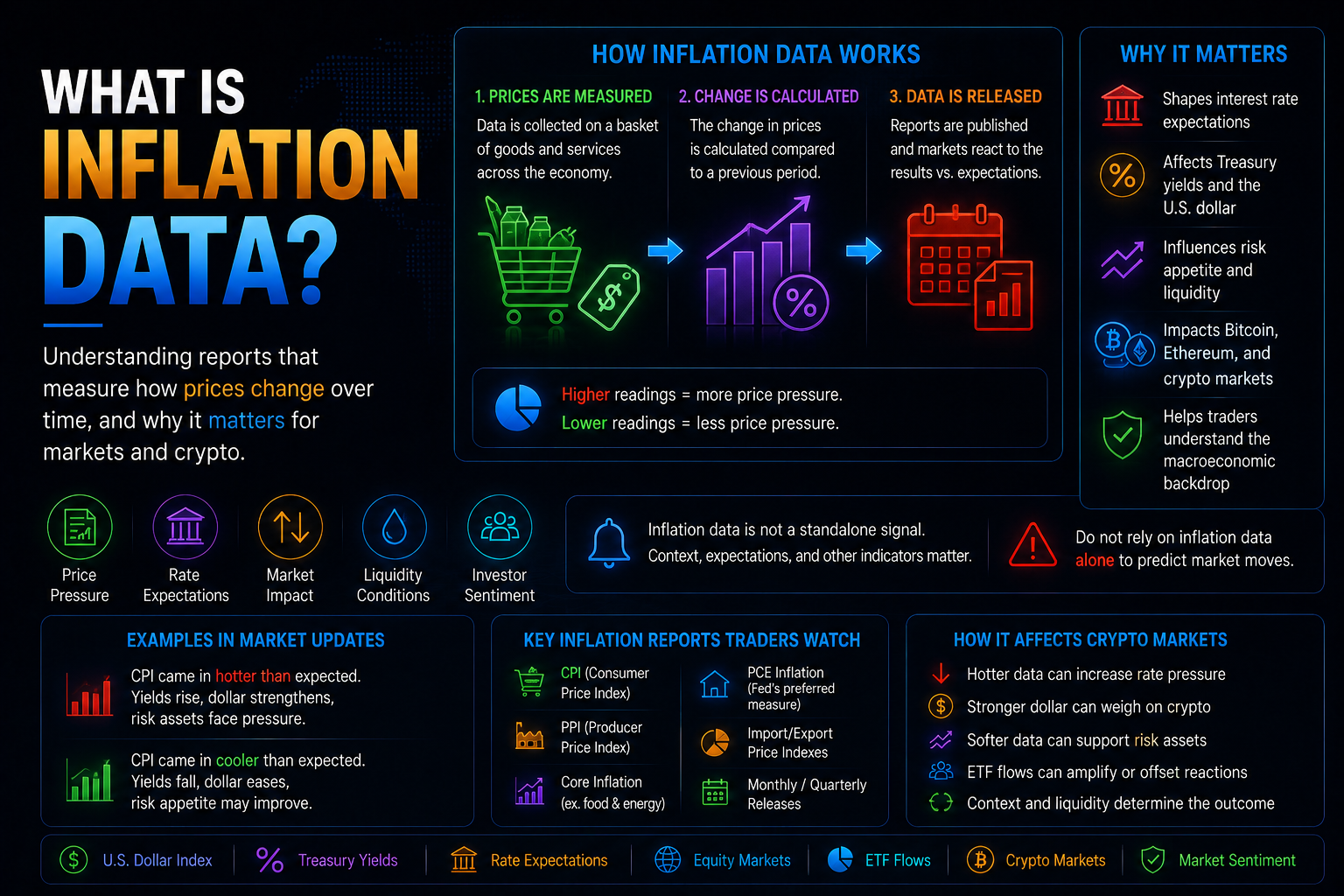
What Does Inflation Data Mean?
Inflation data shows how quickly prices are rising or slowing across an economy. Crypto traders watch inflation data because it can affect interest rate expectations, U.S. dollar strength, Treasury yields, risk appetite, Bitcoin, Ethereum, ETF flows, and broader market sentiment.
Simple definition
Inflation data means economic reports that measure changes in prices over time.
Common inflation reports include consumer price data, producer price data, and other measures that help traders understand whether inflation pressure is rising, falling, or staying sticky.
Why inflation data matters
Inflation data matters because it can shape how traders think about central banks, interest rates, bond yields, and financial conditions.
If inflation looks hotter than expected, traders may expect tighter policy or higher rates for longer. If inflation cools, traders may become more open to the idea of easier financial conditions, depending on the full macro backdrop.
How traders usually read it
Softer inflation data is usually read as more supportive for risk assets because it can reduce pressure from rates and yields.
Hotter inflation data is usually read as more cautious for risk assets because it can support higher yields, a stronger dollar, and tighter liquidity. The meaning depends on expectations because markets often react to the gap between the report and what traders already expected.
Why it matters for crypto
Crypto can be sensitive to inflation data because Bitcoin, Ethereum, and altcoins often react when interest rate expectations and risk appetite change.
Crypto traders may use inflation data as part of a broader market read, especially when it appears alongside U.S. dollar strength, Treasury yields, VIX, ETF flows, liquidity conditions, Bitcoin dominance, and market sentiment.
Inflation data is not a standalone signal
Inflation data should not be used as a standalone price signal. A cooler inflation report does not guarantee stronger crypto prices, and a hotter report does not guarantee weaker crypto prices.
It is most useful when read alongside market expectations, rate expectations, Treasury yields, the U.S. dollar, equities, volatility, ETF flows, liquidity, and crypto price action.
Example in a market update
If inflation data comes in cooler while yields fall and Bitcoin holds support, traders may read the macro backdrop as more constructive.
If inflation data comes in hotter while yields and the dollar rise, traders may read the setup as more cautious for Bitcoin, Ethereum, and broader risk assets.
Common signals traders watch
- Whether inflation data is hotter or cooler than expected
- Whether Treasury yields rise or fall after the report
- Whether the U.S. dollar strengthens or weakens
- Whether Bitcoin and Ethereum hold key price levels
- Whether ETF flows, liquidity, and sentiment confirm the market reaction
Key takeaway
Inflation data helps traders understand macro pressure, rate expectations, and risk appetite, but it should be read with yields, the dollar, liquidity, and crypto price action.
Comments (0)
Join the discussion
Sign in or create a free account to leave a comment.
No comments yet. Be the first to comment!