What Does Implied Volatility Mean?
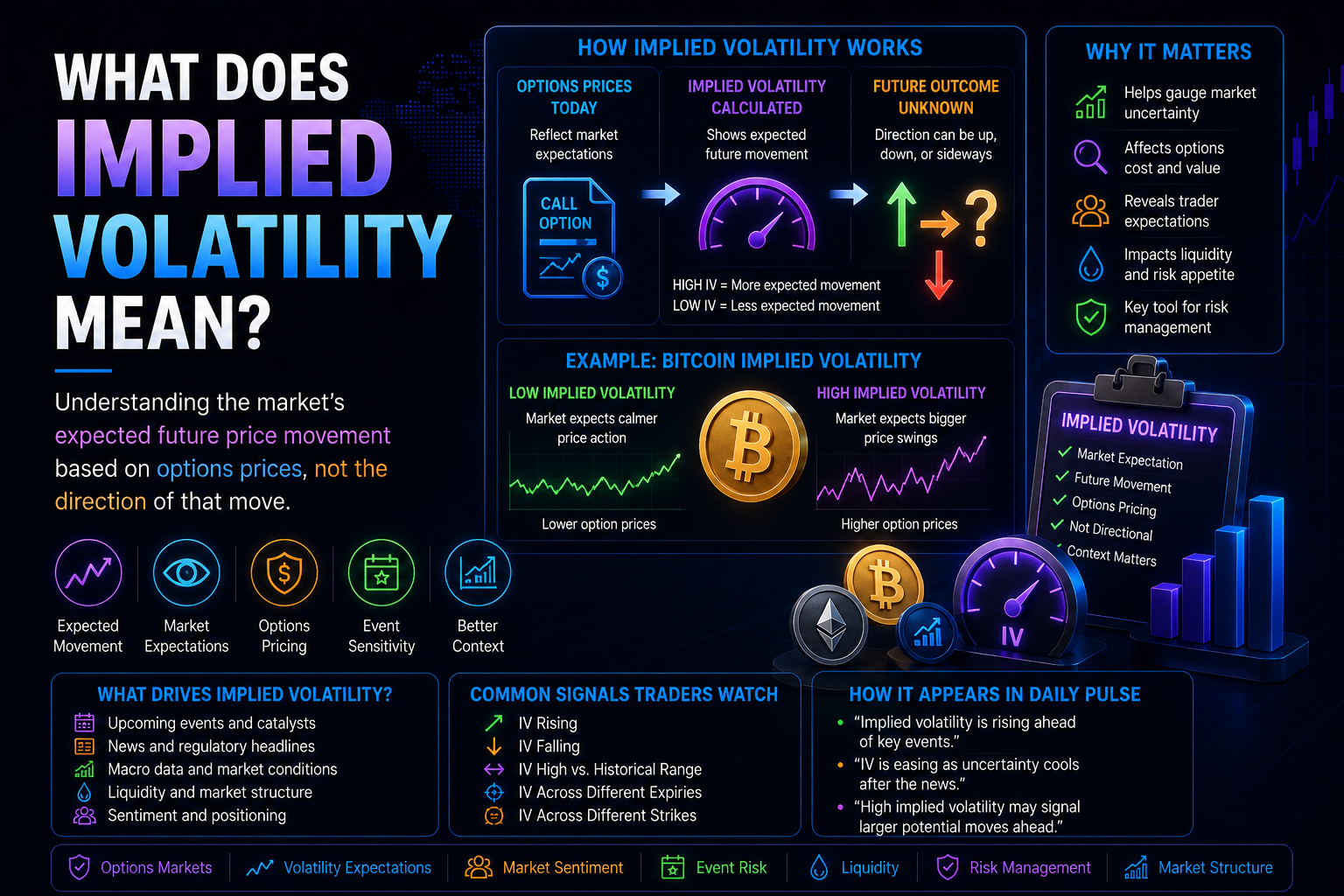
What Is Implied Volatility?
Implied volatility describes how much movement the options market expects in the future. Crypto traders watch implied volatility because it can affect options pricing, Bitcoin, Ethereum, sentiment, liquidity, and broader market structure.
Simple definition
Implied volatility means the market’s expected future price movement based on options prices.
It does not say which direction price may move. It only suggests whether traders expect larger or smaller moves ahead.
Why implied volatility matters
Implied volatility matters because it helps traders understand how much uncertainty or expected movement is priced into options.
When implied volatility is high, options are usually more expensive because traders expect larger moves. When implied volatility is low, options are usually cheaper because the market expects calmer price action.
How traders usually read it
Rising implied volatility usually means traders are pricing in more uncertainty, stronger expected movement, or more event risk.
Falling implied volatility usually means traders expect calmer conditions or less near-term movement. The meaning depends on context because implied volatility can rise before major events and fall after uncertainty clears.
Why it matters for crypto
Crypto can move quickly, so implied volatility can become an important part of how traders read Bitcoin, Ethereum, and major altcoin options markets.
Crypto traders may use implied volatility alongside price action, ETF flows, funding rates, liquidations, macro signals, liquidity, and market sentiment to understand whether the market is pricing calm conditions or larger potential moves.
Implied volatility is not a direction signal
Implied volatility should not be used as a standalone price signal. High implied volatility does not automatically mean price will rise or fall.
It is most useful when read alongside options activity, spot price action, volume, liquidity, macro data, event risk, and broader market structure.
Example in a market update
If Bitcoin is moving sideways but implied volatility is rising, traders may read the options market as preparing for a larger move or a near-term catalyst.
If Bitcoin is volatile but implied volatility is falling, traders may read that as the market pricing less uncertainty after a major event has passed.
Common signals traders watch
- Whether implied volatility is rising or falling
- Whether options prices are becoming more expensive or cheaper
- Whether Bitcoin or Ethereum options are pricing larger expected moves
- Whether event risk, macro data, or policy headlines are changing expectations
- Whether spot price action confirms or challenges the options market signal
Key takeaway
Implied volatility helps traders understand how much future movement the options market is pricing in, but it does not tell them the direction of that move.
Comments (0)
Join the discussion
Sign in or create a free account to leave a comment.
No comments yet. Be the first to comment!