What Is a Futures ETF?
What Does Futures ETF Mean?
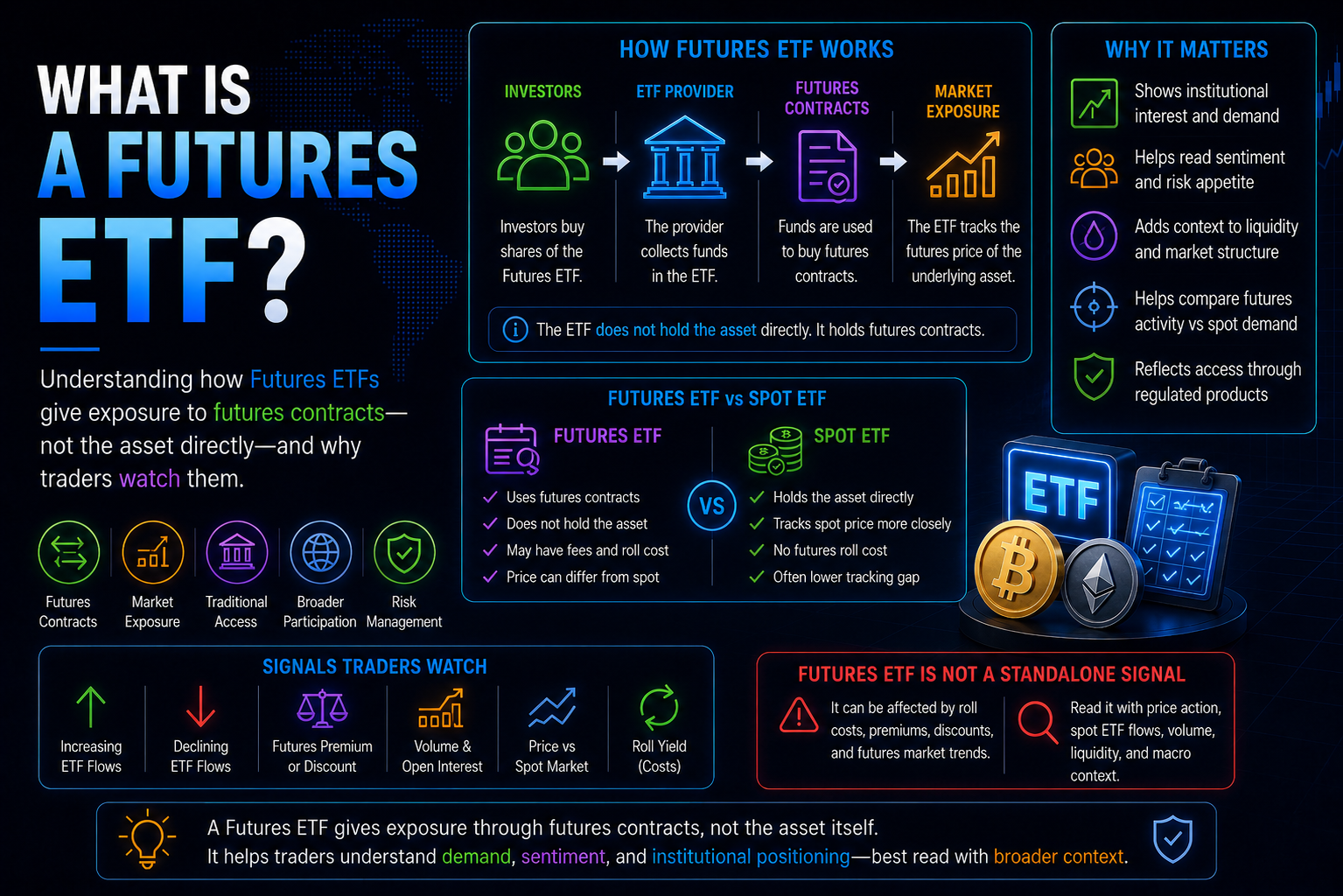
A Futures ETF is an exchange-traded fund that gets exposure through futures contracts instead of directly holding the underlying asset. Crypto traders watch Futures ETFs because they can affect sentiment, ETF flows, Bitcoin, Ethereum, liquidity, and broader market structure.
Simple definition
A Futures ETF is a fund that tracks futures contracts tied to an asset, rather than owning the asset directly.
A futures contract is an agreement to buy or sell an asset at a future date. In crypto, a Futures ETF may give investors exposure to Bitcoin or Ethereum futures without requiring them to hold the crypto asset itself.
Why Futures ETF matters
Futures ETFs matter because they can show how traditional market products are giving investors exposure to crypto-related price movement.
They can also affect how traders read demand, sentiment, derivatives activity, and the difference between futures-based exposure and direct spot-market exposure.
How traders usually read it
Strong interest in a Futures ETF may suggest that investors want exposure to an asset through regulated market products.
Weak interest may suggest caution or lower demand for that type of exposure. The meaning depends on context because futures activity, spot prices, ETF flows, volatility, and macro signals can all point in different directions.
Why it matters for crypto
Crypto traders may watch Futures ETFs because they connect Bitcoin or Ethereum exposure with traditional market products and derivatives markets.
A Futures ETF can appear in a market read when traders are comparing spot ETF flows, futures positioning, Bitcoin price action, Ethereum sentiment, liquidity, and broader risk appetite.
Futures ETF is not the same as a spot ETF
A Futures ETF should not be read the same way as a spot ETF. A spot ETF is designed to track the current market price more directly, while a Futures ETF depends on futures contracts.
Futures ETFs are most useful when read alongside spot ETF flows, price action, futures premiums or discounts, volume, volatility, liquidity, and broader market structure.
Example in a market update
If Bitcoin is steady and Futures ETF activity is rising, traders may read that as a sign of stronger traditional-market interest in Bitcoin exposure.
If Bitcoin is falling while Futures ETF demand weakens, traders may read the setup as more cautious, especially if spot ETF flows are also soft.
Common signals traders watch
- Whether Futures ETF demand is rising or falling
- Whether spot ETF flows are stronger or weaker than futures-based activity
- Whether Bitcoin or Ethereum price action confirms the ETF signal
- Whether futures positioning shows confidence, caution, or stress
- Whether broader liquidity and risk appetite support crypto exposure
Key takeaway
A Futures ETF gives market exposure through futures contracts, so traders should read it alongside spot ETF flows, price action, derivatives activity, and broader market context.
Comments (0)
Join the discussion
Sign in or create a free account to leave a comment.
No comments yet. Be the first to comment!