What Are Futures in Crypto?
What Are Futures in Crypto?
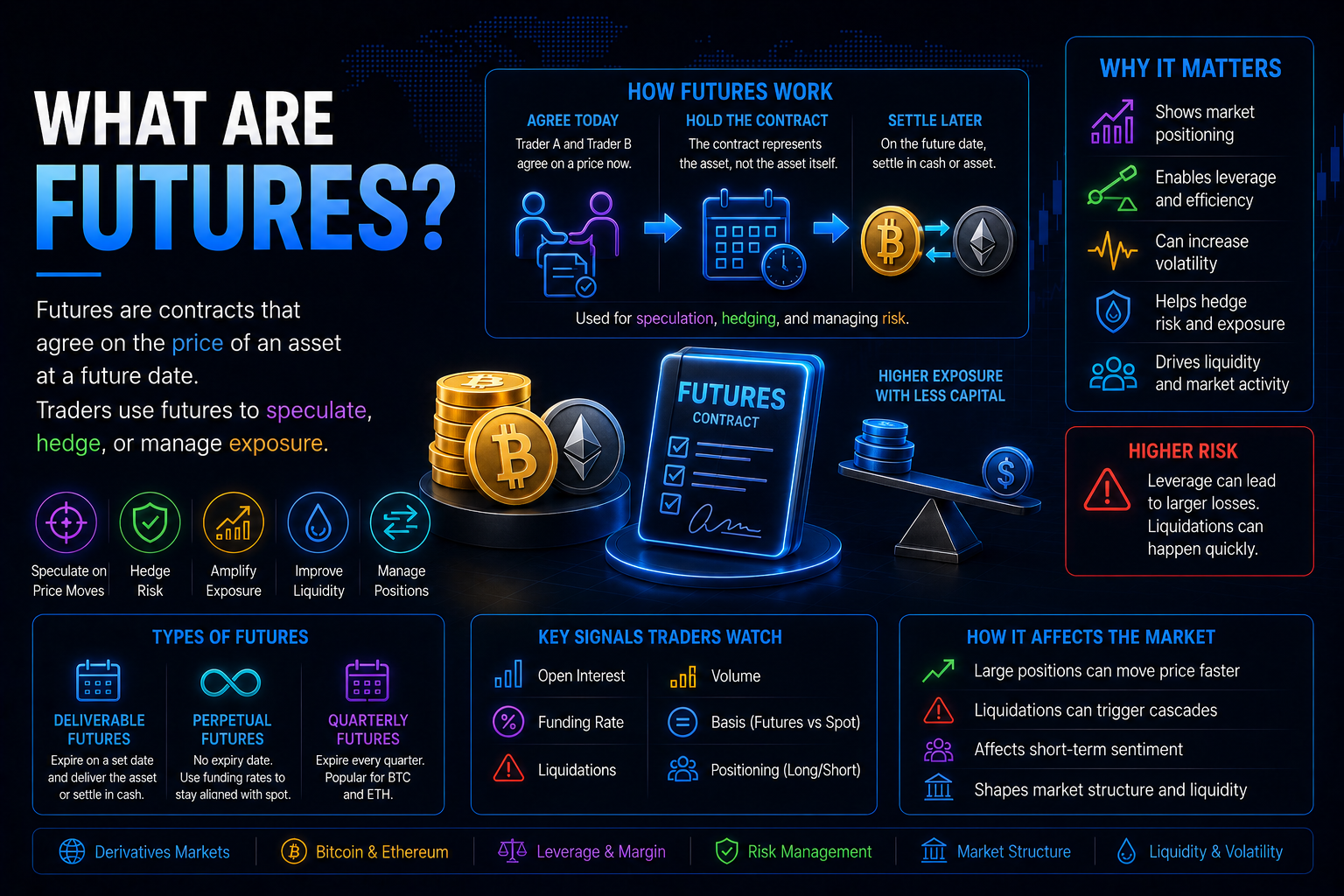
Futures are contracts that let traders agree to buy or sell an asset at a set price on a future date. Crypto traders watch futures because they can affect Bitcoin, Ethereum, liquidity, leverage, market sentiment, and short-term price pressure.
Simple definition
Futures are contracts that set terms for buying or selling an asset at a future date.
In crypto, futures usually let traders take a position on Bitcoin, Ethereum, or another asset without directly buying or selling the coin itself. Traditional futures expire on a set date. Perpetual contracts, commonly grouped with crypto futures, are derivatives designed to keep trading without a fixed expiry date.
Why futures matter
Futures matter because they can show how traders are positioned around price moves. They can also add leverage, which means traders may control a larger position than the cash they put down.
When futures activity is high, price moves may become sharper. Leveraged positions may need to be reduced, closed, or liquidated if the market moves against them.
How traders usually read it
Rising futures activity means there is more activity in the derivatives market. It can point to stronger attention, heavier positioning, or more speculation around a coin.
Futures activity is not automatically bullish or bearish. Traders usually read it alongside price action, funding rates where relevant, liquidations, open interest, volume, and broader market sentiment.
Why it matters for crypto
Crypto futures can matter because Bitcoin and Ethereum often have active derivatives markets. When futures positioning becomes crowded, a fast move can trigger liquidations and make the market feel more volatile.
Crypto traders may use futures as part of a broader market read, especially when BTC weakness, ETF flows, macro signals, liquidity, or risk appetite are also shaping the tape.
Futures are not a standalone signal
Futures should not be used as a complete market explanation by themselves. High futures activity does not always mean prices will move in one direction.
Futures are most useful when read alongside spot price action, open interest, funding rates where relevant, liquidations, volume, volatility, macro signals, and market structure.
Example in a market update
If Bitcoin falls while futures liquidations rise, traders may read the move as partly driven by leveraged positioning being forced out.
If Bitcoin holds steady while futures activity cools, traders may read the setup as calmer and less pressured by derivatives positioning.
Common signals traders watch
- Whether Bitcoin or Ethereum futures activity is rising or falling
- Whether open interest is expanding or shrinking
- Whether funding rates, where relevant, show crowded long or short positioning
- Whether liquidations are adding pressure to price moves
- Whether spot demand supports or disagrees with futures positioning
Key takeaway
Futures help traders understand derivatives positioning, but they should be read with price action, liquidity, volatility, and broader market context.
```
Comments (0)
Join the discussion
Sign in or create a free account to leave a comment.
No comments yet. Be the first to comment!