What Are Exchange Reserves?
What Are Exchange Reserves?
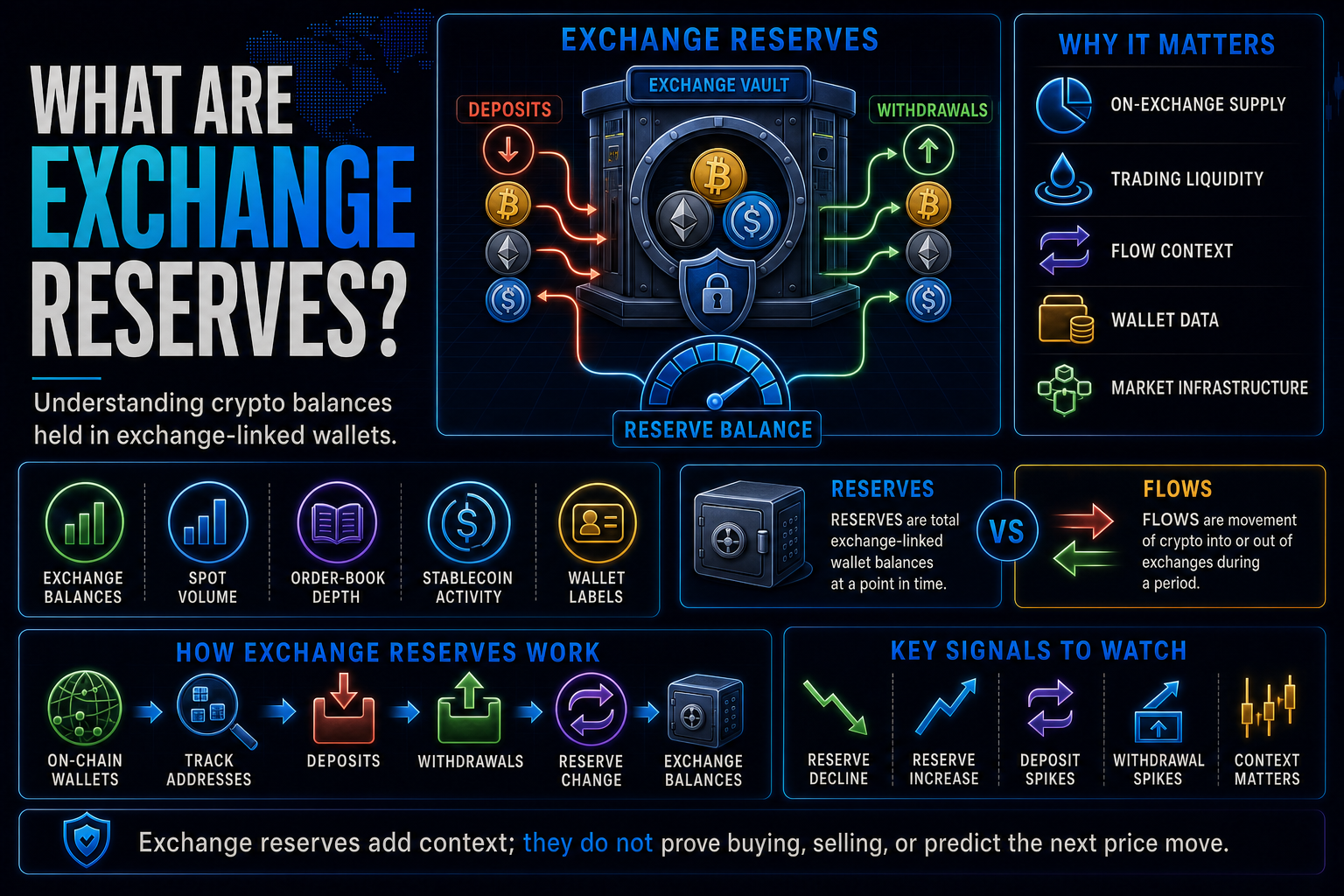
Exchange reserves are the amounts of cryptocurrency held in wallets associated with an exchange. Traders watch changes in these balances because they can show crypto moving onto or away from trading venues.
Simple definition
Exchange reserves are crypto balances held by exchange-linked wallets.
When assets move into exchange wallets, reserves may increase. When assets move out to private wallets, custodians, or other venues, reserves may decrease. Reserve data is usually estimated from addresses identified as belonging to an exchange.
Why exchange reserves matter
Exchange reserves matter because exchanges are major trading venues. Their balances can add context to the supply that is readily available on those venues and to the flow of assets between exchanges and other parts of the crypto ecosystem.
Increasing reserves may indicate that more assets are arriving at exchanges. Falling reserves may indicate that assets are moving away from them. Neither change proves that traders will sell, buy, or hold the assets.
How exchange reserves are tracked
On-chain data providers label clusters of addresses that are believed to belong to an exchange and estimate the combined balance of those addresses. They can then track deposits, withdrawals, and changes in the exchange's reserve over time.
The data is not perfect. Exchanges can reorganize wallets, move funds internally, use custodians, or add new addresses. These changes can affect reserve estimates without reflecting a change in customer demand.
How traders usually read them
Rising exchange reserves may be watched as a sign that more coins are available on trading venues. Falling reserves may be watched as a sign that more coins are leaving exchanges. Traders usually focus on a sustained pattern rather than one transfer.
They often compare reserve changes with spot volume, order-book liquidity, stablecoin balances, wallet activity, and broader market conditions to understand whether a flow is part of a wider trend.
Exchange reserves versus exchange flows
Exchange reserves are the total amount of an asset held in exchange-linked wallets at a point in time. Exchange flows are the deposits and withdrawals moving into and out of those wallets during a period.
Flows help explain how reserves change, while reserves show the resulting balance. Both are more useful when viewed over time and across multiple exchanges.
Why they matter for crypto
Public blockchain data makes it possible to estimate balances held by many exchanges, especially for assets such as Bitcoin and Ethereum. This gives traders a view of some market infrastructure that is not usually visible in traditional markets.
Reserve data does not capture every part of crypto liquidity. Derivatives venues, over-the-counter markets, custodians, cross-chain activity, and unlabelled wallets can all sit outside a particular reserve estimate.
Exchange reserves are not a standalone signal
Rising exchange reserves do not guarantee that price will fall, and falling reserves do not guarantee that it will rise. Funds can move for operational, custody, market-making, or portfolio-management reasons.
Exchange reserves are most useful when read alongside deposits and withdrawals, exchange volume, spot liquidity, stablecoin activity, wallet-label confidence, and price structure.
Example in a market update
If Bitcoin reserves on exchange-linked wallets are declining while spot demand is steady, a market update may note the lower reserve trend as one part of the supply context.
If exchange deposits increase during a volatile period, an update may describe the flow as additional liquidity to monitor while avoiding the assumption that those coins will be sold.
Common signals traders watch
- Exchange-linked wallet balances
- Deposits and withdrawals over time
- Spot trading volume and order-book liquidity
- Stablecoin balances and exchange activity
- Wallet labels and broader market context
Key takeaway
Exchange reserves are crypto balances held in exchange-linked wallets and can add useful context about on-exchange supply and asset flows.
Comments (0)
Join the discussion
Sign in or create a free account to leave a comment.
No comments yet. Be the first to comment!