What Are Exchange Flows?
What Do Exchange Flows Mean?
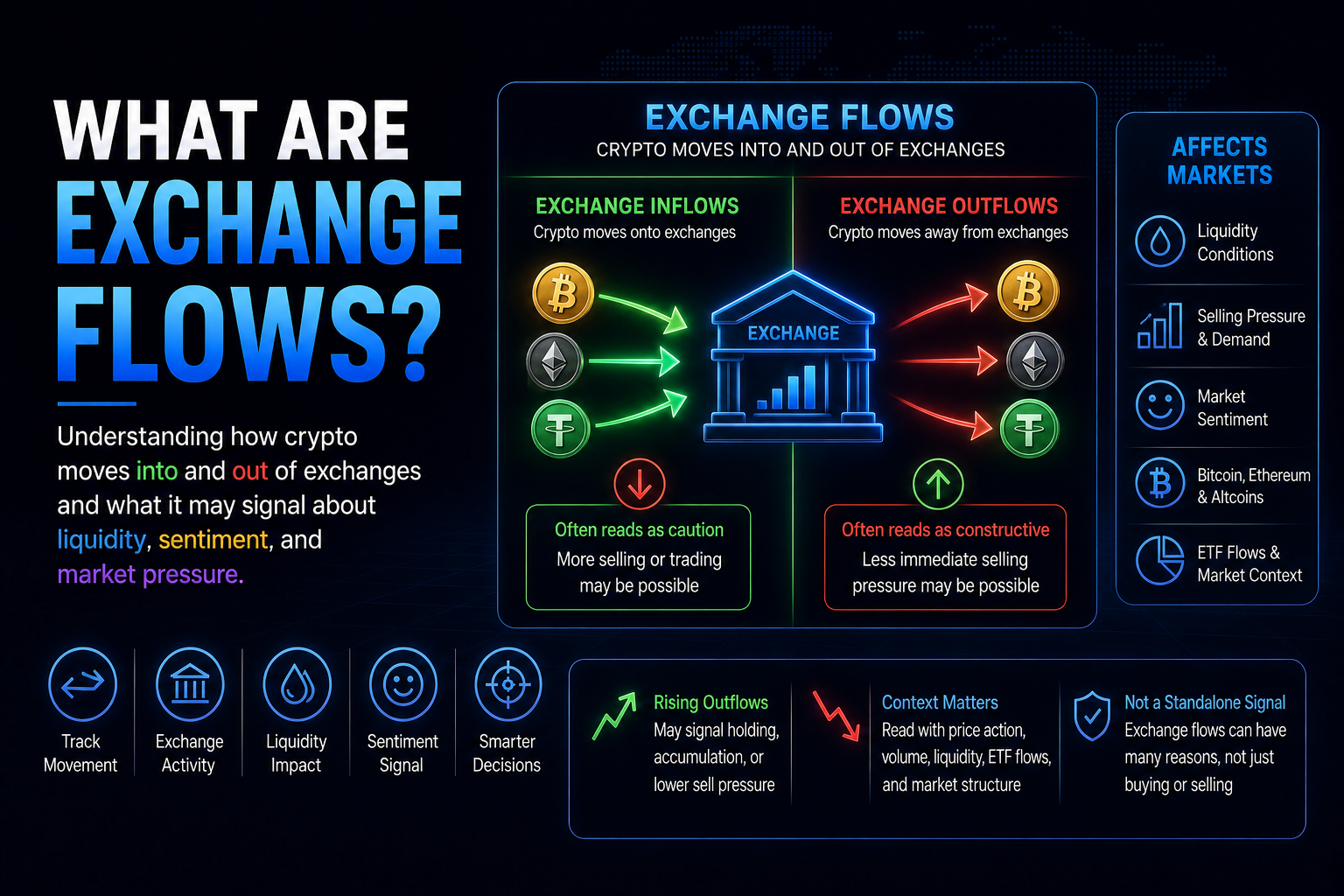
Exchange Flows describe how crypto moves into and out of exchanges. Crypto traders watch exchange flows because they can affect liquidity, sentiment, Bitcoin, Ethereum, altcoins, and broader market behavior.
Simple definition
Exchange Flows mean the movement of crypto assets into or out of exchanges.
There are two main types. Exchange inflows happen when crypto moves into exchanges. Exchange outflows happen when crypto moves away from exchanges.
Why Exchange Flows matters
Exchange Flows matter because exchanges are where many traders buy, sell, or move crypto. When assets move toward exchanges, traders may watch for possible selling pressure or active trading.
When assets move away from exchanges, traders may read it as possible holding, custody movement, or reduced immediate selling pressure. The meaning depends on the asset, the size of the flow, and the broader market context.
How traders usually read it
Exchange inflows are often read as a cautious signal because coins moving onto exchanges may be easier to sell or trade.
Exchange outflows are often read as more constructive because coins moving away from exchanges may suggest holding or custody. Still, exchange flows can also reflect internal transfers, wallet management, institutional custody, or routine operations.
Why it matters for crypto
Crypto can be sensitive to exchange flows because liquidity and sentiment can change quickly. Large flows in Bitcoin, Ethereum, stablecoins, or major altcoins may shape how traders read market strength or caution.
Crypto traders may use exchange flows as part of a broader read, especially when they appear alongside ETF flows, whale movement, Bitcoin dominance, price action, volatility, liquidity, and macro signals.
Exchange Flows are not a standalone signal
Exchange Flows should not be used as a standalone price signal. A large inflow does not guarantee selling, and a large outflow does not guarantee higher prices.
Exchange flows are most useful when read alongside price action, volume, liquidity, ETF flows, whale movement, Bitcoin dominance, volatility, and broader market sentiment.
Example in a market update
If Bitcoin is slipping and exchange inflows are rising, traders may read the market as more cautious because possible selling pressure is increasing.
If Bitcoin is stable and exchange outflows are rising, traders may read the setup as more constructive, though they would still look for confirmation from price action and liquidity.
Common signals traders watch
- Whether crypto is moving into or out of exchanges
- Whether the flow involves Bitcoin, Ethereum, stablecoins, or a specific altcoin
- Whether the movement is large compared with normal activity
- Whether price action and volume confirm the same message
- Whether ETF flows, whale movement, and market sentiment support or challenge the read
Key takeaway
Exchange Flows help traders understand how crypto is moving into and out of exchanges, but they should always be read with price action, liquidity, and broader market context.
Comments (0)
Join the discussion
Sign in or create a free account to leave a comment.
No comments yet. Be the first to comment!