What Is Event Risk?
What Is Event Risk?
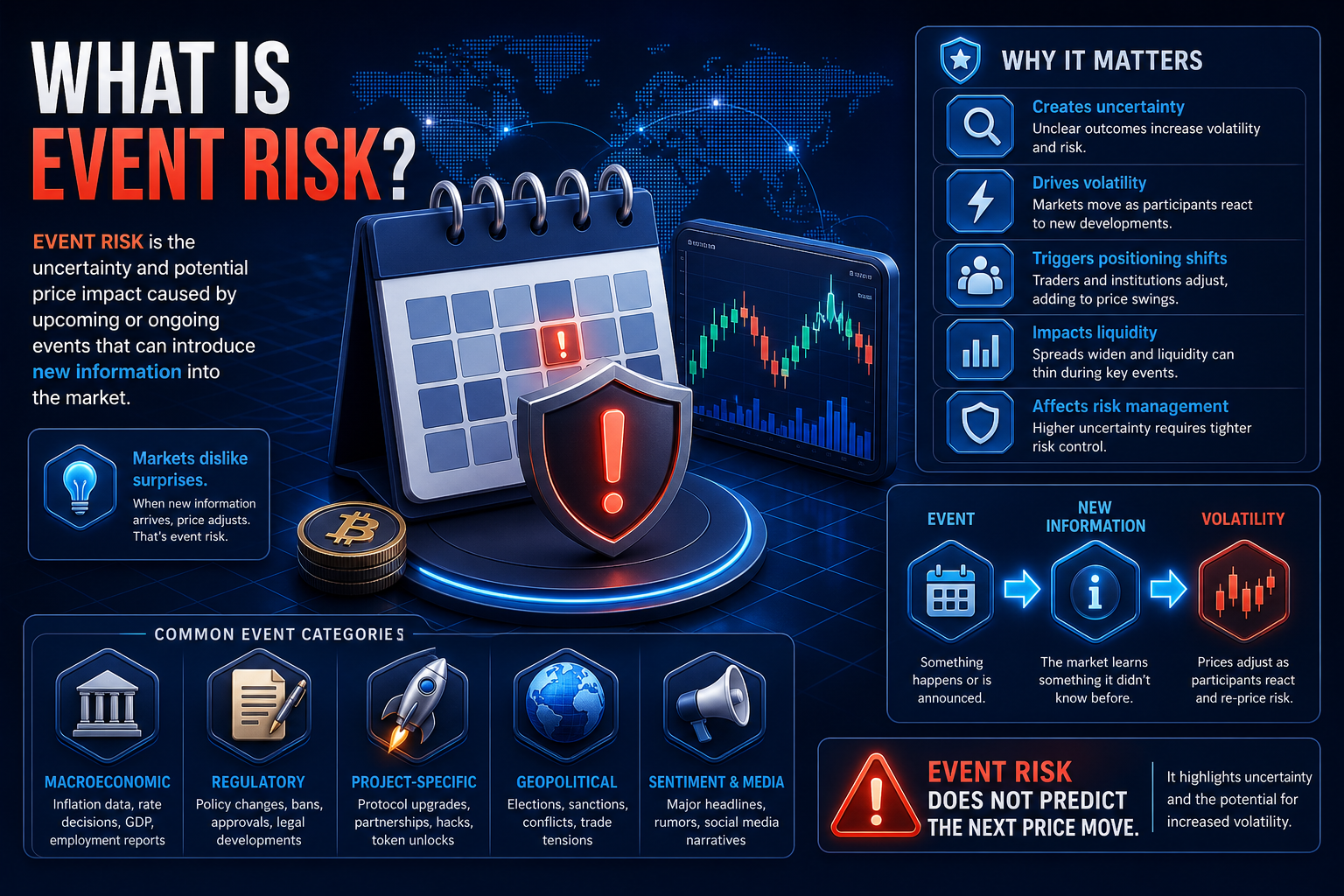
Event risk is the possibility that a scheduled or unexpected event changes market prices or risk conditions. In crypto, it can include policy announcements, economic releases, exchange developments, protocol events, or major global news.
Simple definition
Event risk is uncertainty around information that could change how participants value an asset or manage risk. The event may be known in advance, such as a data release, or appear without warning.
Why event risk matters
Before important events, liquidity may thin as participants wait for clarity. After an event, prices can move quickly if the result differs from expectations. Fast moves may widen spreads, trigger liquidations, and make short-term price action more variable.
How traders usually read it
Traders consider the likely outcomes, how the market is positioned, and what is already priced in. A result that seems positive or negative in isolation can still produce an opposite move if market expectations were more extreme.
Why it matters for crypto
Crypto trades continuously and can react rapidly to global and industry-specific news. Derivatives leverage and uneven liquidity can amplify a reaction, especially when an event arrives during already stressed market conditions.
Event risk is not a standalone signal
Knowing that an event is coming does not reveal its result or the market response. Event risk is most useful as a risk-management concept, read alongside volatility, liquidity, positioning, and confirmation from price action.
Common signals people watch
- The event calendar and available information
- Market expectations and positioning
- Implied and realized volatility
- Liquidity near key price levels
- Price and volume reaction after the event
Reading the wider context
The important question is often how the outcome compares with what was expected, rather than whether it appears positive or negative by itself. A market may already have priced in a likely result. The response across volume, liquidity, derivatives, and related assets can add context around whether a reaction is broad or short-lived.
Key takeaway
Event risk is the potential for new information to change market prices or risk conditions. It highlights uncertainty and preparation, not a guaranteed direction.
Comments (0)
Join the discussion
Sign in or create a free account to leave a comment.
No comments yet. Be the first to comment!