What Are ETF Outflows?
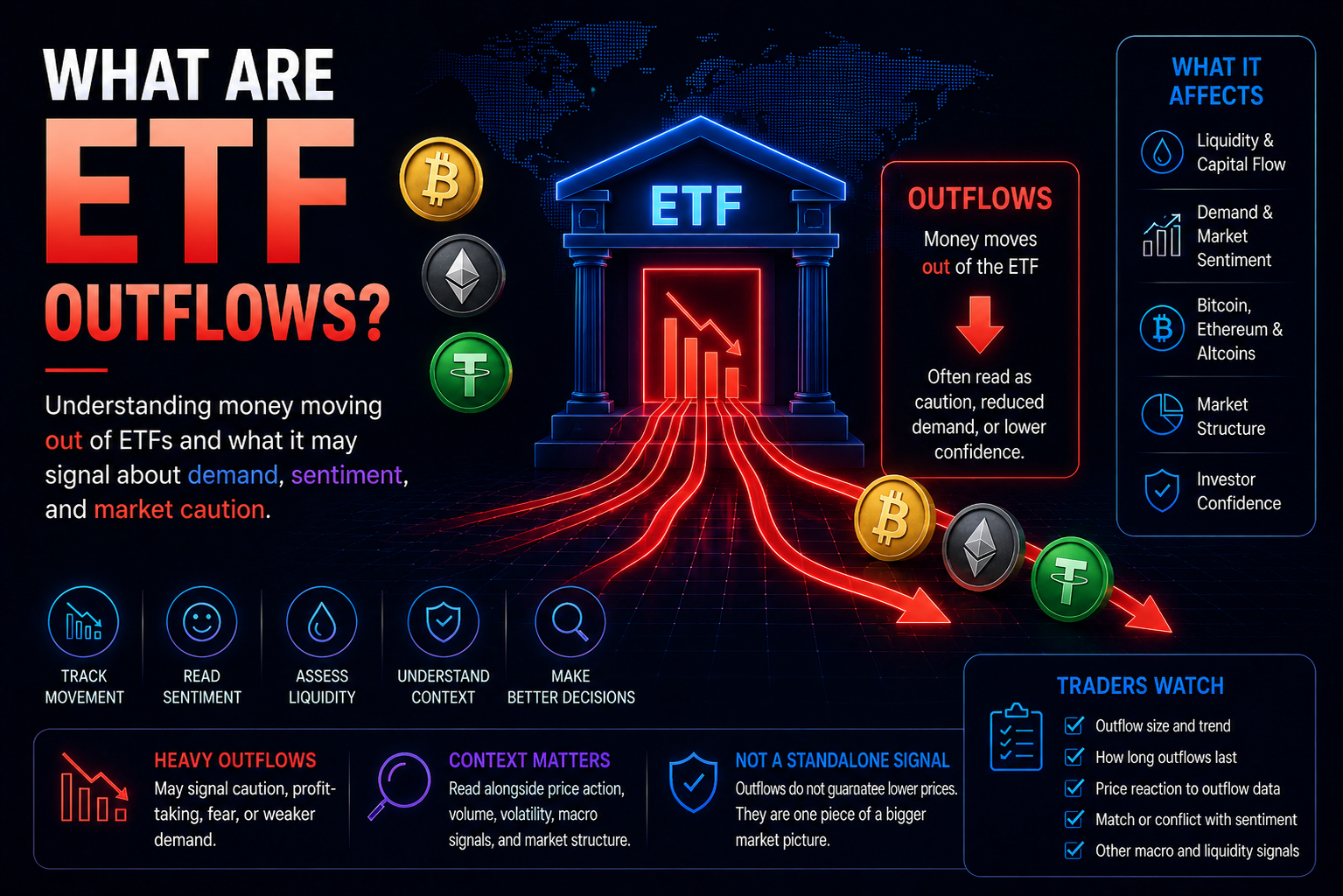
What Do ETF Outflows Mean?
ETF Outflows show when money is moving out of an exchange-traded fund. Crypto readers watch ETF Outflows because they can help explain demand, sentiment, liquidity, Bitcoin, Ethereum, and broader market behavior.
Simple definition
ETF Outflows mean more money is leaving an ETF than entering it during a specific period.
An ETF is a fund that trades on an exchange. When investors reduce exposure and money leaves the fund, traders describe that movement as an outflow.
Why ETF Outflows matter
ETF Outflows matter because they can show whether investors are reducing exposure through a regulated market product.
Heavy outflows may suggest caution, profit-taking, fear, or weaker demand. Smaller or fading outflows may suggest that selling pressure is easing, but the meaning always depends on context.
How traders usually read it
ETF Outflows are usually read as cautious because they suggest money is leaving the fund.
The meaning is not always simple. Outflows can reflect fear, rebalancing, profit-taking, reduced demand, or short-term positioning, so traders usually compare them with price action and broader market signals.
Why it matters for crypto
ETF Outflows matter for crypto because spot Bitcoin ETFs and other crypto-related funds can connect traditional market demand with crypto market behavior.
Crypto traders may use ETF Outflows as part of a broader read alongside Bitcoin price action, Ethereum, BTC dominance, liquidity, VIX, Treasury yields, the U.S. dollar, and market sentiment.
ETF Outflows are not a standalone signal
ETF Outflows should not be used as a complete market signal by themselves. Outflows do not guarantee that prices will keep falling.
ETF Outflows are most useful when read alongside price action, volume, volatility, liquidity, Bitcoin dominance, macro signals, ETF inflows, and broader market structure.
Example in a market update
If Bitcoin is falling while spot Bitcoin ETF outflows are heavy, traders may read ETF Outflows as a sign of weaker demand or more cautious sentiment.
If Bitcoin is holding steady while ETF Outflows remain heavy, traders may read the setup as mixed because price is stable while fund demand looks weaker.
Common signals traders watch
- Whether ETF Outflows are rising or fading
- Whether outflows continue for several days
- Whether Bitcoin or Ethereum weakens after outflow data
- Whether ETF Outflows match or conflict with broader market sentiment
- Whether liquidity, volatility, and macro signals support the same market read
Key takeaway
ETF Outflows help traders understand when money is leaving ETF products, which can shape demand, sentiment, liquidity, and crypto market interpretation.
Comments (0)
Join the discussion
Sign in or create a free account to leave a comment.
No comments yet. Be the first to comment!