What Does ETF Demand Mean?
What Does ETF Demand Mean?
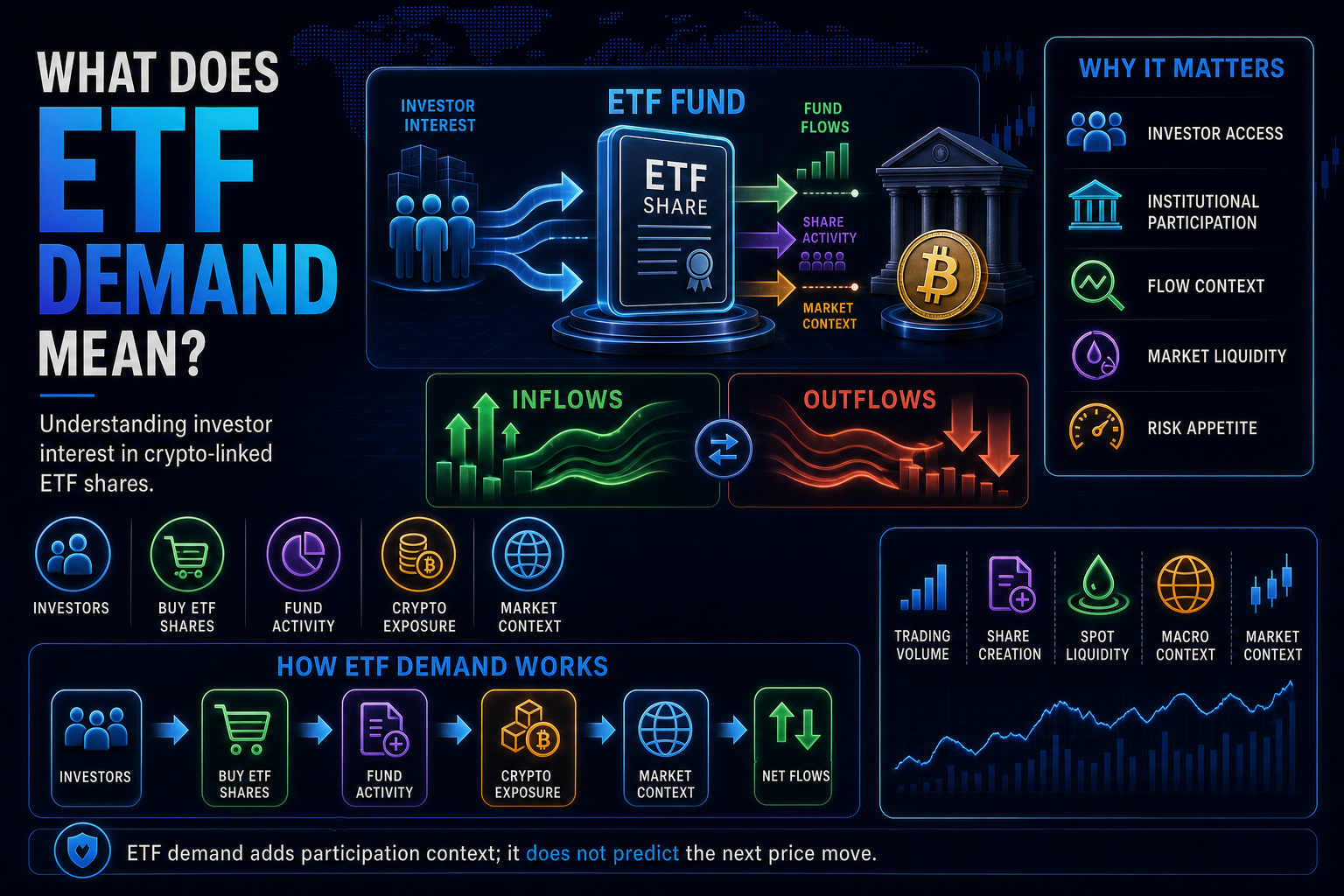
ETF demand describes investor interest in buying shares of an exchange-traded fund. In crypto market updates, it often refers to interest in crypto-linked ETFs and the fund flows, trading activity, or share creation and redemption activity that may accompany it.
Simple definition
ETF demand is the level of buying interest for an exchange-traded fund.
When investors buy ETF shares, demand may be reflected in market trading, net fund inflows, or the creation of new shares. When investors sell or withdraw capital, the opposite may be seen through outflows or redemptions.
Why ETF demand matters
ETF demand matters because ETFs can give investors a familiar route to gain exposure to an asset without directly managing it. For crypto-linked ETFs, the activity can help show whether participation is growing, easing, or remaining selective.
It can also provide context for institutional participation. That context is useful, but it does not show every investor's reason for buying or selling.
How ETF demand is measured
Traders often look at net inflows and outflows, which compare money entering an ETF with money leaving it over a selected period. They may also watch trading volume, assets under management, and whether fund shares are being created or redeemed.
Each measure tells a slightly different story. High trading volume can reflect active exchange trading, while net flows may better describe whether capital is entering or leaving the fund overall.
How traders usually read it
Sustained ETF inflows are often read as a sign of continued investor participation. Sustained outflows may be read more cautiously because they can suggest investors are reducing exposure or reallocating capital.
Short-term flow changes can be noisy, however. Traders usually compare ETF demand with price action, broader market liquidity, macro conditions, and sentiment rather than treating one day of activity as decisive.
Why it matters for crypto
Crypto-linked ETFs can connect traditional market participants with Bitcoin or other crypto-related exposure. Their demand may therefore be one useful view of participation from the ETF market alongside activity on crypto exchanges.
ETF demand does not represent all crypto demand. Direct spot buying, derivatives activity, stablecoin liquidity, and on-chain behavior can all shape market conditions differently.
ETF demand is not a standalone signal
Strong ETF demand does not guarantee that crypto prices will rise, and weak demand does not guarantee they will fall. Market prices respond to many factors, including liquidity, positioning, macro conditions, and changes in risk appetite.
ETF activity is most useful when read alongside the size and persistence of flows, spot price structure, trading volume, derivatives positioning, and wider market context.
Example in a market update
If crypto-linked ETFs are recording steady net inflows while Bitcoin price action is stable, a market update may describe ETF demand as supportive participation context.
If ETF outflows appear while broader trading conditions are cautious, an update may note that investors are watching whether the softer demand persists or changes alongside market liquidity.
Common signals traders watch
- Net ETF inflows and outflows
- ETF trading volume and share turnover
- Share creations and redemptions
- Bitcoin price action and spot-market liquidity
- Broader risk appetite and macro conditions
Key takeaway
ETF demand shows investor interest in buying ETF shares and can add useful context about participation in crypto-linked funds.
Comments (0)
Join the discussion
Sign in or create a free account to leave a comment.
No comments yet. Be the first to comment!