What Does Equity Risk Mean?
What Does Equity Risk Mean?
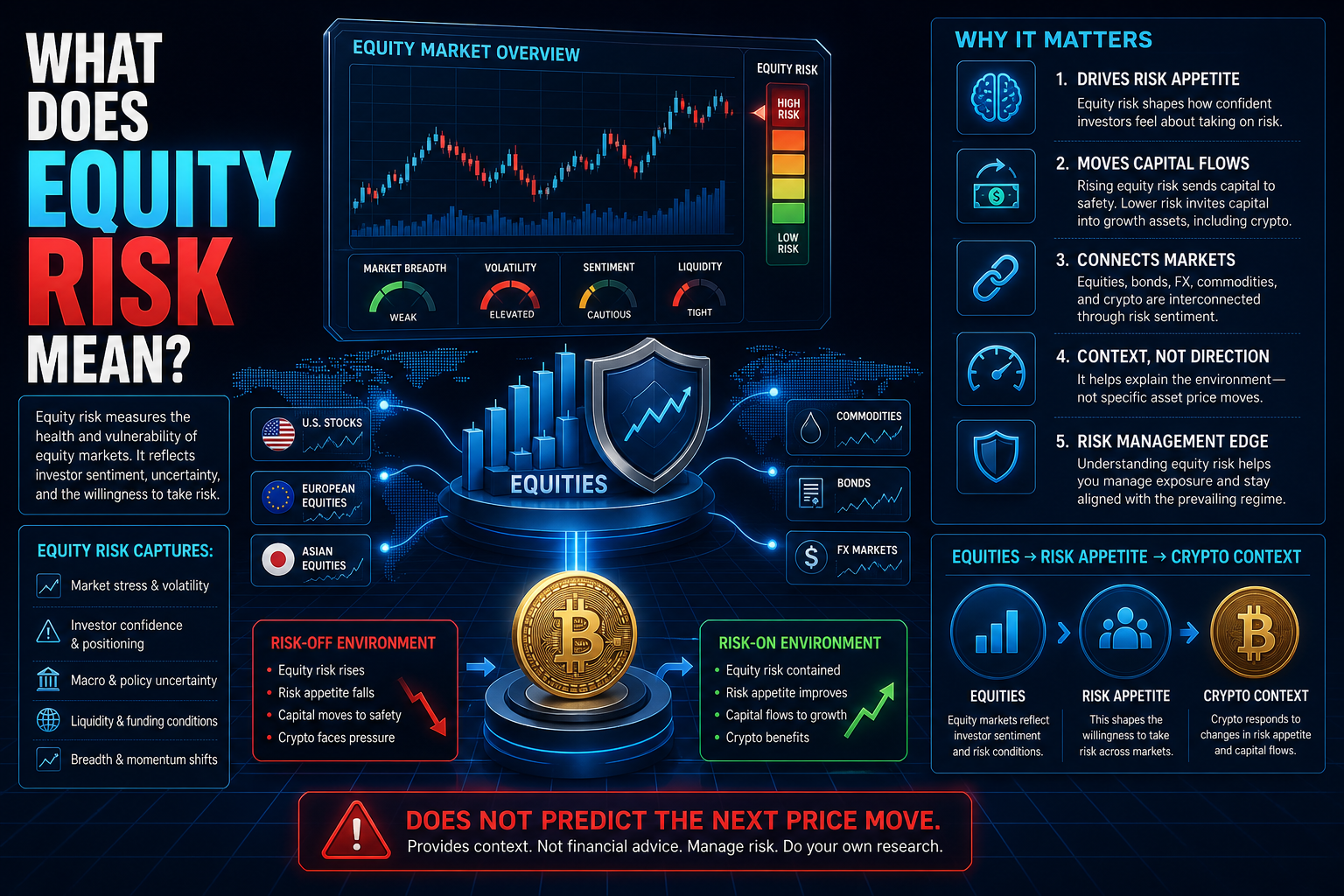
Equity risk is the possibility that stock prices decline or fluctuate because of changes in company earnings, the economy, interest rates, sentiment, or other market conditions. Crypto traders monitor it because equities can shape broader risk appetite.
Simple definition
Equity risk describes the uncertainty associated with owning stocks. A share price can change for reasons connected to an individual company, an industry, or the wider market. It is broader than any single index move.
Why equity risk matters
Stocks are a major part of global risk markets. When investors become more cautious about growth, rates, earnings, or liquidity, equity-market volatility can rise and influence positioning across other assets. The effect varies with the underlying cause.
How markets usually read it
Rising equity risk may appear through falling indexes, greater volatility, weaker cyclical sectors, or stronger demand for defensive assets. It is important to distinguish a short-term price pullback from a broader change in financial conditions or risk appetite.
Why it matters for crypto
Crypto can sometimes trade as a higher-volatility risk asset, especially when macro conditions drive markets. That relationship is not constant: ETF flows, network developments, regulation, and crypto liquidity can cause crypto to diverge from equities.
Equity risk is not a standalone signal
An equity-market move does not automatically determine crypto direction. Traders compare it with bond yields, the dollar, volatility, crypto flows, and price structure instead of treating it as a forecast.
Common signals people watch
- Broad equity-index performance
- Market volatility measures
- Sector leadership and breadth
- Bond yields and dollar strength
- Crypto relative performance and flows
Reading the wider context
Equity risk can come from different sources, including earnings, growth concerns, inflation, valuations, or changes in policy expectations. Those causes can produce different cross-market effects. Looking at market breadth, volatility, rates, and the reasons behind the move provides more useful context than an index change by itself.
Key takeaway
No single market captures the full situation. Comparing equities with rates, currencies, liquidity, and crypto participation helps separate a temporary reaction from a broader change in risk appetite.
For that reason, readers often focus on the evolving backdrop rather than using an equity move as a one-step explanation for crypto behavior. The durability of the reaction, market breadth, and confirmation across rates and currencies can provide useful context.
Equity risk describes uncertainty in stock markets and can influence the wider risk environment. It is valuable crypto context, not a direct trading signal.
Comments (0)
Join the discussion
Sign in or create a free account to leave a comment.
No comments yet. Be the first to comment!