What Does Derivatives Positioning Mean?
What Does Derivatives Positioning Mean?
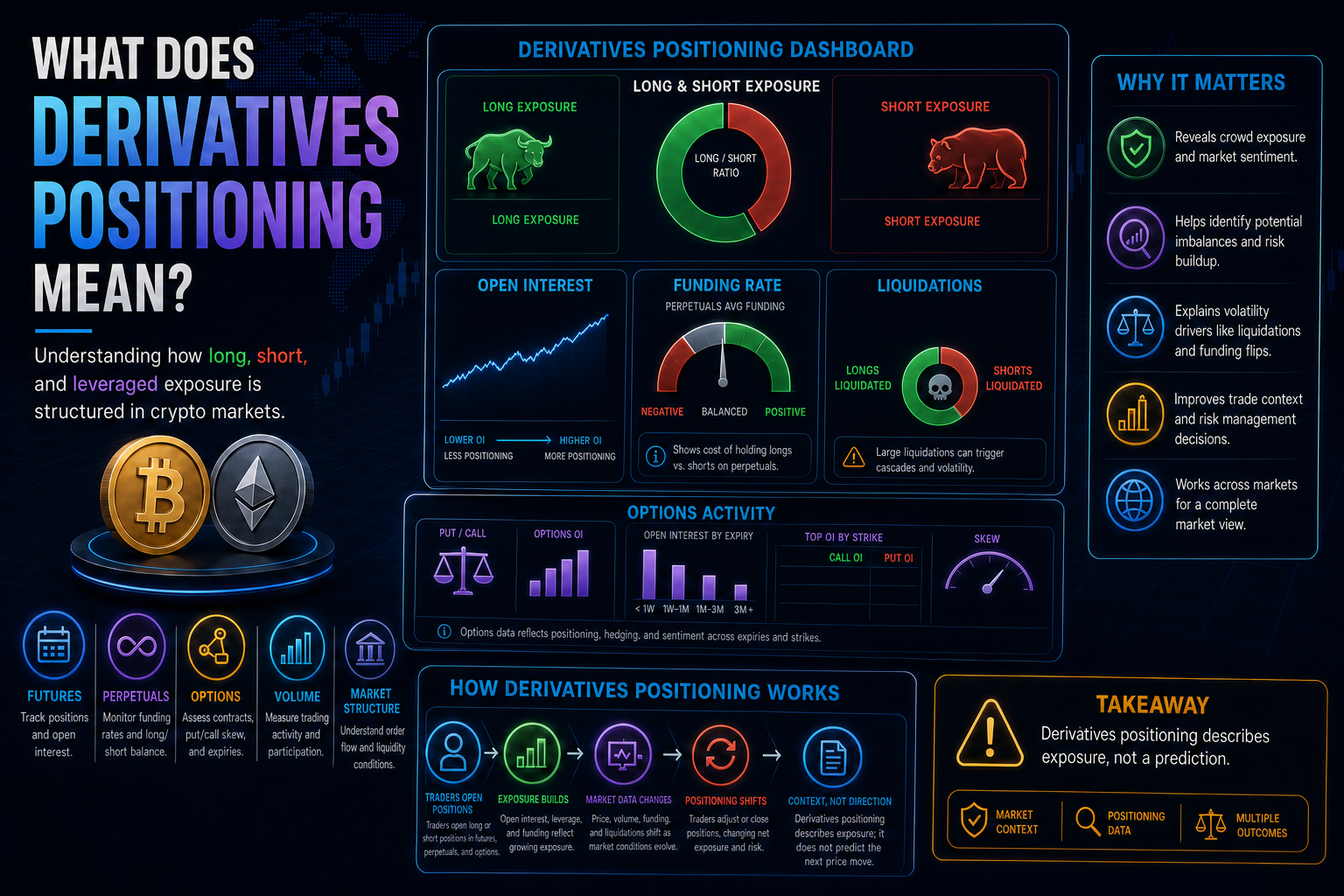
Derivatives positioning describes how traders are positioned in markets such as futures, perpetual futures, and options. In crypto, the term can refer to the balance of long and short exposure, the amount of leverage in use, and how open interest and funding conditions are changing.
Simple definition
Derivatives positioning is the overall way traders are set up in leveraged and derivatives markets.
It does not show every individual trade. Instead, traders use available market data to build a picture of whether exposure appears more concentrated in long positions, short positions, options strategies, or other derivatives activity.
Why derivatives positioning matters
Derivatives positioning matters because it can affect how a market reacts when price moves. A large amount of leveraged exposure on one side of the market may increase the chance of faster buying or selling if traders need to close positions.
Positioning can also help explain why price, volume, and open interest are moving together or in different directions. It is a way to add context to the derivatives backdrop, not a forecast.
Common parts of derivatives positioning
Open interest shows the amount of outstanding derivatives contracts. Funding rates in perpetual futures can reflect the relative cost of holding long or short exposure. Liquidation data may show when leveraged positions are being closed quickly.
Options data, futures basis, and volume can add more detail. Each measure has limits, so they are usually read together rather than as a single answer about market direction.
How traders usually read it
Traders often compare derivatives positioning with current price action. For example, rising price with rising open interest can be read differently from rising price with falling open interest, which may reflect position closures rather than new exposure.
They may also look at whether funding is positive or negative, whether liquidations are concentrated on one side, and whether price is near an important support or resistance area.
Derivatives positioning versus market sentiment
Derivatives positioning describes activity and exposure in derivatives markets. Market sentiment is a broader idea about how optimistic, cautious, or uncertain market participants feel.
The two can be related, but they are not the same. A bullish-looking derivatives setup does not guarantee bullish sentiment or a higher price, and the reverse is also true.
Why derivatives positioning matters in crypto
Crypto markets have active perpetual futures and options markets, especially for Bitcoin and Ethereum. Positioning data can help explain why a move is becoming faster, why volatility is increasing, or why a market is becoming more sensitive around a key level.
Altcoin derivatives activity can also provide context, although liquidity and data availability may be less consistent than in larger assets.
Derivatives positioning is not a standalone signal
Derivatives positioning does not predict the next price direction. It describes the structure of exposure in a market that can change quickly.
It is most useful when read alongside spot price action, market structure, volume, liquidity, macro conditions, and the wider market environment.
Example in a market update
If Bitcoin rises while open interest and funding both increase, a market update may say that derivatives positioning is becoming more active on the long side.
If Ethereum falls as open interest declines and liquidations rise, an update may describe the derivatives market as reducing long exposure.
Common signals traders watch
- Changes in open interest
- Funding rates in perpetual futures
- Long and short liquidations
- Futures volume and basis
- Options activity and key price levels
Key takeaway
Derivatives positioning shows how exposure is structured in futures and options markets, helping explain market pressure without predicting the next price move.
Comments (0)
Join the discussion
Sign in or create a free account to leave a comment.
No comments yet. Be the first to comment!