What Are Derivatives in Crypto?
What Are Derivatives in Crypto?
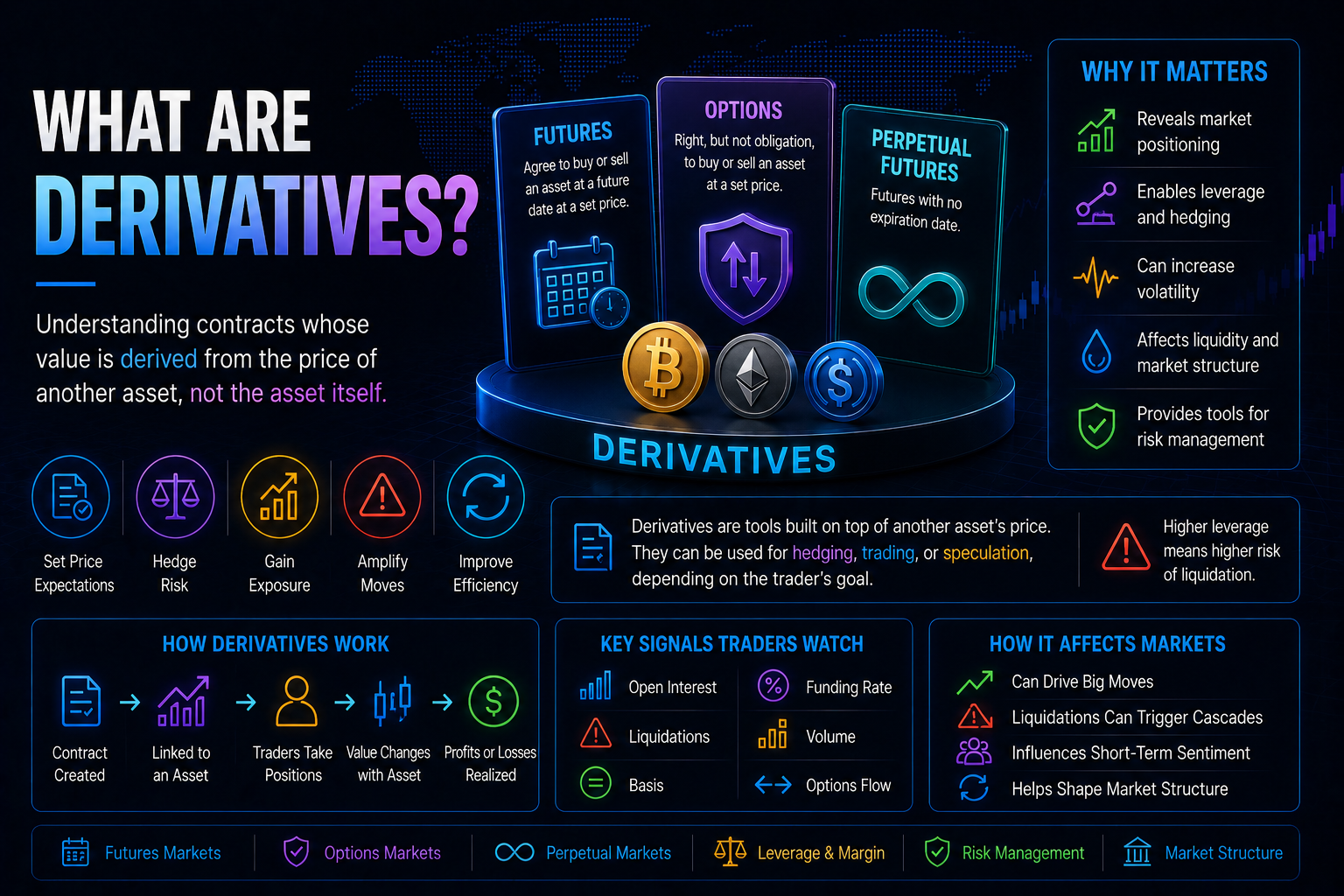
Derivatives are financial contracts whose value comes from another asset, index, or reference rate, such as Bitcoin, Ethereum, a stock index, or a commodity. Crypto traders watch derivatives because they can affect leverage, liquidations, funding rates for perpetual contracts, open interest, volatility, liquidity, and broader market structure.
Simple definition
Derivatives are contracts that get their value from the price or value of another asset, index, or reference rate.
Instead of directly buying or selling the asset itself, traders use a contract linked to that asset. Common examples include futures, options, swaps, and perpetual contracts.
Why derivatives matter
Derivatives matter because they can show how traders are positioning around price moves, risk, and volatility.
When derivatives activity rises, it can affect market behavior. More leverage can make price moves sharper, especially if many traders are forced to close positions at the same time.
How traders usually read it
High derivatives activity usually means traders are actively using contracts to express views, hedge risk, or manage exposure.
That can be bullish, bearish, or neutral depending on the context. Derivatives data should usually be read alongside price action, volume, open interest, funding rates for perpetual contracts, and liquidations.
Why it matters for crypto
Crypto derivatives are important because Bitcoin, Ethereum, and major altcoins often have active futures, options, and perpetual-contract markets.
Crypto traders may use derivatives as part of a broader market read, especially when leverage is high, liquidations are rising, funding rates for perpetual contracts are stretched, or volatility is increasing.
Derivatives are not a standalone signal
Derivatives should not be used as a complete market explanation by themselves. A busy derivatives market does not automatically mean prices will rise or fall.
Derivatives are most useful when read alongside spot demand, ETF flows, liquidity, macro signals, market sentiment, Bitcoin dominance, and broader market structure.
Example in a market update
If Bitcoin is falling while liquidations are rising and open interest is dropping, traders may read derivatives pressure as part of a leverage reset.
If Bitcoin is steady while derivatives activity grows and funding rates for perpetual contracts remain balanced, traders may read the setup as active but not necessarily overheated.
Common signals traders watch
- Whether open interest is rising or falling
- Whether funding rates for perpetual contracts are calm or stretched
- Whether long or short liquidations are increasing
- Whether futures, options, and perpetual-contract activity is affecting market structure
- Whether spot price action confirms or rejects the derivatives signal
Key takeaway
Derivatives help traders understand positioning, leverage, volatility, and market structure, but they should always be read in context.
```
Comments (0)
Join the discussion
Sign in or create a free account to leave a comment.
No comments yet. Be the first to comment!