What Does Defensive Positioning Mean?
What Does Defensive Positioning Mean?
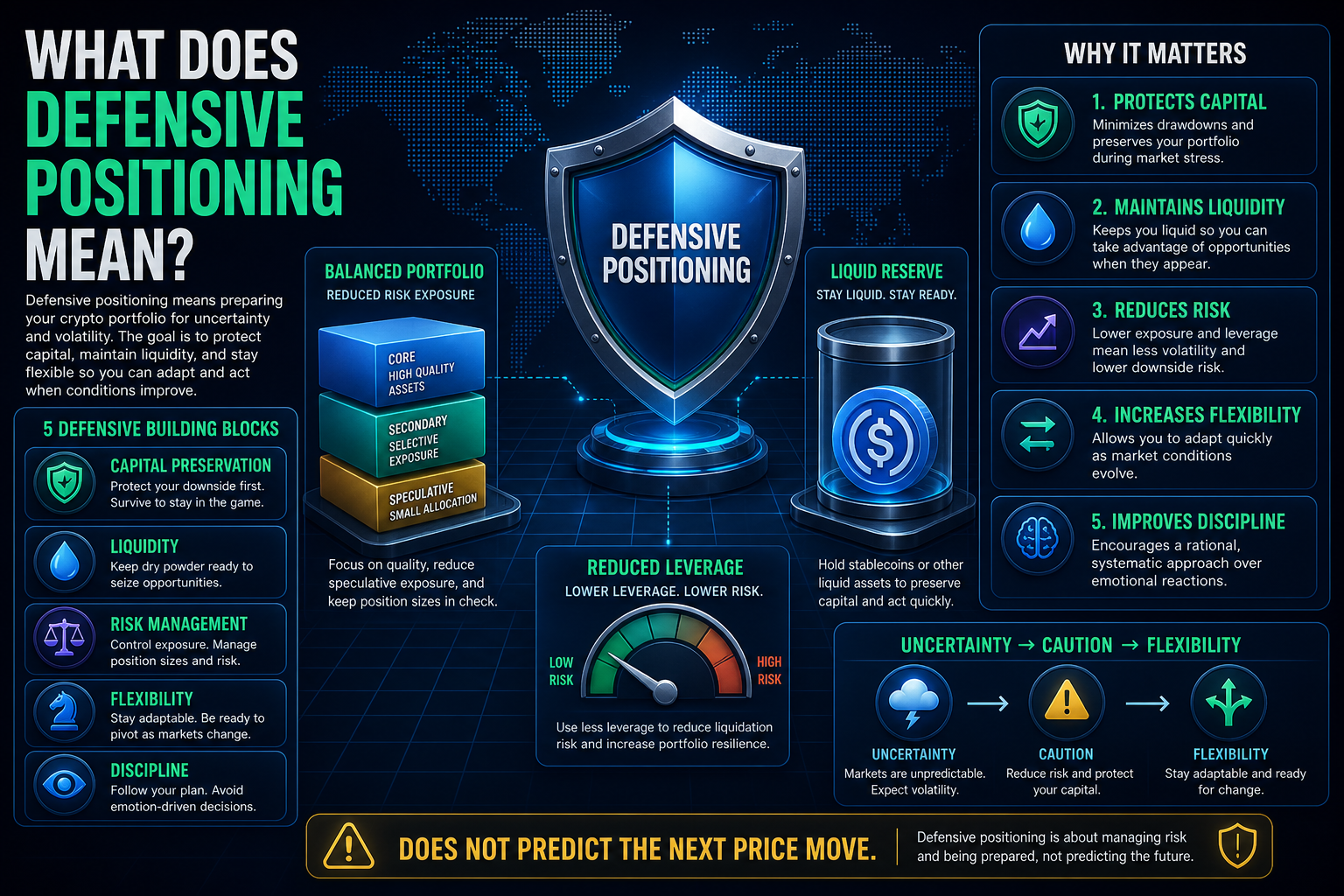
Defensive positioning means arranging a portfolio or trading exposure to reduce sensitivity to uncertainty and large market swings. It usually reflects caution, not a certainty that prices will fall.
Simple definition
Defensive positioning is a shift toward lower-risk exposure, more liquidity, reduced leverage, or assets perceived as more resilient. What counts as defensive depends on the investor, market conditions, and time horizon.
Why it matters
When uncertainty rises, participants may prioritize capital protection over seeking the highest return. This can affect asset allocation, trading volume, borrowing demand, and the willingness to hold more volatile assets.
How markets usually read it
Defensive behavior may appear through lower leverage, flows into cash-like assets, weaker performance in risk-sensitive sectors, or demand for hedges. It is a market condition rather than a simple buy-or-sell instruction.
Why it matters for crypto
Crypto is often treated as a higher-volatility asset class, so defensive positioning can reduce participation or concentrate liquidity in larger assets and stablecoins. However, crypto-specific catalysts can still create moves that differ from traditional markets.
Defensive positioning is not a standalone signal
Caution can persist while markets rise, and a market can reverse before positioning changes are visible. Traders combine positioning with price structure, macro data, liquidity, and confirmation rather than using it to forecast direction.
Common signals people watch
- Leverage and derivatives positioning
- Stablecoin and cash-like demand
- Relative strength across assets
- Volatility and liquidity conditions
- Bond, dollar, and equity-market behavior
Reading the wider context
Defensive positioning has degrees: participants may simply reduce leverage, favor larger liquid assets, or hold more readily available reserves. It can also coexist with selective risk-taking. Looking at several indicators over time helps distinguish a broad market shift from temporary caution around a particular event.
Key takeaway
This is why defensive behavior is best understood as a spectrum. It may become more visible during volatile periods, but it can also reflect routine portfolio discipline and changing objectives.
No single positioning measure captures the full situation. Comparing price action, liquidity, and participation over time helps separate temporary caution from a broader market condition.
For that reason, readers often focus on the evolving backdrop rather than using positioning as a one-step explanation for market behavior. The durability of the change, price confirmation, and liquidity conditions can all provide useful context.
Defensive positioning reflects an effort to reduce exposure to uncertainty. It helps describe market behavior but does not predict the next price move.
Comments (0)
Join the discussion
Sign in or create a free account to leave a comment.
No comments yet. Be the first to comment!