What Are Defensive Assets?
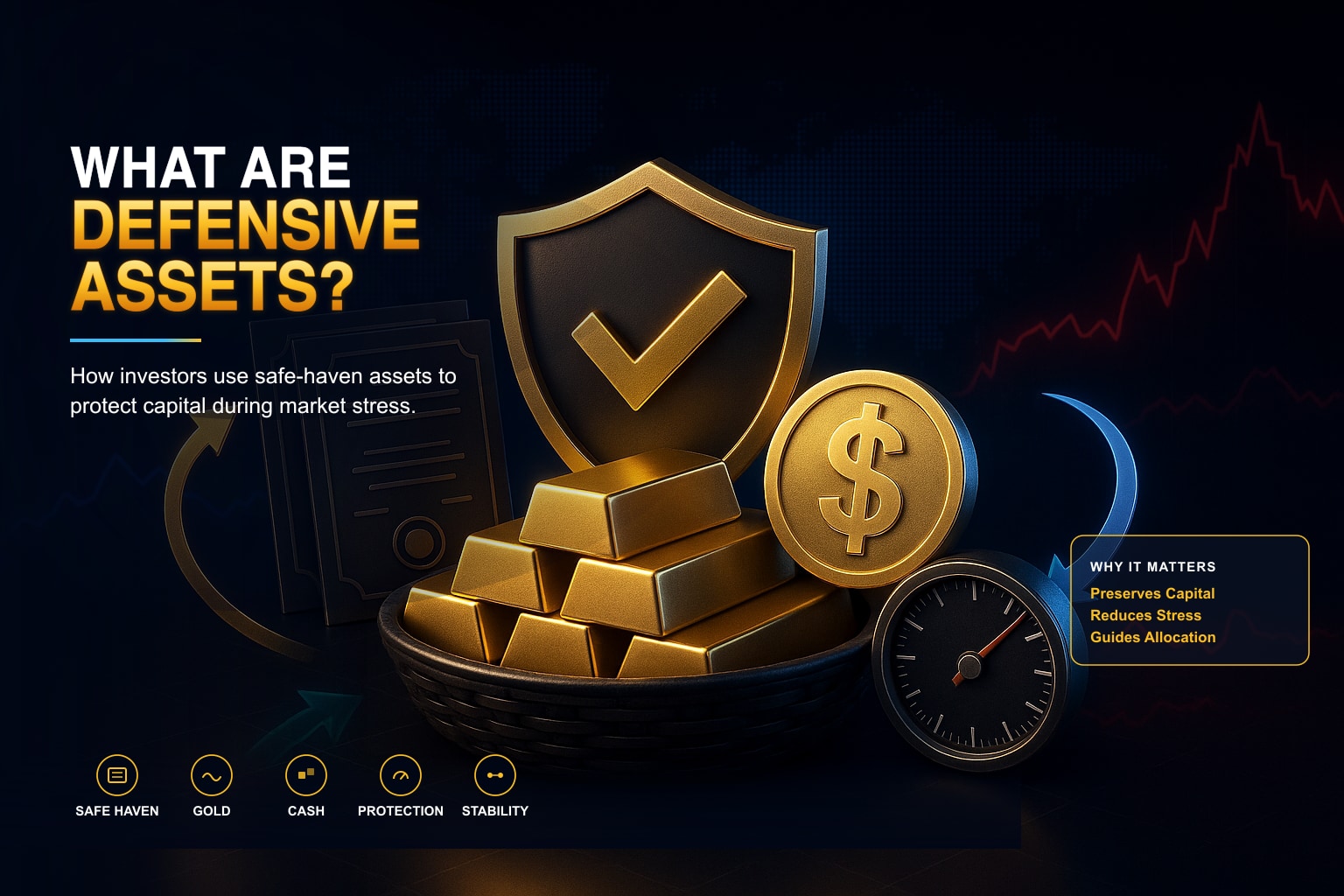
What Are Defensive Assets in Markets?
Defensive assets are assets traders may watch when markets feel uncertain or risk appetite weakens. Crypto readers watch defensive assets because they can help explain shifts in market sentiment, liquidity, Bitcoin, Ethereum, stablecoins, and broader risk behavior.
Simple definition
Defensive assets are assets that traders usually expect to hold up better when markets become more cautious.
They are not guaranteed to rise during stress. The idea is that defensive assets may be viewed as more stable, more liquid, or less sensitive to risk appetite than higher-risk assets.
Why defensive assets matters
Defensive assets matter because they can show how investors are positioning when confidence changes. When traders move toward defensive assets, it may suggest they are becoming more careful.
This can affect how markets read equities, bond yields, the U.S. dollar, gold, stablecoins, and crypto. A defensive shift often means traders are watching risk more closely instead of chasing broad upside.
How traders usually read it
Rising demand for defensive assets is usually read as a cautious or risk-off signal.
Falling demand for defensive assets can suggest traders are more willing to hold risk assets. The meaning depends on context because defensive flows can be driven by macro data, volatility, policy headlines, liquidity, or short-term positioning.
Why it matters for crypto
Crypto can react when traders move toward or away from defensive assets because Bitcoin, Ethereum, and altcoins often depend on risk appetite. If investors become more defensive, crypto participation may become more selective.
Crypto traders may watch defensive assets alongside ETF flows, stablecoin balances, Bitcoin dominance, VIX, Treasury yields, the U.S. dollar, liquidity, and market structure to understand whether the market is leaning cautious or constructive.
Defensive assets are not a standalone signal
Defensive assets should not be used alone to explain every market move. A shift toward defensive assets can show caution, but it does not automatically mean Bitcoin, Ethereum, or altcoins must fall.
They are most useful when read alongside price action, volume, volatility, ETF flows, macro signals, liquidity, Bitcoin dominance, and broader market sentiment.
Example in a market update
If the U.S. dollar is strengthening, VIX is rising, and Bitcoin is fading, traders may say demand for defensive assets is increasing.
If equities are firm, VIX is falling, and Bitcoin is holding higher levels, traders may read the market as moving away from defensive positioning and toward more risk appetite.
Common signals traders watch
- Whether the U.S. dollar is strengthening or weakening
- Whether VIX is rising or falling
- Whether traders are moving into or out of risk assets
- Whether Bitcoin and Ethereum are holding up during cautious market conditions
- Whether stablecoins, ETF flows, and liquidity signals show caution or confidence
Key takeaway
Defensive assets help traders understand when markets are becoming more cautious, but they should always be read alongside volatility, liquidity, macro signals, ETF flows, and crypto market structure.
Comments (0)
Join the discussion
Sign in or create a free account to leave a comment.
No comments yet. Be the first to comment!