What Is Counterparty Risk?
What Is Counterparty Risk?
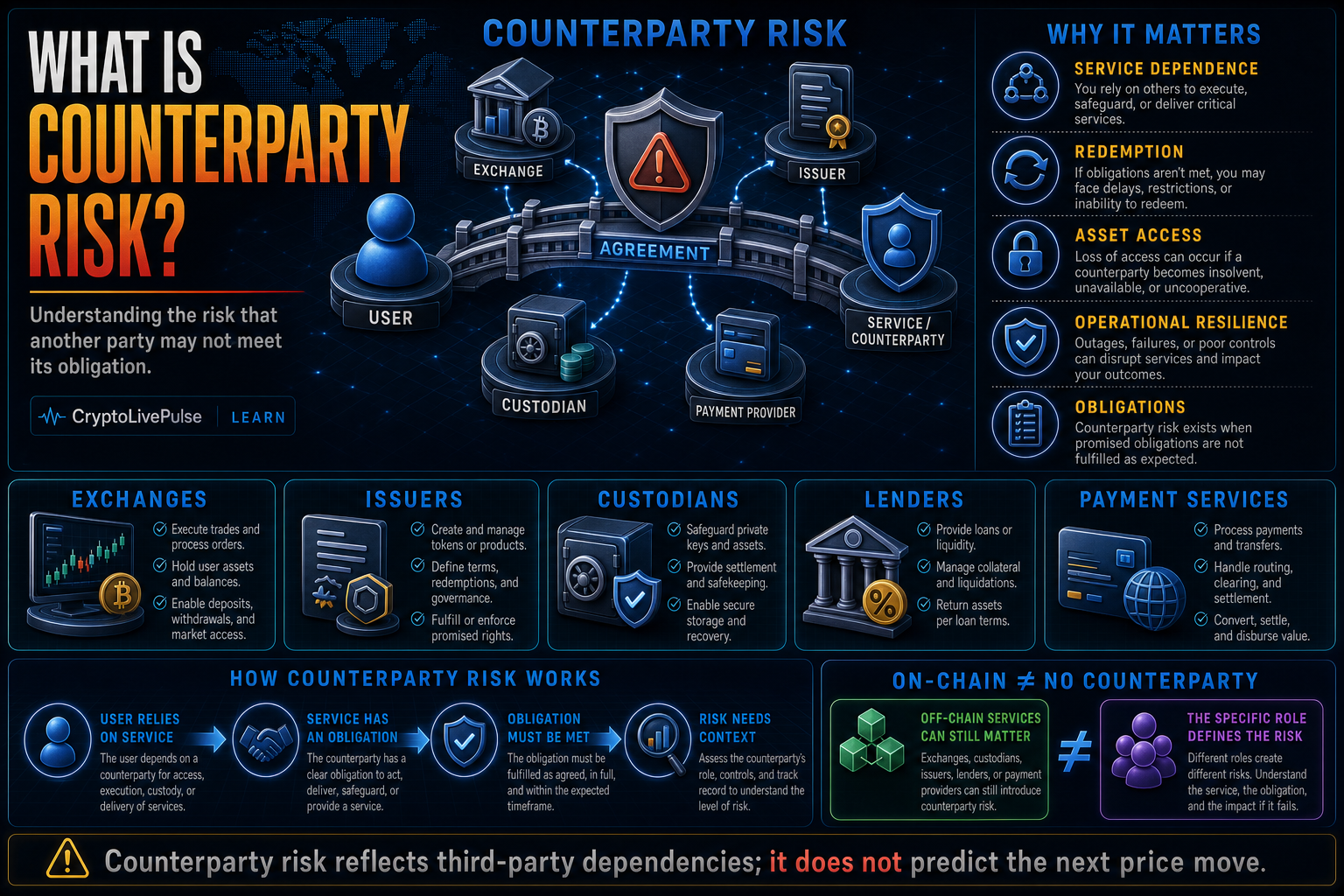
Counterparty risk is the risk that another party in a transaction or arrangement may not meet its obligation.
Simple definition
A counterparty is the other person, company, platform, issuer, or service involved. The risk can arise if that party cannot deliver assets, process a redemption, protect funds, or perform as expected.
Why counterparty risk matters
Many crypto activities rely on third parties, including exchanges, issuers, custodians, lenders, payment services, and bridges. Their financial strength, controls, and ability to operate can affect users.
How people usually read it
People assess who the counterparty is, what obligation they have, what safeguards exist, and whether there are alternatives if the service is disrupted. Counterparty risk can be financial, legal, operational, or technological.
Why it matters for crypto
Even when a token moves on-chain, users may rely on off-chain parties for custody, redemption, liquidity, trading access, or asset backing. Understanding those dependencies is a core part of crypto risk management.
Not a standalone signal
Counterparty risk is not limited to one type of service, and it cannot be judged from a brand name alone. The relevant risk depends on the specific role and the terms of the arrangement.
Example in a market update
If a market update discusses whether an issuer can support redemptions or whether an exchange can process withdrawals, it may be discussing counterparty risk.
Common signals people watch
- Who the counterparty is
- What obligation they have
- Financial and operational resilience
- Transparency and contractual terms
- Available alternatives and concentration
Counterparty risk can take different forms
The issue is not only whether a party has enough financial resources. A counterparty can create risk through technology failures, unclear contractual terms, operational disruption, poor controls, or an inability to provide the promised service when needed.
The same user can have several counterparties at once. For example, an exchange, a custodian, an issuer, and a payment provider may each play a separate role in access to an asset or transaction.
Questions to keep in mind
Which party is relied on, what are they required to do, and what alternatives exist if they cannot perform? These questions make counterparty risk more specific and useful.
Counterparty risk can also be concentrated when many services depend on the same provider. Looking at relationships across the full workflow helps show where a disruption might have the greatest impact.
Key takeaway
Counterparty risk is the possibility that another party will not meet its obligation, making third-party dependencies important to understand.
Comments (0)
Join the discussion
Sign in or create a free account to leave a comment.
No comments yet. Be the first to comment!