What Does Correlation Mean?
What Is Correlation?
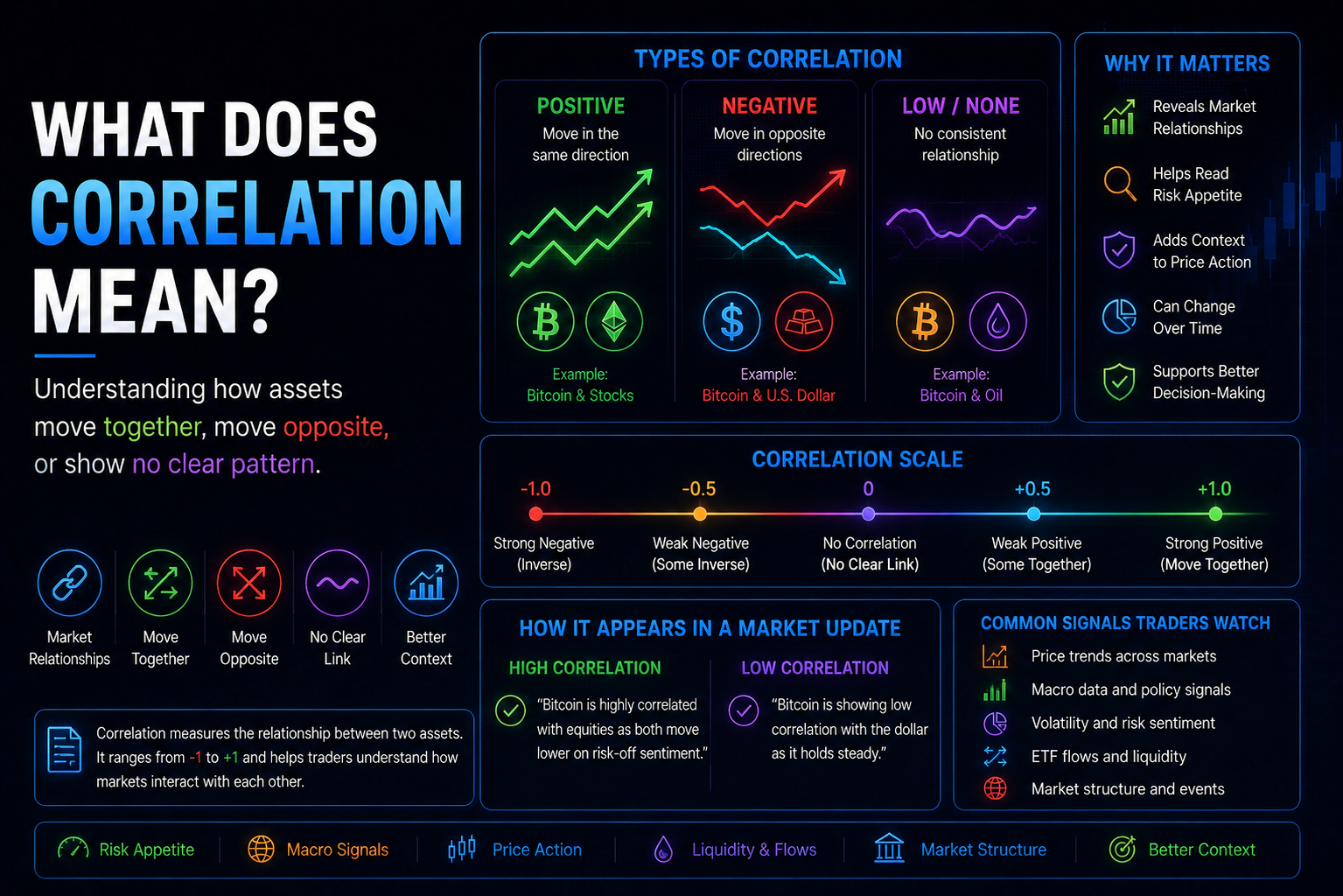
Correlation describes how closely two markets or assets move together. Crypto traders watch correlation because Bitcoin, Ethereum, stocks, the U.S. dollar, yields, and broader risk assets can sometimes move in similar or opposite directions.
Simple definition
Correlation means the relationship between how two things move.
If two assets often rise and fall together, they have positive correlation. If one often rises while the other falls, they have negative correlation. If there is no clear pattern, the correlation may be weak or unstable.
Why correlation matters
Correlation matters because it helps traders understand whether markets are moving together or acting separately.
When correlation is high, one market can give context for another. When correlation breaks down, traders may need to look more closely at asset-specific news, flows, liquidity, or market structure.
How traders usually read it
Positive correlation usually means two assets are moving in the same direction. For example, Bitcoin and risk assets may both rise when investors are more willing to take risk.
Negative correlation usually means two assets are moving in opposite directions. The meaning depends on context because correlations can change when macro signals, liquidity, policy expectations, or market stress shift.
Why it matters for crypto
Correlation matters for crypto because Bitcoin, Ethereum, and altcoins can sometimes trade like risk assets, especially when macro signals are driving broad market behavior.
Crypto traders may compare Bitcoin with equities, the U.S. dollar, Treasury yields, ETF flows, VIX, and market sentiment to understand whether crypto is following broader risk appetite or moving on its own drivers.
Correlation is not a standalone signal
Correlation should not be used as a complete market explanation. Two assets can move together for a while and then separate when new information changes the setup.
Correlation is most useful when read alongside price action, volume, liquidity, ETF flows, macro signals, volatility, Bitcoin dominance, and market structure.
Example in a market update
If Bitcoin is falling while equities are also weaker and yields are rising, traders may say crypto is showing stronger correlation with broader risk assets.
If Bitcoin holds steady while equities weaken, traders may say the correlation is softer and crypto is showing more independent behavior.
Common signals traders watch
- Whether Bitcoin is moving with or against equities
- Whether Ethereum and altcoins are following Bitcoin
- Whether the U.S. dollar is rising or falling
- Whether Treasury yields are pressuring risk assets
- Whether ETF flows, liquidity, and sentiment support or weaken the crypto read
Key takeaway
Correlation helps traders understand whether crypto is moving with broader markets, against them, or on its own separate drivers.
Comments (0)
Join the discussion
Sign in or create a free account to leave a comment.
No comments yet. Be the first to comment!