What Is Core Inflation?
What Does Core Inflation Mean?
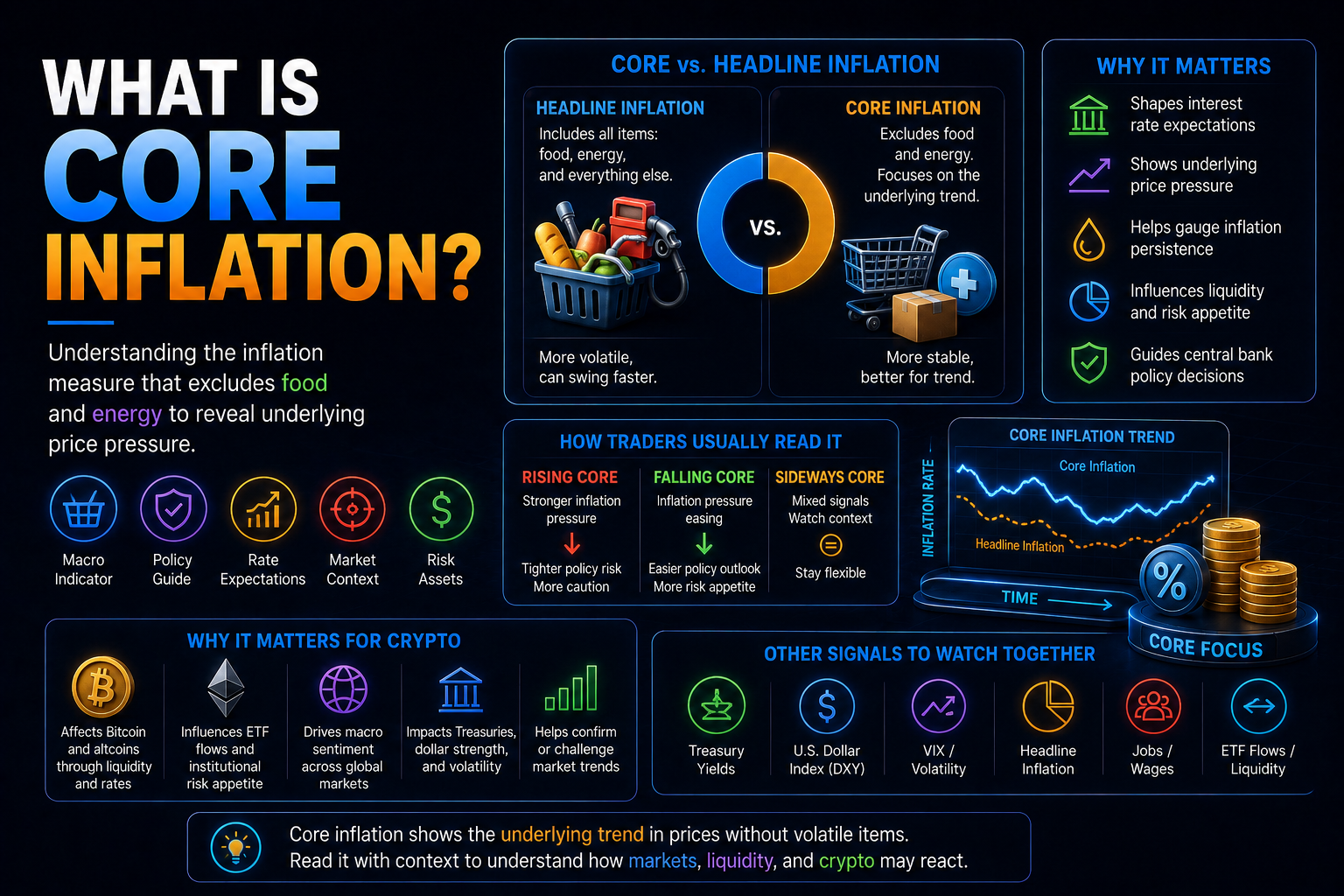
Core inflation measures inflation after removing food and energy prices, which can move sharply from month to month. Crypto readers watch core inflation because it can affect interest rate expectations, liquidity, risk appetite, Bitcoin, Ethereum, and broader market sentiment.
Simple definition
Core inflation means the inflation rate after excluding food and energy prices.
Food and energy are excluded because they can be more volatile. Core inflation is used to help traders and policymakers see whether price pressure is becoming more persistent across the economy.
Why core inflation matters
Core inflation matters because it can shape expectations for interest rates and central bank policy. When core inflation stays high, traders may expect policy to stay tighter for longer.
When core inflation cools, traders may become more open to the idea that rate pressure could ease. That can affect bonds, stocks, the U.S. dollar, liquidity, and risk assets.
How traders usually read it
Hotter core inflation usually means price pressure is stronger than expected, which can make traders more cautious about risk assets.
Cooler core inflation usually suggests price pressure may be easing. The meaning depends on context because markets also watch headline inflation, wages, growth data, Treasury yields, the U.S. dollar, and central bank guidance.
Why it matters for crypto
Crypto traders watch core inflation because Bitcoin, Ethereum, and altcoins can react when inflation data changes expectations for rates and liquidity. If inflation looks sticky, traders may become more defensive toward risk assets.
Core inflation can be useful in a broader crypto market read alongside Treasury yields, the U.S. dollar, VIX, SPY, ETF flows, liquidity, Bitcoin dominance, and market sentiment.
Core inflation is not a standalone signal
Core inflation should not be used as a standalone crypto signal. A single inflation reading does not automatically tell traders where Bitcoin, Ethereum, or altcoins will move next.
Core inflation is most useful when read alongside headline inflation, Treasury yields, the U.S. dollar, volatility, liquidity, ETF flows, price action, and broader market structure.
Example in a market update
If core inflation cools while yields fall and Bitcoin holds steady, a market update may say macro pressure is easing for risk assets.
If core inflation comes in hotter while the U.S. dollar rises and Bitcoin weakens, a market update may say traders are reading the macro backdrop as more cautious.
Common signals traders watch
- Whether core inflation is rising, falling, or staying sticky
- Whether the reading is hotter or cooler than expected
- Whether Treasury yields and the U.S. dollar rise or fall after the data
- Whether volatility increases or settles after the inflation report
- Whether Bitcoin, Ethereum, and ETF flows confirm or ignore the macro signal
Key takeaway
Core inflation helps traders read underlying price pressure and rate expectations, but crypto traders should compare it with yields, liquidity, volatility, ETF flows, and Bitcoin market structure.
Comments (0)
Join the discussion
Sign in or create a free account to leave a comment.
No comments yet. Be the first to comment!