What Is a Continuation Pattern?
What Is a Continuation Pattern?
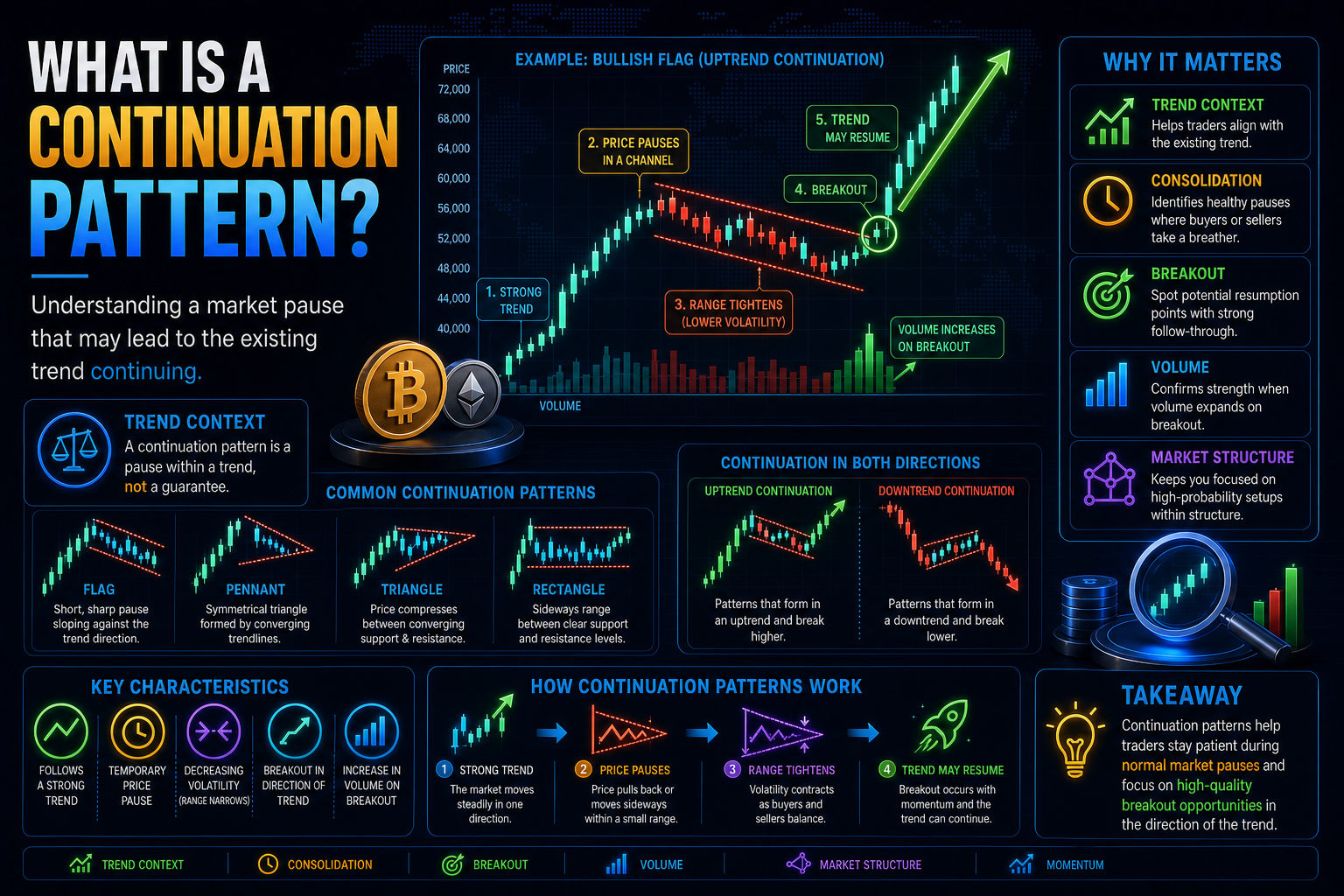
A continuation pattern is a price formation that appears during an existing trend and may show that the trend is pausing before it continues. In crypto, traders use the term when price moves sideways or briefly against the larger trend while buyers and sellers reassess the market.
Simple definition
A continuation pattern is a chart pattern that may suggest an existing trend could resume after a pause.
It can develop in an uptrend or a downtrend. The pattern does not predict the outcome by itself, but it gives traders a way to describe a period of consolidation within a broader market move.
Why continuation patterns matter
Continuation patterns matter because trends often include pauses, pullbacks, and periods of tighter price movement. They can help distinguish a normal consolidation from a possible larger change in market structure.
When price breaks out in the direction of the previous trend, traders may view the pattern as a sign that the earlier market pressure is still present. A break in the other direction can instead weaken the continuation idea.
Common continuation patterns
Common examples include flags, pennants, triangles, and rectangles. These patterns can look different, but they often share the same broad idea: price pauses or compresses after a strong move.
For example, a flag may look like a short pullback after a sharp move, while a rectangle may show price moving between a clear support and resistance range.
How traders usually read them
Traders usually look at the trend before the pattern, the shape of the consolidation, and the direction of any breakout. Volume, momentum, and nearby support or resistance can add useful context.
A continuation pattern is often clearer when the market had a visible trend beforehand. In a choppy sideways market, similar shapes may be less meaningful.
Continuation pattern versus reversal pattern
A continuation pattern appears within a trend and may point to that trend resuming. A reversal pattern may instead suggest that the prior trend is losing control and could change direction.
The difference becomes clearer after price leaves the pattern. That is why traders often wait for broader context instead of treating the pattern alone as confirmation.
Why continuation patterns matter in crypto
Crypto markets can move quickly after a strong Bitcoin, Ethereum, or altcoin trend. A continuation pattern can help describe whether a pause in that move looks orderly or whether market structure may be changing.
Because crypto is volatile, breakouts can fail or reverse quickly. Reading the pattern with broader market participation, liquidity, and sentiment adds important context.
Continuation patterns are not standalone signals
A continuation pattern does not guarantee that a trend will continue. Price can break in either direction, and a pattern can become less relevant when market conditions change.
Continuation patterns are most useful when read alongside market structure, trading volume, momentum, support and resistance, and the wider market environment.
Example in a market update
If Bitcoin rallies, then trades in a narrow downward-sloping range while volume becomes quieter, a market update may describe the range as a possible bullish continuation pattern.
If an altcoin falls sharply and then pauses in a small triangle before breaking lower, an update may say that the pattern supported the existing downward trend.
Common signals traders watch
- The direction of the trend before the pattern
- A tightening range or short consolidation
- A breakout in the direction of the prior trend
- Changes in trading volume and momentum
- Nearby support and resistance levels
Key takeaway
A continuation pattern is a pause within an existing trend that may show the trend is preparing to resume, but it needs wider market context.
Comments (0)
Join the discussion
Sign in or create a free account to leave a comment.
No comments yet. Be the first to comment!