What Is Consolidation in Crypto?
What Does Consolidation Mean?
Consolidation happens when price moves sideways instead of clearly rising or falling. Crypto traders watch consolidation because it can affect Bitcoin, Ethereum, altcoins, volume, sentiment, liquidity, and market structure.
Simple definition
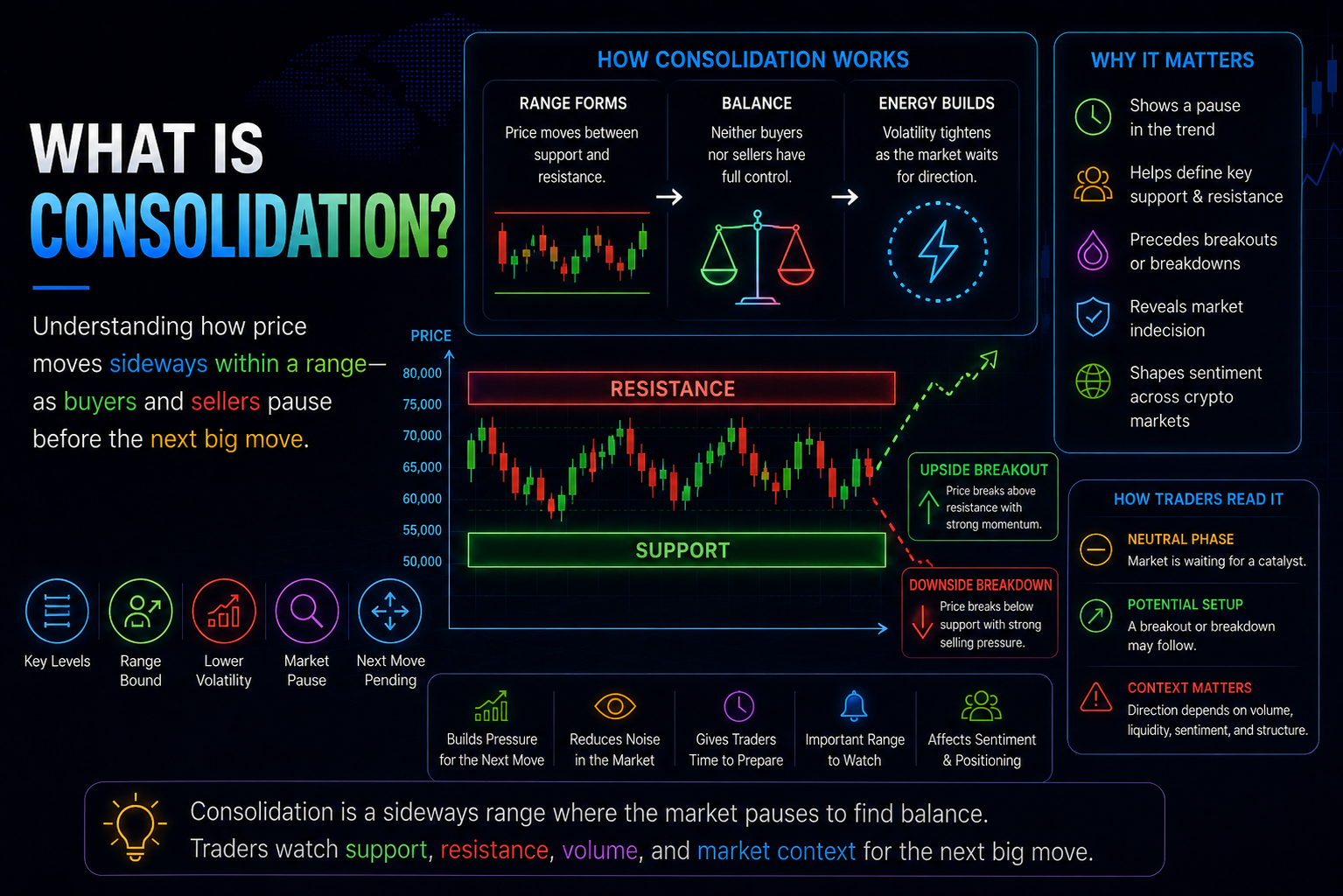
Consolidation means price is moving within a range while the market pauses and waits for clearer direction.
During consolidation, buyers and sellers are often more balanced. Price may move between support and resistance without making a strong breakout or breakdown.
Why consolidation matters
Consolidation matters because it can show that the market is digesting a previous move. After a strong rise or fall, price may pause while traders reassess momentum, demand, supply, and risk appetite.
A consolidation phase can also help traders identify important support and resistance levels. Those levels may become useful context if price later attempts a breakout or breakdown.
How traders usually read it
Consolidation is usually read as a neutral or waiting phase. It does not automatically mean the market is strong or weak.
The meaning depends on context. Consolidation after a strong rally may look like a pause before traders decide whether momentum can continue. Consolidation after a sharp drop may show caution while traders wait to see if support can hold.
Why it matters for crypto
Crypto can move quickly when consolidation ends, especially if Bitcoin or Ethereum breaks out of a well-watched range. This can affect broader market sentiment and altcoin participation.
Crypto traders may use consolidation alongside volume, ETF flows, open interest, liquidity, Bitcoin dominance, macro signals, and market sentiment to understand whether the market is building strength, losing momentum, or simply waiting.
Consolidation is not a standalone signal
Consolidation should not be used as a standalone price signal. A sideways range does not tell traders by itself whether price will break higher, break lower, or continue moving sideways.
Consolidation is most useful when read alongside support and resistance, volume, volatility, liquidity, ETF flows, macro signals, market sentiment, and broader market structure.
Example in a market update
If Bitcoin trades between support and resistance while volume stays quiet, a market update may say Bitcoin is consolidating while traders wait for confirmation.
If Ethereum holds a narrow range after a strong move, a market update may say Ethereum is consolidating as the market checks whether demand can continue.
Common signals traders watch
- Whether price is staying inside a clear range
- Whether volume is rising or fading during the range
- Whether support and resistance are holding
- Whether Bitcoin, Ethereum, or altcoins are confirming the same sideways tone
- Whether liquidity, sentiment, and macro signals support a breakout, breakdown, or continued pause
Key takeaway
Consolidation means price is moving sideways within a range, and traders usually watch for confirmation before deciding whether the market is preparing for a breakout, breakdown, or continued pause.
Comments (0)
Join the discussion
Sign in or create a free account to leave a comment.
No comments yet. Be the first to comment!