What Does Compliance Mean?
What Is Compliance?
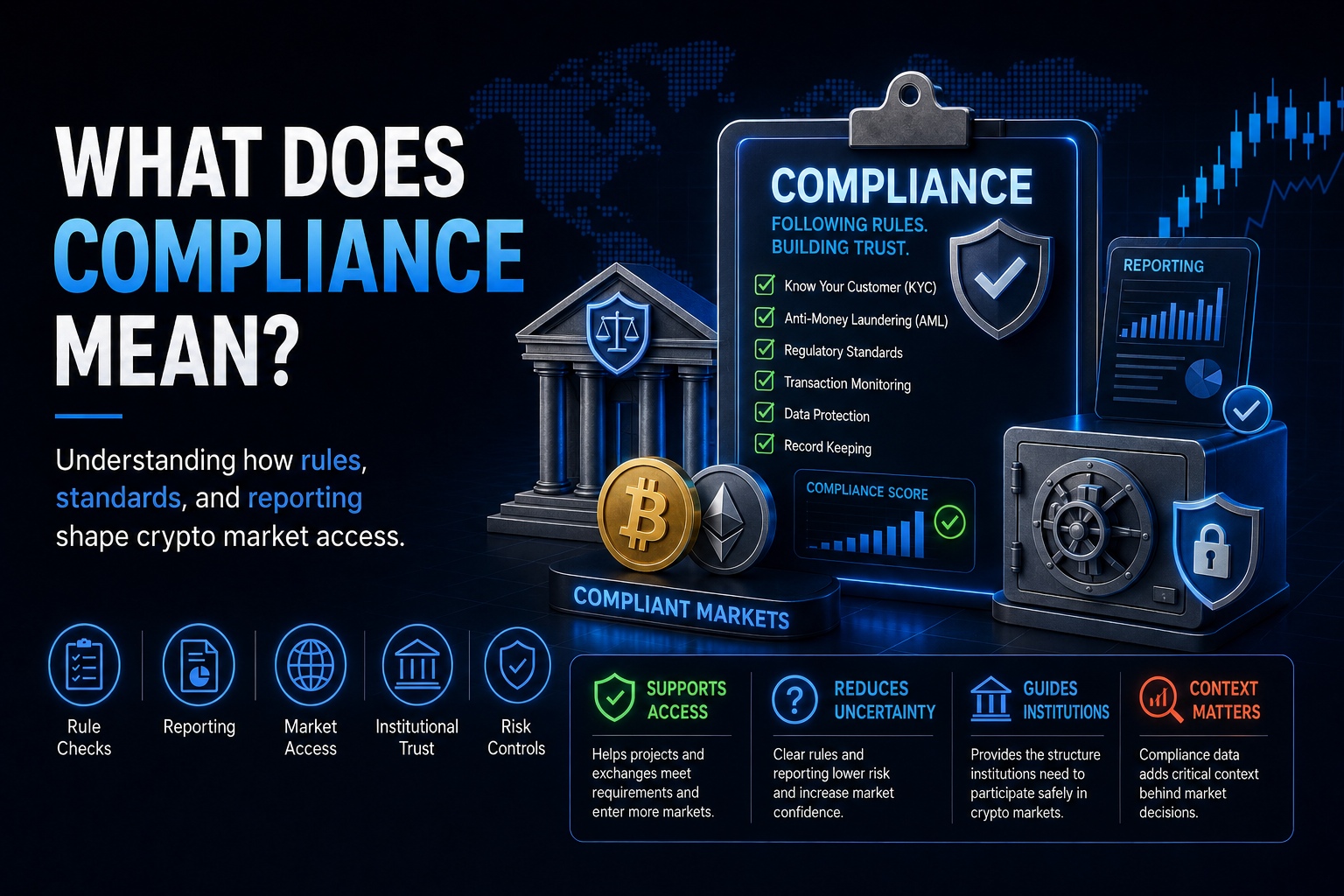
Compliance means following rules, laws, policies, or required standards. Crypto readers often see the term in market updates because compliance can affect exchanges, stablecoins, ETF flows, custody, regulation, institutional activity, and market confidence.
Simple definition
Compliance means acting in line with the rules that apply to a company, market, product, or financial activity.
In crypto, compliance can involve how exchanges, issuers, custodians, payment companies, and other market participants follow legal, regulatory, reporting, and operational requirements.
Why compliance matters
Compliance matters because financial markets depend on rules, trust, and access. When a company or product has a clearer compliance framework, traders may read that as a sign of better structure or lower uncertainty.
Weak compliance, unclear compliance, or enforcement pressure can create caution because it may affect access, operations, listings, payments, custody, or institutional participation.
How traders usually read it
Traders usually read stronger compliance as a potentially supportive signal when it reduces uncertainty or makes regulated participation easier.
Compliance concerns can be read as a risk signal when they raise questions about legal exposure, business operations, product access, or market confidence. The meaning depends on who is affected and how important that entity or product is to the market.
Why it matters for crypto
Crypto can be sensitive to compliance headlines because Bitcoin, Ethereum, stablecoins, exchanges, ETF products, custody providers, and payment rails often operate inside a changing regulatory environment.
Crypto traders may use compliance as part of a broader read, especially when it appears alongside regulation, ETF flows, exchange activity, liquidity, market sentiment, and institutional demand.
Compliance is not a standalone signal
Compliance should not be used as a standalone price signal. A compliance headline does not automatically mean Bitcoin, Ethereum, or the broader crypto market will move in one direction.
Compliance is most useful when read alongside price action, regulation headlines, ETF flows, exchange activity, liquidity, volatility, institutional participation, and broader market sentiment.
Example in a market update
If a crypto company strengthens its compliance process while institutional demand is improving, traders may read the setup as more constructive for regulated market participation.
If compliance concerns appear alongside weaker sentiment, exchange pressure, or policy uncertainty, traders may read the setup as more cautious for that part of the market.
Common signals traders watch
- Whether a company or product is operating under clearer rules
- Whether compliance concerns are affecting exchanges, custody, payments, or stablecoins
- Whether regulation headlines are improving or pressuring market confidence
- Whether institutional participation is expanding or slowing
- Whether compliance news lines up with liquidity, ETF flows, and broader market sentiment
Key takeaway
Compliance means following the rules, and traders watch it because it can shape access, confidence, regulation, and institutional participation in crypto markets.
Comments (0)
Join the discussion
Sign in or create a free account to leave a comment.
No comments yet. Be the first to comment!