What Is Capital Rotation?
What Does Capital Rotation Mean?
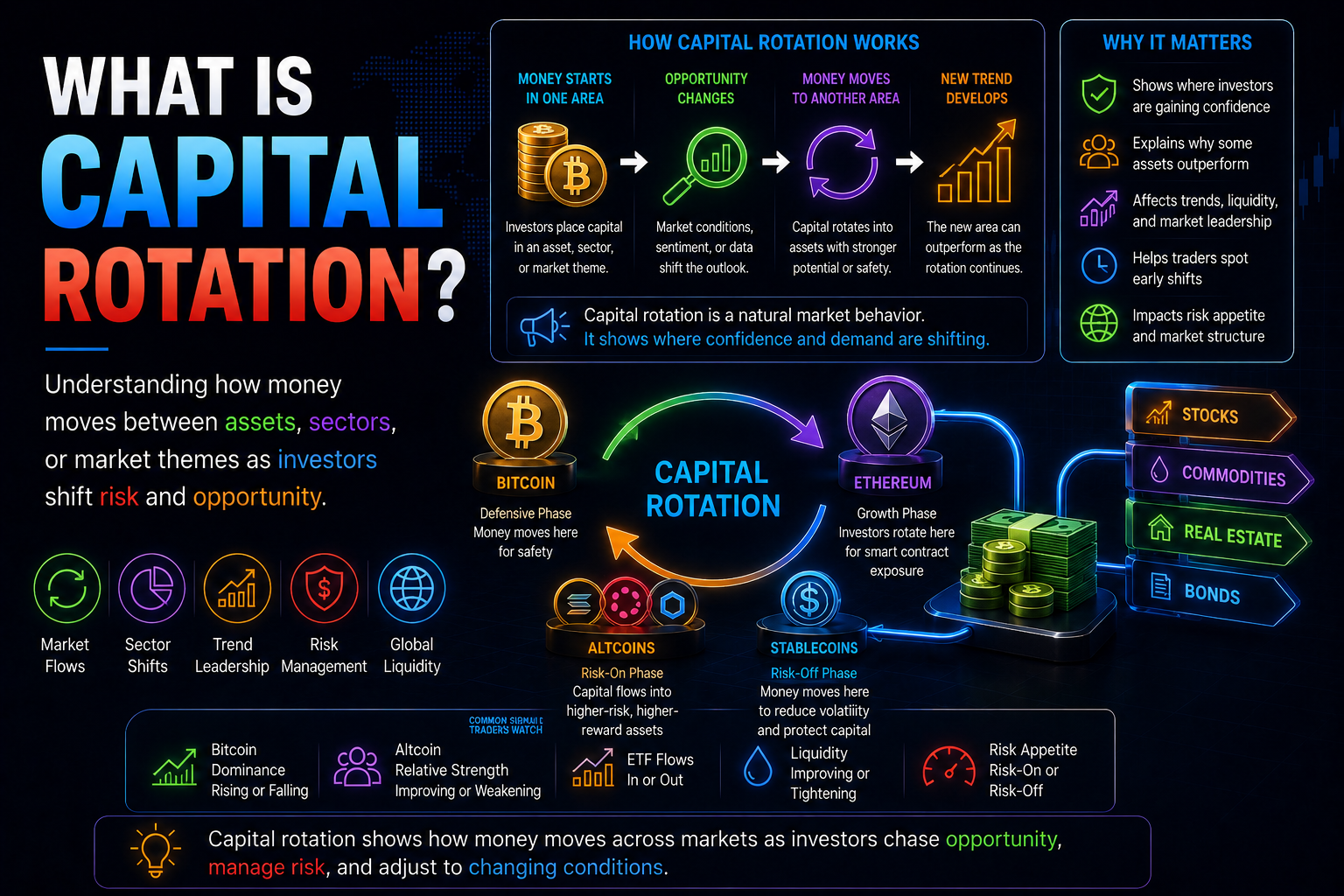
Capital rotation describes money moving from one asset, sector, or market theme into another. Crypto readers watch capital rotation because it can affect Bitcoin, Ethereum, altcoins, ETF flows, liquidity, sentiment, and broader market structure.
Simple definition
Capital rotation means money is shifting from one part of the market to another.
In crypto, that can mean traders moving from Bitcoin into altcoins, from altcoins back into Bitcoin, from crypto into stablecoins, or from riskier assets into safer positions.
Why capital rotation matters
Capital rotation matters because it can show where traders are becoming more confident or more cautious. It helps explain why one part of the market may rise while another part weakens.
When capital rotates, market leadership can change. Traders may use this to understand whether demand is broadening, narrowing, or becoming more defensive.
How traders usually read it
Capital rotating into Bitcoin is often read as a more defensive crypto signal, especially when altcoins are weak and Bitcoin dominance is rising.
Capital rotating into Ethereum or altcoins may suggest broader risk appetite, but the meaning depends on context. Traders usually compare rotation with liquidity, ETF flows, volatility, market sentiment, and price structure.
Why it matters for crypto
Capital rotation matters for crypto because market participation is not always evenly spread. Bitcoin may lead during cautious phases, while Ethereum or altcoins may attract attention when traders are more willing to take risk.
Crypto traders may use capital rotation as part of a broader market read, especially when it appears alongside Bitcoin dominance, ETF flows, liquidity, exchange flows, stablecoin activity, and macro signals.
Capital rotation is not a standalone signal
Capital rotation should not be used as a standalone price signal. Money moving into one area does not guarantee that trend will continue, and rotation can reverse quickly.
Capital rotation is most useful when read alongside price action, volume, liquidity, ETF flows, Bitcoin dominance, volatility, macro signals, and broader market sentiment.
Example in a market update
If Bitcoin dominance is rising while altcoins are falling, traders may read capital rotation as moving toward Bitcoin and away from higher-risk crypto assets.
If Bitcoin is steady and altcoins begin to strengthen, traders may read capital rotation as broadening into more risk-sensitive parts of the market.
Common signals traders watch
- Whether Bitcoin dominance is rising or falling
- Whether Ethereum and altcoins are outperforming or lagging Bitcoin
- Whether ETF flows are supporting Bitcoin demand
- Whether liquidity is improving or tightening
- Whether market sentiment is becoming more confident or more cautious
Key takeaway
Capital rotation helps traders understand where money is moving inside the market, but it should be read with liquidity, dominance, ETF flows, price action, and sentiment.
Comments (0)
Join the discussion
Sign in or create a free account to leave a comment.
No comments yet. Be the first to comment!