What Is a Breakout in Crypto?
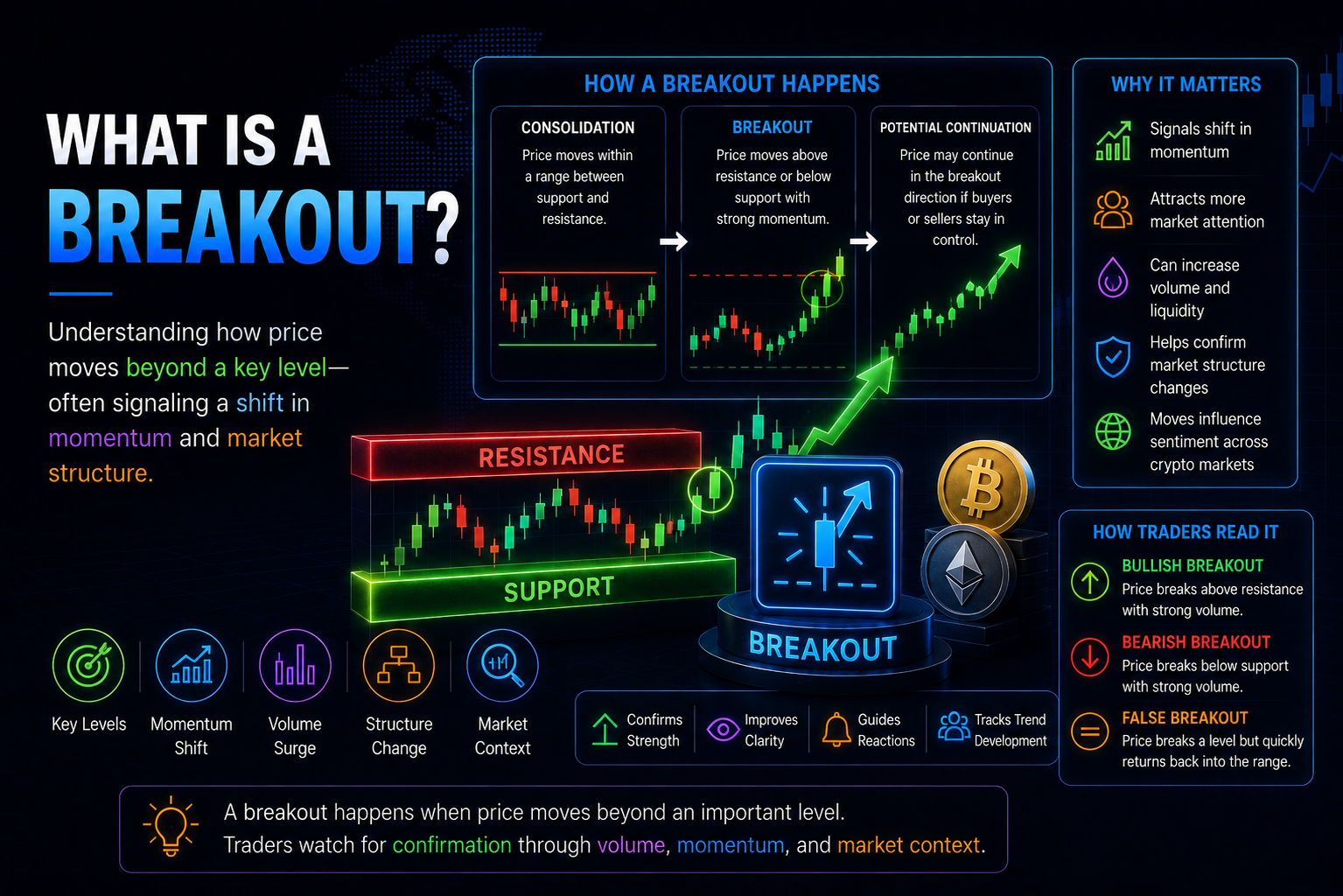
What Does Breakout Mean?
A breakout happens when price moves beyond an important level that traders have been watching. Crypto traders watch breakouts because they can affect Bitcoin, Ethereum, altcoins, volume, sentiment, liquidity, and market structure.
Simple definition
A breakout means price moves above resistance or below support after being held inside a range or pattern.
Resistance is an area where sellers may step in. Support is an area where buyers may step in. A breakout suggests price has moved past one of those important areas, but traders usually wait for confirmation before treating it as meaningful.
Why breakout matters
Breakout matters because it can show that the market is trying to leave an old price range and move into a new one. This can change how traders read momentum, demand, supply, and market structure.
A strong breakout may attract more attention if it happens with rising volume, improving sentiment, or supportive macro conditions. A weak breakout may fade if there is not enough follow-through.
How traders usually read it
An upside breakout is usually read as constructive because price is moving above a level where sellers previously limited the move.
A downside breakout is usually read as cautious or negative because price is moving below a level where buyers previously supported the market. The meaning depends on context because some breakouts fail quickly and return back into the old range.
Why it matters for crypto
Crypto can react strongly to breakouts because Bitcoin, Ethereum, and altcoins often move quickly when key levels are crossed. A breakout in Bitcoin can also influence broader crypto sentiment and market participation.
Crypto traders may use breakout signals alongside ETF flows, volume, open interest, liquidity, Bitcoin dominance, macro signals, and market sentiment to decide whether the move looks strong or fragile.
Breakout is not a standalone signal
A breakout should not be used as a standalone price signal. Price can briefly move beyond a level and then reverse back into the old range.
Breakouts are most useful when read alongside volume, follow-through, volatility, liquidity, market sentiment, ETF flows, macro signals, and the broader market structure.
Example in a market update
If Bitcoin moves above a resistance level with stronger volume and improving sentiment, a market update may say Bitcoin is attempting an upside breakout.
If Bitcoin moves above resistance but quickly loses momentum and falls back into its range, a market update may say the breakout needs confirmation or has not followed through yet.
Common signals traders watch
- Whether price moves clearly above resistance or below support
- Whether volume increases during the breakout
- Whether price holds the new level after the move
- Whether Bitcoin, Ethereum, or altcoins confirm the broader market tone
- Whether liquidity, sentiment, and macro signals support the move
Key takeaway
A breakout means price has moved beyond an important level, but traders usually look for confirmation before treating it as a lasting market shift.
Comments (0)
Join the discussion
Sign in or create a free account to leave a comment.
No comments yet. Be the first to comment!