What Is Bitcoin Volatility?
What Does Bitcoin Volatility Mean?
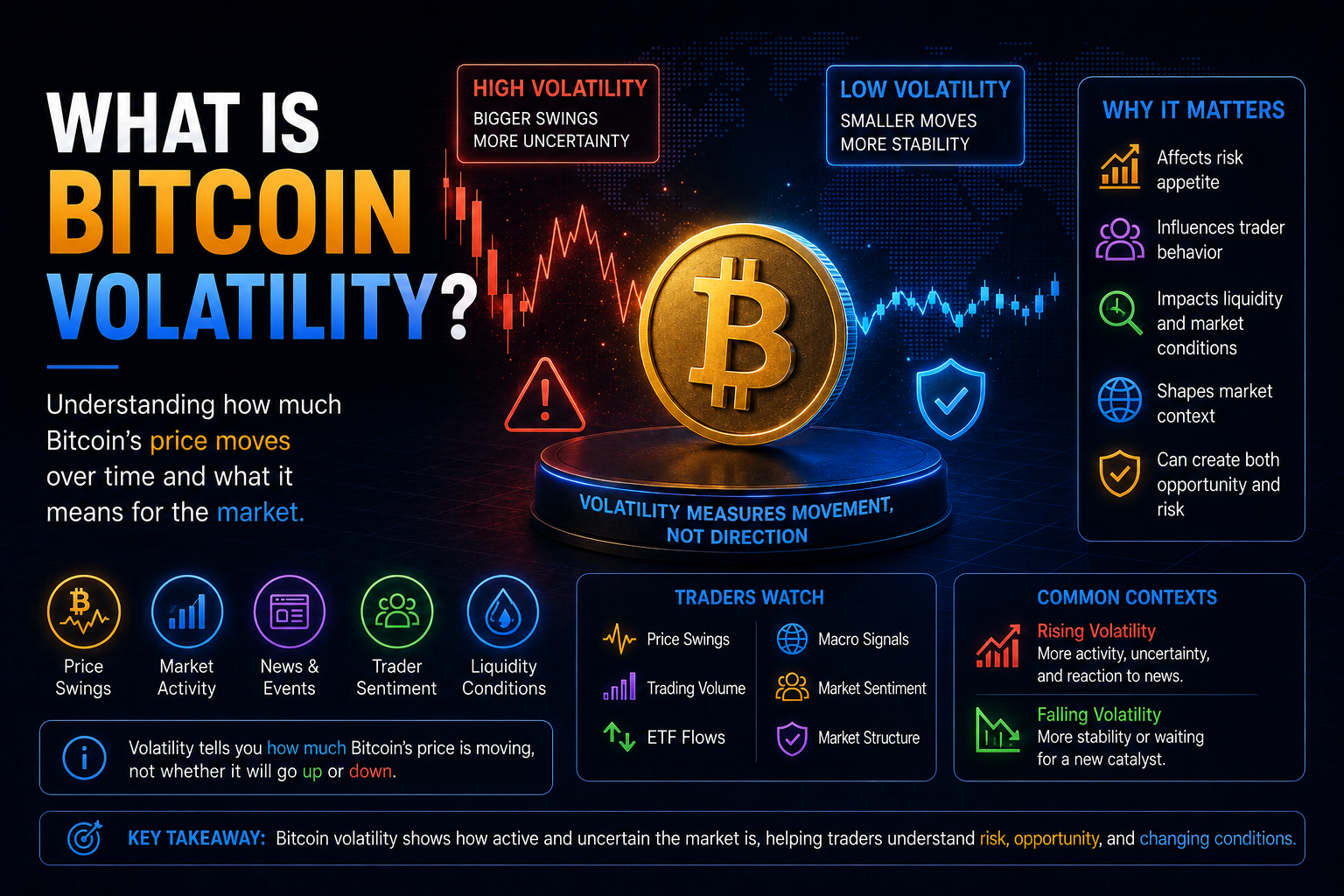
Bitcoin volatility describes how much Bitcoin's price moves over a period of time. Crypto readers watch Bitcoin volatility because large price swings can affect market confidence, trading activity, and how the broader crypto market is interpreted.
Volatility can increase during major news, changes in market sentiment, shifts in liquidity, or periods of uncertainty. It does not tell traders which direction the market will move, only how much prices may be changing.
Simple definition
Bitcoin volatility measures how much the price of Bitcoin rises or falls over time.
High volatility means prices are moving more sharply, while low volatility means prices are changing more gradually. Both conditions are normal parts of financial markets.
Why Bitcoin volatility matters
Bitcoin volatility matters because it can influence how comfortable traders and investors feel about taking risk.
Periods of higher volatility often bring larger opportunities and larger risks. Lower volatility may suggest that the market is becoming quieter while participants wait for new information.
How traders usually read it
Rising Bitcoin volatility usually tells traders that market activity is increasing. It does not automatically mean prices will move higher or lower.
Falling volatility may suggest that the market is becoming more stable or that traders are waiting for a new catalyst. The meaning depends on price action, volume, liquidity, and the broader market environment.
Why it matters for crypto
Bitcoin often influences the rest of the crypto market, so changes in Bitcoin volatility can affect Ethereum and many other digital assets.
Crypto traders may consider Bitcoin volatility alongside ETF flows, liquidity, macro signals, sentiment, and market structure to better understand the current market environment.
Bitcoin volatility is not a standalone signal
Bitcoin volatility should not be used by itself to judge whether the market is bullish or bearish. Large price swings can happen in either direction.
It is most useful when read alongside trend, trading volume, liquidity, sentiment, ETF flows, and other market signals that help explain why prices are moving.
Example in a market update
A market update may say that Bitcoin volatility is increasing after important economic news, suggesting that traders are reacting more actively than usual.
Another update may note that Bitcoin volatility remains low, indicating that the market is relatively calm while participants wait for the next major catalyst.
Common signals traders watch
- Whether Bitcoin price swings are becoming larger or smaller
- Whether trading volume is increasing or decreasing
- Whether ETF flows are supporting or pressuring market activity
- Whether macro signals are changing overall risk appetite
- Whether price action confirms the broader market trend
Key takeaway
Bitcoin volatility measures how much Bitcoin's price moves, helping traders understand market activity, uncertainty, and changing risk conditions without predicting direction.
Comments (0)
Join the discussion
Sign in or create a free account to leave a comment.
No comments yet. Be the first to comment!