What Is Bitcoin Network Difficulty?
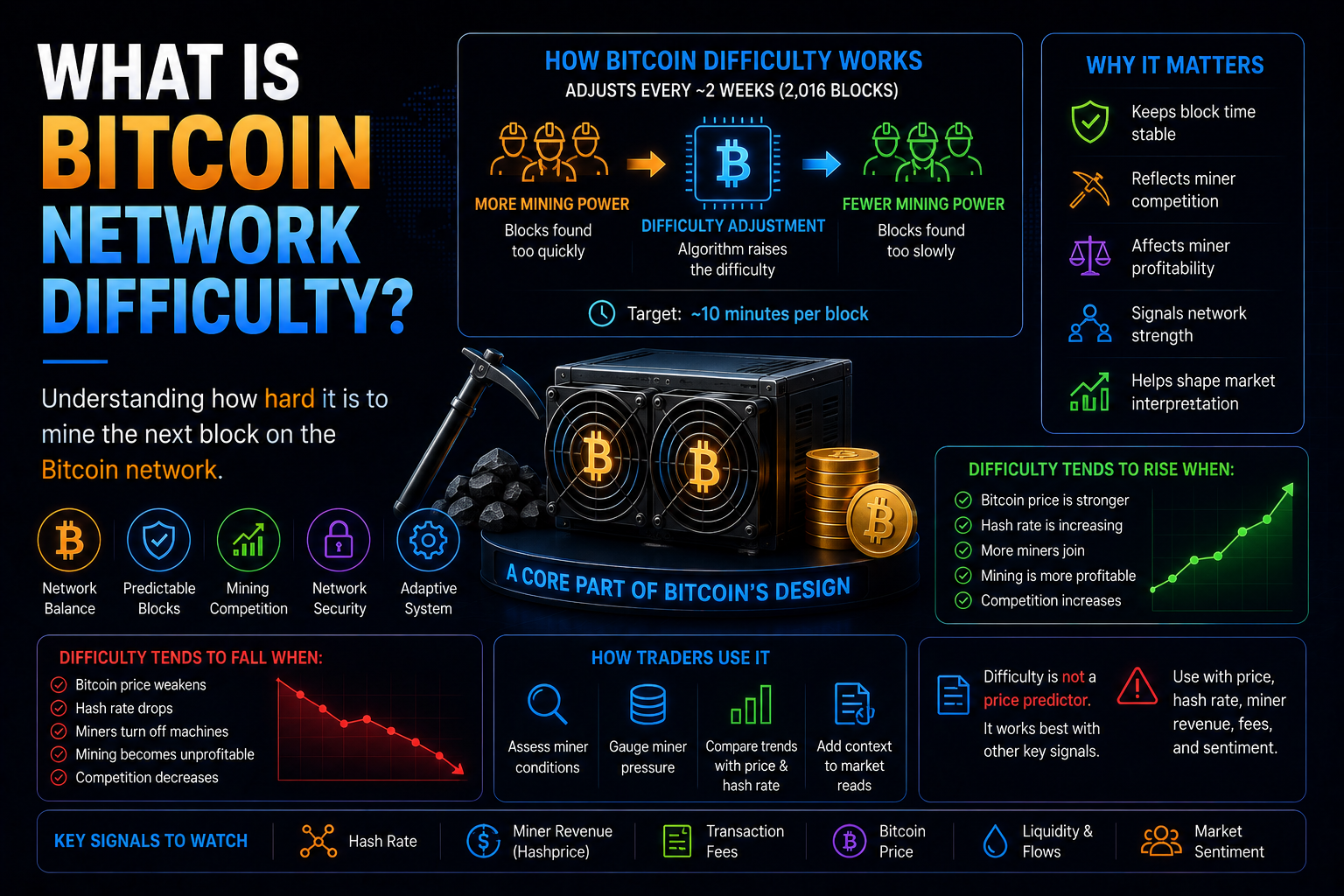
What Does Bitcoin Network Difficulty Mean?
Bitcoin network difficulty shows how hard it is for miners to find the next valid block. Crypto traders watch it because it can help explain mining conditions, network security, miner pressure, and Bitcoin market structure.
Simple definition
Bitcoin network difficulty is a measure of how difficult it is for miners to add a new block to the Bitcoin blockchain.
When more computing power joins the network, difficulty usually rises. When computing power leaves, difficulty can fall after the network adjusts.
Why Bitcoin network difficulty matters
Bitcoin network difficulty matters because it helps keep Bitcoin block production stable over time, even as miner activity changes.
It can also affect miner economics. Higher difficulty can make mining more competitive, while lower difficulty can reduce pressure for some miners.
How traders usually read it
Rising difficulty is usually read as a sign that more mining power is competing on the network.
Falling difficulty can suggest weaker miner participation or a temporary adjustment after some miners leave. The meaning depends on context and should not be read alone.
Why it matters for crypto
Bitcoin network difficulty matters for crypto because mining is part of Bitcoin’s core market structure and security model.
Crypto traders may use difficulty alongside Bitcoin price action, hash rate, miner revenue, hashprice, liquidity, and market sentiment to understand whether miners are under pressure or operating in a healthier environment.
Bitcoin network difficulty is not a standalone signal
Bitcoin network difficulty should not be used as a standalone price signal. Rising difficulty does not automatically mean Bitcoin price will rise, and falling difficulty does not automatically mean Bitcoin price will fall.
It is most useful when read alongside hash rate, miner revenue, transaction fees, Bitcoin price action, market liquidity, and broader risk appetite.
Example in a market update
If Bitcoin network difficulty is rising while price is steady, traders may read mining competition as strong but watch whether miner margins stay healthy.
If difficulty falls while miner revenue is under pressure, traders may read the setup as a sign that some miners are facing tougher operating conditions.
Common signals traders watch
- Whether Bitcoin network difficulty is rising or falling
- Whether Bitcoin hash rate is increasing or decreasing
- Whether miner revenue and hashprice are improving or weakening
- Whether Bitcoin price action supports miner profitability
- Whether transaction fees are helping or pressuring miner economics
Key takeaway
Bitcoin network difficulty helps explain how competitive Bitcoin mining is, but it works best as context alongside miner revenue, hash rate, price action, and broader market conditions.
Comments (0)
Join the discussion
Sign in or create a free account to leave a comment.
No comments yet. Be the first to comment!