What Are Bitcoin Miner Reserves?
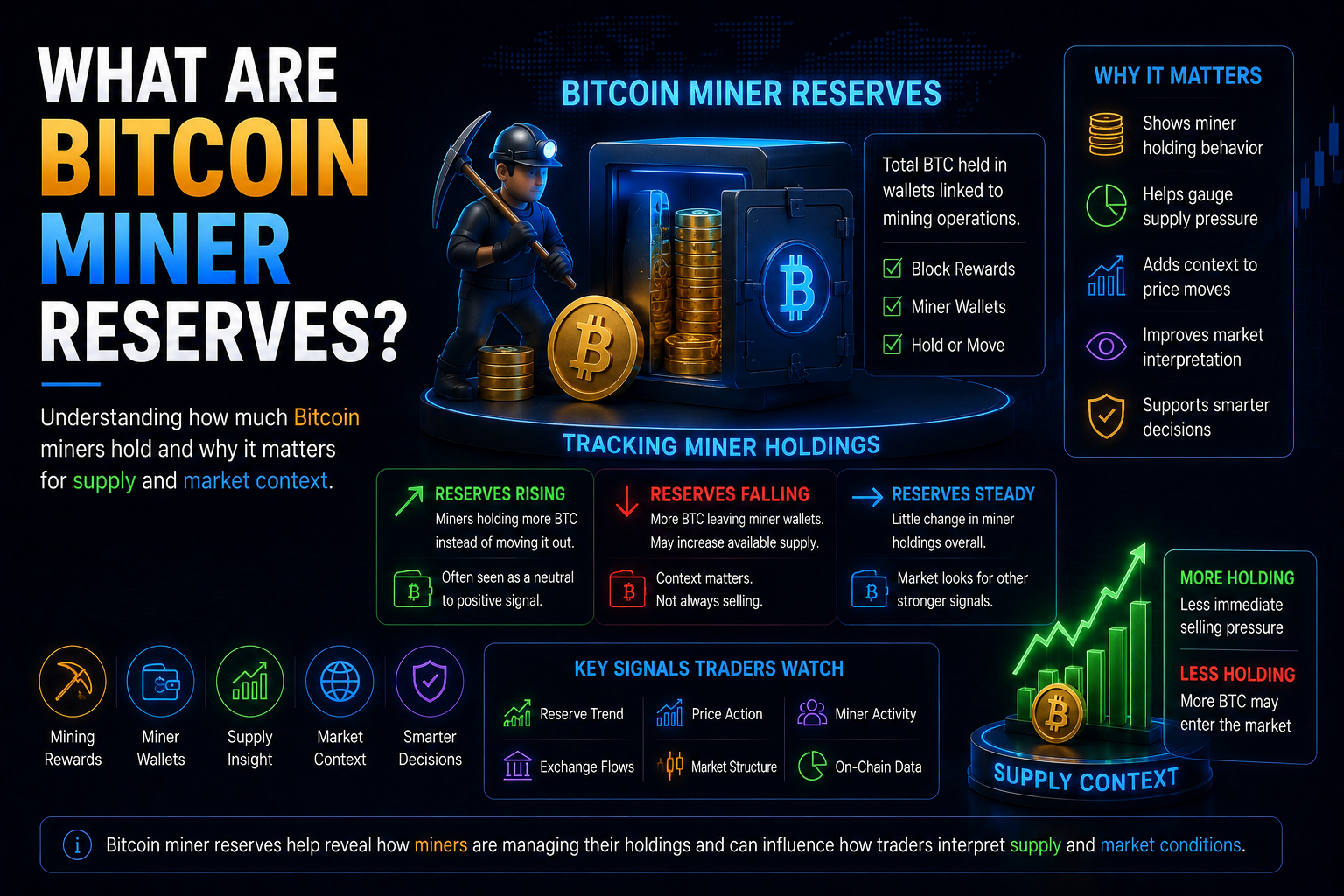
What Do Bitcoin Miner Reserves Mean?
Bitcoin miner reserves measure how much Bitcoin is being held in wallets associated with miners. Crypto traders watch this metric because changes in miner holdings can provide additional context about supply, selling activity, and overall market conditions.
Simple definition
Bitcoin miner reserves are the total amount of Bitcoin held by wallets linked to mining operations.
When miners earn new Bitcoin through block rewards, they can either keep those coins or move them elsewhere, such as to an exchange or another wallet. Tracking reserve levels helps observers understand whether miners are generally holding or reducing their balances.
Why Bitcoin miner reserves matter
Miners are one of the main sources of newly created Bitcoin. Their decisions about holding or moving coins may influence how much Bitcoin becomes available in the market.
Although miners represent only one group of market participants, changes in their reserves can help traders better understand supply conditions and market behavior.
How traders usually read it
Rising miner reserves usually suggest miners are holding more of the Bitcoin they earn instead of moving it out immediately.
Falling miner reserves may suggest more Bitcoin is leaving miner wallets. That does not always mean miners are selling, so traders usually combine this metric with exchange flows, price action, volume, and other on-chain data before reaching conclusions.
Why it matters for crypto
Bitcoin miner reserves are unique to the Bitcoin network because they reflect the behavior of miners who secure the blockchain and receive newly issued Bitcoin.
Crypto traders may watch miner reserves alongside ETF flows, liquidity, market sentiment, and other on-chain indicators to build a broader view of market conditions rather than relying on a single signal.
How to read Bitcoin miner reserves in context
Bitcoin miner reserves should not be treated as a standalone market signal. Miner balances can change for many operational reasons that are unrelated to market direction.
This metric is most useful when combined with exchange inflows and outflows, trading volume, market structure, liquidity, and broader on-chain activity.
Example in a market update
A market update might note that Bitcoin miner reserves remained stable while Bitcoin continued trading within a narrow range, suggesting little change in miner behavior.
Another update might mention declining miner reserves alongside higher exchange inflows, providing additional context that traders may monitor as part of the broader market picture.
Common signals traders watch
- Whether miner reserves are rising or falling
- Whether Bitcoin is leaving miner wallets
- Whether exchange inflows are increasing at the same time
- Whether price and trading volume confirm the broader trend
- Whether other on-chain indicators support the same market view
Key takeaway
Bitcoin miner reserves help traders understand how miner-held Bitcoin is changing over time, providing useful context about supply without predicting future price moves.
Comments (0)
Join the discussion
Sign in or create a free account to leave a comment.
No comments yet. Be the first to comment!