What Is Bitcoin Hashprice?
What Does Bitcoin Hashprice Mean?
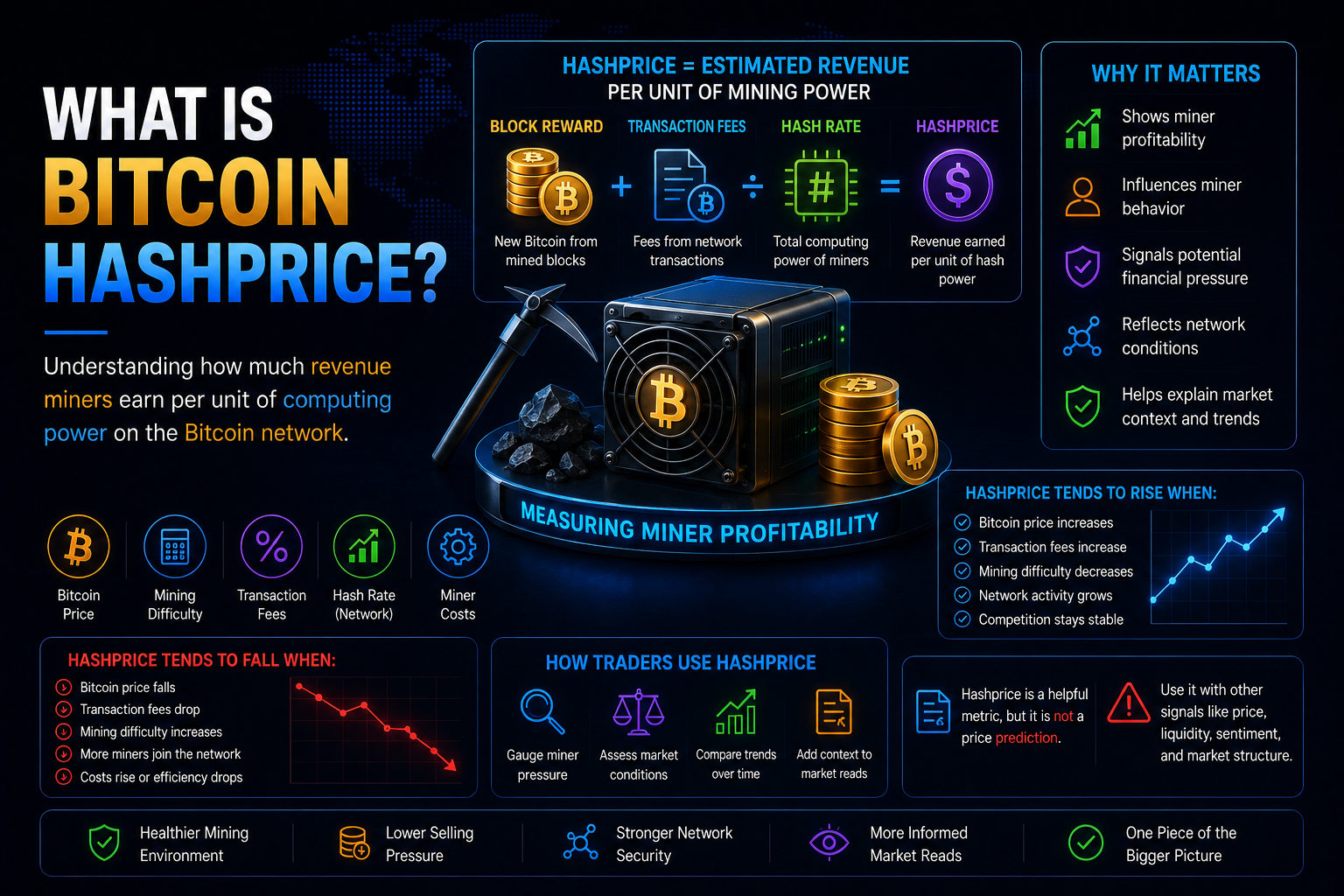
Bitcoin hashprice is a mining metric that shows how much revenue miners earn for a unit of computing power. Traders watch it because it can help explain miner pressure, network conditions, Bitcoin price action, and the broader mining backdrop.
Simple definition
Bitcoin hashprice means the estimated revenue miners earn from each unit of mining power they contribute to the Bitcoin network.
In simple terms, it helps show whether mining power is earning more or less revenue. Hashprice can move with Bitcoin price, transaction fees, mining difficulty, and competition among miners.
Why Bitcoin hashprice matters
Bitcoin hashprice matters because miners have costs. When hashprice is stronger, miners may have an easier time covering operating costs. When hashprice is weaker, mining conditions can feel tighter.
This can affect how traders interpret miner behavior, selling pressure, network health, and the strength or weakness behind Bitcoin market conditions.
How traders usually read it
A rising Bitcoin hashprice usually suggests miners are earning more revenue per unit of mining power.
A falling Bitcoin hashprice can suggest miners are facing more pressure. The meaning depends on context because hashprice can fall from lower Bitcoin prices, lower fees, higher difficulty, or stronger mining competition.
Why it matters for crypto
Bitcoin hashprice matters for crypto because miners are part of Bitcoin’s market structure. When miner economics tighten, traders may watch for signs of stress, reduced margins, or possible selling pressure.
Crypto traders may use Bitcoin hashprice as part of a broader market read alongside Bitcoin price action, mining difficulty, transaction fees, miner revenue, liquidity, and market sentiment.
Bitcoin hashprice is not a standalone signal
Bitcoin hashprice should not be used as a standalone price signal. A higher hashprice does not guarantee Bitcoin will rise, and a lower hashprice does not guarantee Bitcoin will fall.
It is most useful when read alongside Bitcoin price, mining difficulty, hash rate, transaction fees, miner reserves, ETF flows, liquidity, and overall market structure.
Example in a market update
If Bitcoin is rising and hashprice is improving, traders may read miner conditions as more supportive.
If Bitcoin is flat but hashprice is falling, traders may watch whether miner margins are tightening and whether that adds pressure to the broader market read.
Common signals traders watch
- Whether Bitcoin hashprice is rising or falling
- Whether Bitcoin price action is helping or hurting miner revenue
- Whether mining difficulty is increasing or decreasing
- Whether transaction fees are adding meaningful miner income
- Whether miner stress could affect market sentiment or selling pressure
Key takeaway
Bitcoin hashprice helps traders understand miner revenue pressure, but it works best as one part of a broader Bitcoin market read.
Comments (0)
Join the discussion
Sign in or create a free account to leave a comment.
No comments yet. Be the first to comment!