What Are Bitcoin Exchange Reserves?
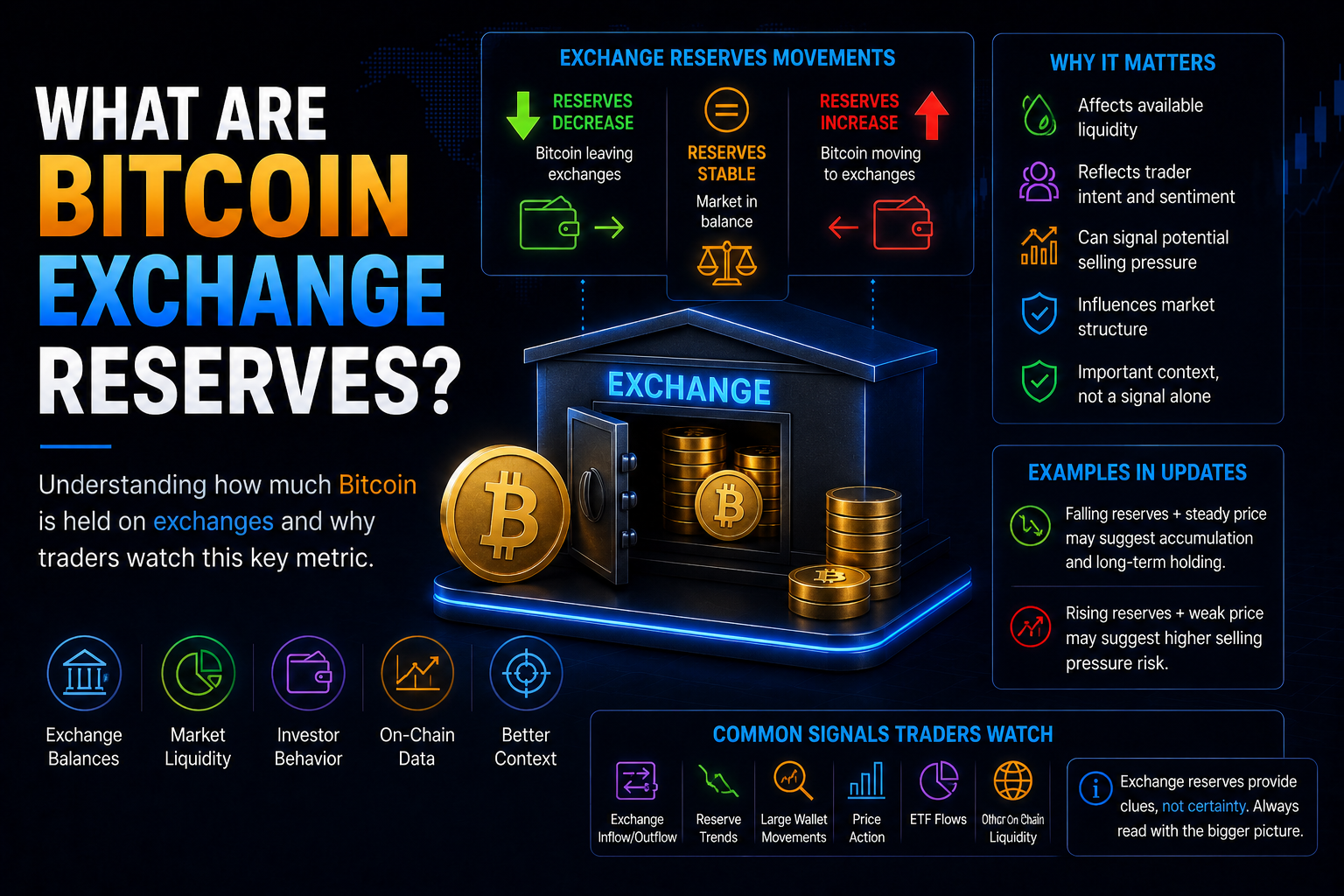
What Do Bitcoin Exchange Reserves Mean?
Bitcoin exchange reserves measure how much Bitcoin is being held on cryptocurrency exchanges. Crypto traders watch Bitcoin exchange reserves because changes in those balances can provide additional context about liquidity, investor behavior, and how market participants may be positioning.
Simple definition
Bitcoin exchange reserves are the total amount of Bitcoin held in wallets controlled by cryptocurrency exchanges.
When Bitcoin moves onto or off exchanges, the size of exchange reserves changes. Traders often monitor these changes alongside other on-chain and market indicators.
How Bitcoin exchange reserves are tracked
Bitcoin exchange reserve data comes from on-chain analytics providers such as Glassnode and CryptoQuant, which identify clusters of wallet addresses believed to belong to specific exchanges and track the combined Bitcoin balance held across them over time.
This tracking is not perfect. Exchanges can reorganize wallets, use custodians, or hold funds across addresses that are not yet labeled, so reserve estimates can shift for reasons unrelated to actual buying or selling activity. Traders typically look at sustained trends across weeks or months rather than reacting to a single daily change.
Why Bitcoin exchange reserves matter
Bitcoin exchange reserves matter because they can provide clues about how investors are managing their holdings. Moving Bitcoin to an exchange may suggest someone wants easier access to trade or sell, while moving Bitcoin away from an exchange may suggest a preference for holding it elsewhere.
These movements can influence how traders think about available market liquidity and overall market conditions, although they never explain the full picture on their own.
How traders usually read it
Declining Bitcoin exchange reserves are often viewed as a sign that more Bitcoin is leaving exchanges, which some traders interpret as supportive for longer-term holding.
Rising exchange reserves may suggest more Bitcoin is becoming available for trading. The meaning always depends on context, market sentiment, liquidity conditions, and whether other signals point in the same direction.
Why it matters for crypto
Bitcoin exchange reserves are one of the on-chain indicators that crypto traders frequently monitor because Bitcoin often influences the broader digital asset market.
Many traders compare exchange reserves with Bitcoin price action, ETF flows, liquidity conditions, market sentiment, and other on-chain data to build a broader view of market behavior.
Bitcoin exchange reserves are not a standalone signal
Bitcoin exchange reserves should not be used alone to predict future prices. A change in reserves does not automatically mean Bitcoin will move higher or lower.
Exchange reserves are most useful when read alongside price action, trading volume, ETF flows, liquidity, macro signals, and other on-chain indicators.
Example in a market update
If Bitcoin exchange reserves continue falling while Bitcoin holds key support levels, traders may describe the combination as supportive for the broader market backdrop.
If exchange reserves increase while market sentiment weakens, traders may become more cautious and watch whether other indicators confirm the change.
Common signals traders watch
- Whether Bitcoin exchange reserves are rising or falling over time
- Whether large amounts of Bitcoin move onto or off exchanges
- Whether Bitcoin price action supports the reserve trend
- Whether ETF flows and liquidity conditions support the broader market view
- Whether other on-chain indicators confirm the market interpretation
Key takeaway
Bitcoin exchange reserves help traders understand how much Bitcoin is being held on exchanges, providing useful context about liquidity and market behavior when combined with other signals.
Comments (0)
Join the discussion
Sign in or create a free account to leave a comment.
No comments yet. Be the first to comment!