What Are Bitcoin ETFs?
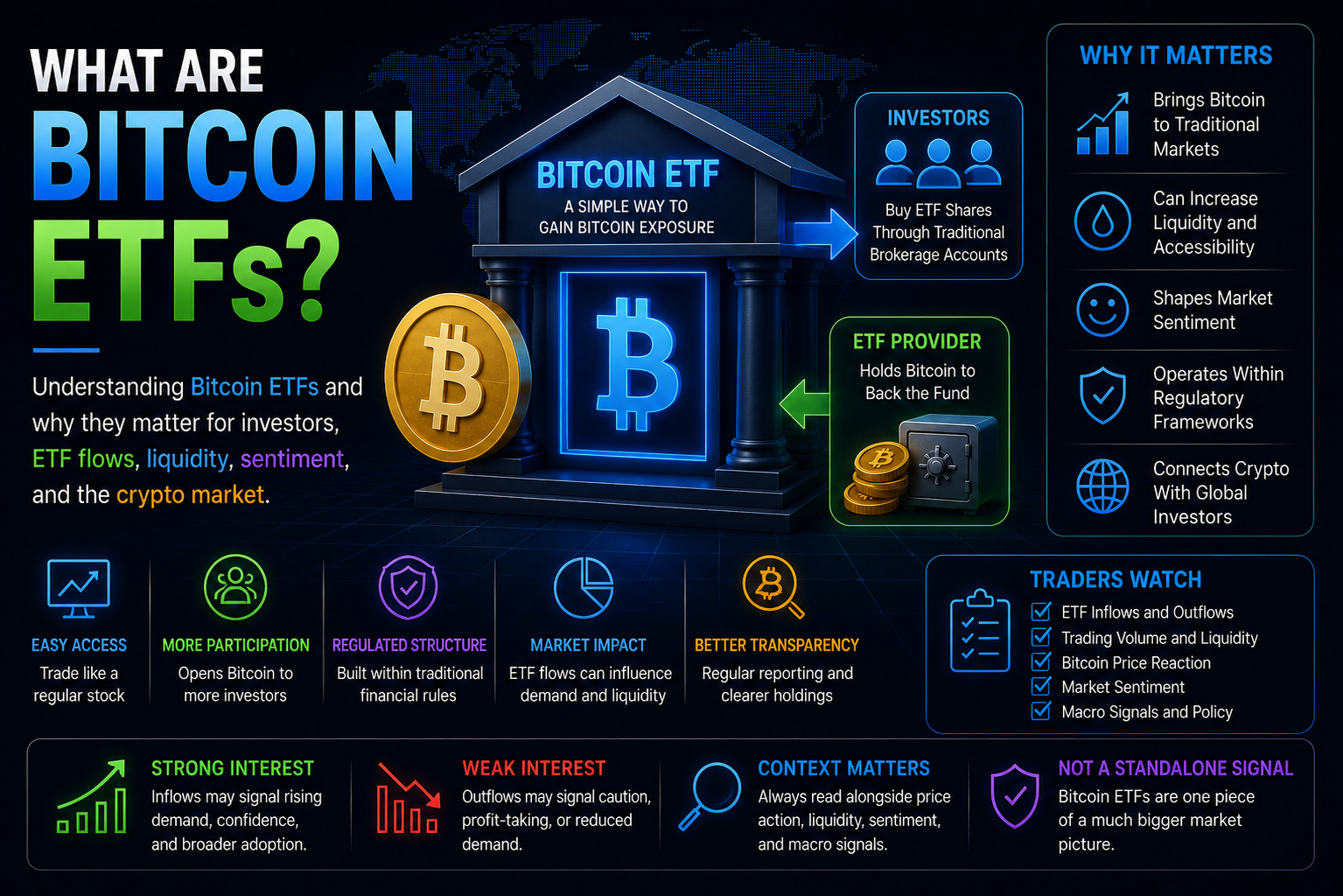
What Do Bitcoin ETFs Mean?
Bitcoin ETFs are exchange-traded funds that give investors exposure to Bitcoin through traditional market products. Crypto readers watch Bitcoin ETFs because they can affect ETF flows, liquidity, sentiment, Bitcoin demand, and broader market behavior.
Simple definition
Bitcoin ETFs are funds that trade on exchanges and are designed to track or provide exposure to Bitcoin.
ETF stands for exchange-traded fund. Instead of using a crypto wallet or exchange directly, some investors use Bitcoin ETFs through traditional brokerage or investment platforms.
Why Bitcoin ETFs matter
Bitcoin ETFs matter because they can make Bitcoin exposure easier for some traditional investors, funds, and institutions to access.
When Bitcoin ETFs attract attention, traders may watch them as a sign of demand, confidence, caution, or changing risk appetite in the broader market.
How traders usually read it
Strong interest in Bitcoin ETFs is usually read as supportive because it may suggest investors want more Bitcoin exposure through traditional market channels.
Weak interest, slowing demand, or heavy outflows may be read as more cautious. The meaning depends on context because ETF activity can reflect demand, rebalancing, profit-taking, hedging, or short-term sentiment.
Why it matters for crypto
Bitcoin ETFs matter for crypto because they connect traditional market participation with Bitcoin market behavior.
Crypto traders may use Bitcoin ETFs as part of a broader read alongside Bitcoin price action, ETF flows, Bitcoin dominance, liquidity, VIX, Treasury yields, the U.S. dollar, and market sentiment.
Bitcoin ETFs are not a standalone signal
Bitcoin ETFs should not be used as a complete market signal by themselves. ETF interest does not guarantee higher prices, and ETF weakness does not guarantee lower prices.
Bitcoin ETFs are most useful when read alongside price action, volume, ETF inflows, ETF outflows, liquidity, volatility, macro signals, and broader market structure.
Example in a market update
If Bitcoin is rising while Bitcoin ETF inflows are strong, traders may read ETF demand as supportive for sentiment and liquidity.
If Bitcoin is flat while Bitcoin ETF outflows are heavy, traders may read the setup as mixed because price is stable but fund demand looks weaker.
Common signals traders watch
- Whether Bitcoin ETF inflows are rising or fading
- Whether Bitcoin ETF outflows are increasing or slowing
- Whether Bitcoin price confirms or conflicts with ETF flow data
- Whether Bitcoin dominance shows capital staying concentrated
- Whether liquidity, volatility, and macro signals support the same market read
Key takeaway
Bitcoin ETFs help traders understand how traditional market demand may be connecting with Bitcoin, ETF flows, liquidity, sentiment, and broader crypto market behavior.
Comments (0)
Join the discussion
Sign in or create a free account to leave a comment.
No comments yet. Be the first to comment!